You are designing a national flag from scratch. Where do you put the most important symbol? Almost every instinct, and most design textbooks, says center it, or tuck it into the upper-left canton the way the Union Jack nests inside an Australian flag.
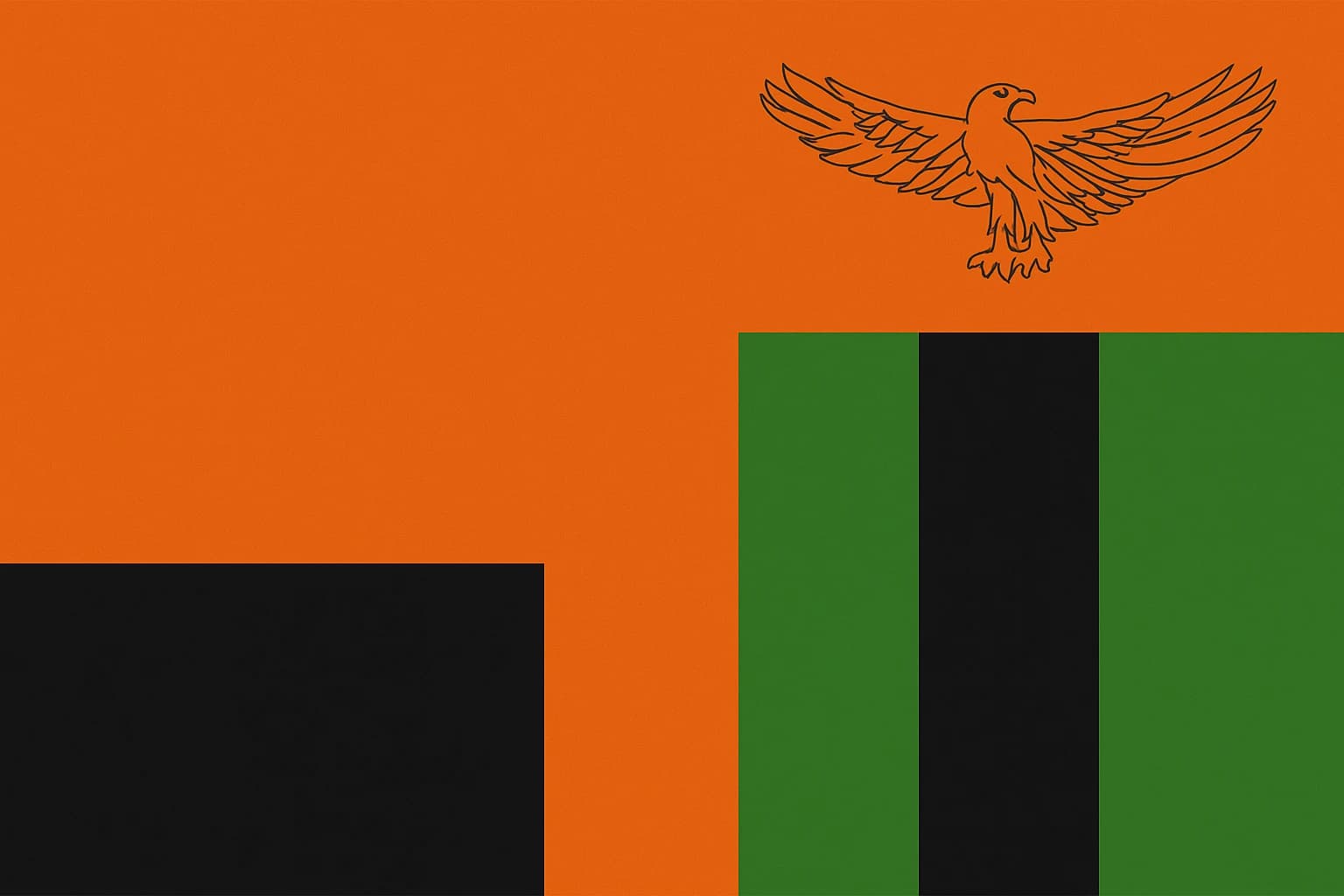
When Zambia raised its first national flag on October 24, 1964, the designers did something quietly radical. They pushed everything that mattered, an orange eagle in flight and three vertical stripes of red, black, and orange, into the lower-right corner. Roughly two-thirds of the flag stayed an uninterrupted field of green. It looks like a flag someone forgot to finish. It is a masterclass in asymmetric composition.
The rules most flags follow (and why they exist)
There are three dominant layout conventions in vexillology. Centered symbols: Japan's red circle, Brazil's diamond-and-globe arrangement. Canton placement: the U.S. stars in the upper-left, Tonga's red cross in the same position. And horizontal or vertical stripe symmetry: France, Germany, Italy, and dozens of others splitting the cloth into equal bands.
The conventions are practical. Flags are read left to right when hanging from a pole. The hoist side, the left edge nearest the pole, is structurally the most stable and most visible part of the fabric. Centered designs stay legible from either side. When your flag is flapping over an embassy in a foreign capital, people need to recognize it instantly, and symmetry helps.
The North American Vexillological Association published its influential "Good Flag, Bad Flag" guide back in 2006, laying out five fundamental principles: simplicity, meaningful symbolism, two-to-three basic colors, no lettering or seals, and distinctiveness. Symmetry is not on the list.
Yet of the 193 UN-member flags flying right now, the overwhelming majority default to symmetrical layouts, which produces a kind of visual monoculture. Green-white-red. Blue-white-red. Green-yellow-red. At a distance many become interchangeable blurs, and distinctiveness, the fifth principle, is the one most often sacrificed.
Zambia, 1964: building a flag for a new nation
Northern Rhodesia had been a British protectorate, and its colonial flag was a British Blue Ensign with a territorial badge, functional and forgettable. As independence approached under Kenneth Kaunda and the United National Independence Party, the old flag had to go.
The design is widely credited to Gabriel Ellison, a Zambian-born artist of British descent, who worked with the independence committee to choose symbols that spoke to Zambia's identity without mimicking the pan-African tricolor template. By 1964 that template was crowded. Ghana had adopted green-gold-red in 1957, Guinea followed in 1958, Mali in 1960. The colors carried real meaning, solidarity with the pan-African movement, but the visual similarity between the flags was already a problem.
Zambia went another way, and every element on its flag carries specific meaning. The green field represents natural vegetation and agricultural wealth. The orange eagle, an African fish eagle (Haliaeetus vocifer), stands for freedom and the ability to rise above the nation's challenges. The three vertical stripes clustered beneath the eagle encode the independence narrative: red for the freedom struggle, black for the Zambian people, orange for mineral wealth, especially copper.
All of that symbolic weight sits in the lower-right corner, at the fly end. The fly is the direction the flag moves, the forward edge that catches the wind, so putting Zambia's identity there reads as forward-looking. And the vast green field is not empty. It is the most important symbol on the flag, representing the land itself.
A footnote worth mentioning: in 1996, under President Chiluba, the green shade was slightly lightened. A marginal shift in hue, and it provoked genuine national debate. When citizens care that much about a specific shade of green, the design is working.
Why off-center works
Graphic designers talk about visual weight. Elements with high contrast, saturated color, or complex detail carry more weight and can balance a much larger area of empty space. The Japanese concept of ma, negative space as a compositional element, works on the same principle, and so does the rule of thirds in photography. You do not need to fill every inch of a frame to create a compelling image.
Apply that to flags. A flag snapping in wind is never seen flat. The fly end ripples and catches the eye, so placing a high-contrast symbol there, an orange eagle against a green field, means the most dynamic part of the fabric carries the most information. It sounds counterintuitive until you watch a flag on a windy day and notice where your eye goes. Zambia's designers understood this.
There is a distinctiveness argument too. At 100 meters most tricolor flags become indistinguishable. Zambia's large green field with a concentrated burst of color in one corner creates a silhouette no other national flag shares. It is the same principle that makes Japan's flag so effective: maximum contrast, minimum clutter.
Set that against the seal-on-a-bedsheet problem. Many U.S. state flags put a detailed coat of arms or state seal on a blue background, and from across a stadium they all look identical, because the central emblem becomes an illegible smudge.
The corner-weighted family
Zambia is not entirely alone. A small family of flags shares its willingness to break the grid.
Nauru adopted its flag in 1968: a deep blue field with a single gold horizontal stripe running across the center and a white 12-pointed star in the lower-left corner. The star represents the island's 12 original tribes, and its off-center placement mirrors the nation's geographic isolation, a tiny island sitting just below the equator, which is what the gold stripe represents.
Sri Lanka adopted its flag in 1950, with modifications in 1972. The golden lion holding a sword occupies a maroon field on the fly side, balanced by green and orange vertical stripes at the hoist. The asymmetry is aesthetic and political at once: the lion represents the Sinhalese majority, the hoist-side stripes the Tamil and Muslim minorities. The resulting visual hierarchy has been praised for its beauty and criticized for its symbolism, sometimes in the same conversation.
Bangladesh adopted its flag in 1972, and its design contains a subtle optical trick. The red circle on the green field is deliberately offset toward the hoist so that when the flag hangs from a pole it appears centered to an observer on the ground. Off-center on the cloth, centered in practice. The correction was reportedly inspired by Japan's flag, which is itself precisely centered on the fabric.
A few other outliers deserve a nod: Oman's vertical red stripe at the hoist with the national emblem in the canton, Eritrea's triangle-and-olive-branch shifted left, and the Marshall Islands' diagonal stripe rising from lower-left to upper-right, one of the few national flags to use a true diagonal as a primary element.
These flags are not connected by culture or geography. They are connected by a willingness to let empty space do expressive work.
Asymmetry as design sovereignty
When dozens of African and Asian nations gained independence in the mid-twentieth century, many adopted symmetrical stripe patterns drawn from pan-African (green-yellow-red) or pan-Arab (red-white-black-green) palettes. That was strategic and meaningful, signaling solidarity with broader political movements, but it also meant many flags looked nearly identical.
Zambia's break from the template was an act of design sovereignty. Compare it with Mozambique or Kenya, which both add unique, recognizable symbols, the AK-47 and the Maasai shield, but place them inside conventional symmetrical layouts.
Zambia changed the whole composition.
Asymmetric flags also communicate something harder to pin down. A symmetrical design is a safe choice that looks right to most people immediately. An asymmetric design asks the viewer to engage with an unfamiliar composition, and it rewards a second look.
That connects to more recent flag design. Mississippi replaced its flag in 2020, moving away from Confederate iconography toward a bold magnolia design. Utah adopted a redesigned flag in 2024, swapping its old seal-on-blue for a clean, geometric composition. The New Zealand flag debate did not result in a change but generated enormous public interest in what makes a flag work. In each case the conversation favored bold simplicity and distinctive silhouettes, which Zambia's 1964 flag already had.
Lessons for designers
Zambia's flag is a design case study as much as a piece of national symbolism.
Negative space can be a symbol. Zambia's green field is not unused space. It is the flag's largest and most important element, representing the land itself. Too many designs, flags and otherwise, treat empty space as something to fill rather than something to protect.
Design for motion. Flags are kinetic objects, and placing detail in the fly exploits the physics of fabric, since the part that moves most carries the eye. Static mockups on a screen do not capture this. Anything that will exist in physical space, signage, banners, merchandise, deserves the same thought about how it behaves when it is not lying flat.
Break conventions only when the break means something. Zambia's asymmetry works because the composition reinforces the message: freedom soaring above the nation's resources, with the land itself as the foundation. Random asymmetry is just a mess.
And test at distance. The bedsheet test asks whether you can identify a flag from across a stadium, which automatically favors high-contrast, low-clutter designs. Zambia passes. Most U.S. state flags fail. If a design needs the viewer within arm's reach to work, it is a logo, not a flag.
These principles travel well beyond vexillology, to logos, app icons, national branding, even presentation slides. The courage to leave space empty, and the discipline to put the focal point where it matters rather than where convention says it belongs.
Where the interesting design happens
Most vexillology coverage fixates on the world's most famous flags: the Stars and Stripes, the Union Jack, the Tricolore. All symmetrical, all following the grid.
The more interesting design thinking tends to happen at the margins, literally and figuratively. Zambia's eagle does not sit in the corner because the designers ran out of room. It sits there because asymmetry, used with intention, creates tension and directs the eye, and because a flag that refuses to be mistaken for anything else has already done the hardest part of its job.