The Flag of The United States
United States of America
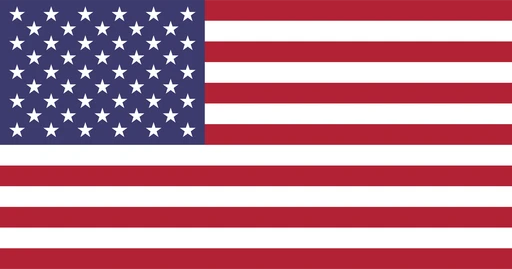
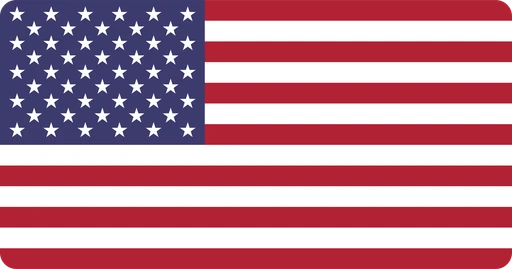
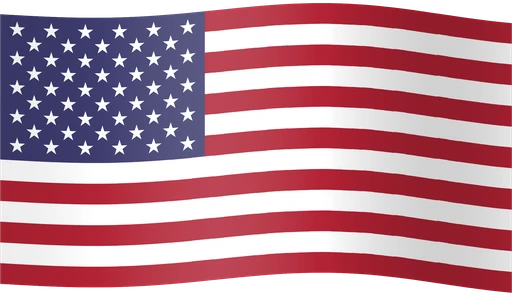
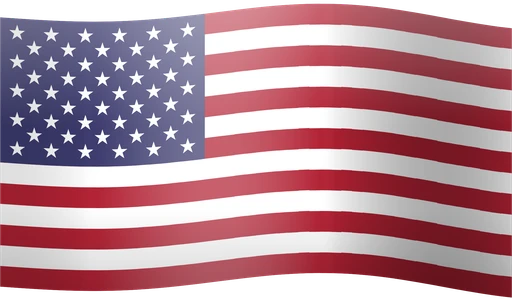
The flag of the United States, also known as the Stars and Stripes, Old Glory, or the Star-Spangled Banner, consists of thirteen horizontal stripes of equal size, alternating red and white, starting and ending with red. In the canton, on a blue field, are fifty white stars representing the fifty states of the union. The stripes symbolize the original Thirteen Colonies that declared independence from Britain, and the stars stand for the states that make up the union.
The flag of the United States of America, often referred to as the American flag, the Stars and Stripes, Old Glory, or the Star-Spangled Banner, is the national flag of the United States. The design consists of thirteen equal horizontal stripes of red alternating with white (seven red and six white), representing the original Thirteen Colonies that declared independence from Great Britain in 1776, and a blue canton bearing fifty small, white, five-pointed stars arranged in nine offset horizontal rows, representing the 50 states of the Union. The flag has been modified 27 times since its initial adoption on June 14, 1777, with the most recent change, the addition of the 50th star for Hawaii, taking effect on July 4, 1960. It is one of the most widely recognized national symbols in the world.
From thirteen stripes to fifty stars
The Continental Congress passed the first Flag Act on June 14, 1777, resolving that the flag of the thirteen United States shall consist of thirteen stripes alternating red and white, with thirteen white stars in a blue field representing a new constellation. This resolution, recorded in the Journals of the Continental Congress, did not specify the arrangement of the stars or the proportions of the flag, leaving considerable variation in early designs.
A popular legend credits Betsy Ross of Philadelphia with sewing the first flag in 1776 at the request of George Washington. Historians widely debate this claim. The earliest documentation dates to 1870, when her grandson William Canby presented the story to the Historical Society of Pennsylvania. No contemporaneous evidence supports the account. Francis Hopkinson, a signer of the Declaration of Independence and delegate to the Continental Congress, holds a stronger historical claim to the flag's design. Hopkinson submitted invoices to Congress for his work on the flag and other government symbols, though Congress ultimately declined payment, noting he was not the sole contributor.
The Flag Act of 1794 added two stars and two stripes to reflect the admission of Vermont and Kentucky, creating the 15-star, 15-stripe flag. This version flew over Fort McHenry during the Battle of Baltimore in 1814 and inspired Francis Scott Key to write "The Star-Spangled Banner."
The Flag Act of 1818 addressed concerns that adding a stripe for each new state would make the flag unwieldy. Congress returned the stripe count to thirteen and established the practice of adding one star for each new state, effective the following July 4th. This principle has governed all subsequent modifications.
The flag has gone through 27 official versions. Notable iterations include the 48-star flag, in use from 1912 to 1959, and the current 50-star flag. The 50-star arrangement was designed by 17-year-old Robert G. Heft of Lancaster, Ohio, as a high school class project in 1958. His teacher gave the project a B-minus but agreed to raise the grade if the design was accepted by Congress. President Eisenhower selected Heft's design from over 1,500 submissions, and the grade was changed to an A.
June 14 is celebrated annually as Flag Day in the United States, commemorating the adoption of the flag in 1777. President Woodrow Wilson issued a proclamation establishing Flag Day in 1916, and Congress formally designated the observance in 1949.
Design and symbolism
The flag's precise dimensions, colors, and proportions are defined by Executive Order 10834, signed by President Dwight D. Eisenhower on August 21, 1959. The order specifies the arrangement of the 50 stars in alternating rows of six and five, as well as the exact spacing and sizing of all elements. The hoist-to-fly ratio is 1:1.9, and detailed specifications govern the size and placement of the canton, stars, and stripes.
The thirteen stripes represent the original Thirteen Colonies: Connecticut, Delaware, Georgia, Maryland, Massachusetts, New Hampshire, New Jersey, New York, North Carolina, Pennsylvania, Rhode Island, South Carolina, and Virginia. The fifty stars represent the current 50 states of the Union.
No official meaning was assigned to the colors at the time of the flag's adoption. Charles Thomson, Secretary of the Continental Congress, described the symbolism when presenting the Great Seal of the United States in 1782: white signifies purity and innocence, red signifies hardiness and valor, and blue signifies vigilance, perseverance, and justice. These meanings are commonly applied to the flag as well.
The official colors are named Old Glory Red, White, and Old Glory Blue. Each has defined values in textile and print color systems, including CIE coordinates and Pantone equivalents, so that official reproductions match.
Flag etiquette and the Flag Code
The United States Flag Code (Title 4, United States Code, Chapter 1) codifies guidelines for the display and respect of the flag. Congress originally adopted the code on June 22, 1942. It says the flag should fly from sunrise to sunset unless it is lit at night, should never touch the ground, and should hang with the union uppermost and to the observer's left. When flown at half-staff it should first be hoisted to the peak, then lowered.
The flag is traditionally folded into a triangular shape showing only the blue field with stars. The process requires 13 folds, each of which has been assigned symbolic meaning in military and civic tradition.
The Flag Code is advisory and carries no penalties for civilian violations. It remains an important guide for respectful display in government and military contexts. Proper disposal of worn flags is traditionally done through ceremonial burning, often conducted by organizations such as the American Legion, Veterans of Foreign Wars, and Boy Scouts of America.
The Supreme Court ruled in Texas v. Johnson (1989) that flag desecration constitutes protected symbolic speech under the First Amendment. The Court reaffirmed this position in United States v. Eichman (1990), striking down federal and state flag-burning statutes. These rulings remain in effect despite repeated legislative attempts to pass a constitutional amendment permitting Congress to prohibit flag desecration.
Variants and related flags
Several historical and ceremonial variants of the flag exist. These include the Betsy Ross flag (13 stars arranged in a circle), the Bennington flag, the Grand Union flag (also called the Continental Colors), and the Serapis flag. The 48-star flag (1912 to 1959) remains one of the most frequently displayed historical versions and appears at many historical sites and in period imagery.
Specialized military variants include service flags and the POW/MIA flag, which by law is displayed alongside the national flag at federal buildings and national cemeteries. The flag of the President of the United States features the presidential seal on a dark blue background and is a direct derivative of national symbolism. Each branch of the U.S. Armed Forces maintains its own flag, but the national flag holds precedence in display order.
The Gadsden flag, the Gonzales flag, and various Revolutionary-era banners are historically associated with American independence but are distinct from the national flag. The Stars and Stripes has directly influenced the designs of other flags, including those of Liberia, Malaysia, Chile, Cuba, Puerto Rico, and several U.S. states and territories.
Notable displays
The flag hangs at government buildings, schools, private houses and businesses across the country.
Its best known appearances include the raising of the flag on Mount Suribachi during the Battle of Iwo Jima in February 1945, immortalized in Joe Rosenthal's Pulitzer Prize-winning photograph. On July 20, 1969, Apollo 11 astronauts Neil Armstrong and Buzz Aldrin planted the flag on the surface of the Moon. On September 11, 2001, firefighters raised a flag at Ground Zero in New York City, an image that was quickly taken up as a symbol of national resilience.
The Star-Spangled Banner, the actual garrison flag that flew over Fort McHenry during the 1814 bombardment, is preserved and displayed at the Smithsonian National Museum of American History in Washington, D.C. The flag measures 30 by 34 feet and underwent an eight-year conservation effort completed in 2008.
Jasper Johns' "Flag" paintings (1954 to 1955) are among the most recognized works of 20th-century American art, and the flag's image turns up constantly in advertising, fashion and political imagery.
The Pledge of Allegiance and the national anthem
The Pledge of Allegiance was composed by Francis Bellamy in 1892 for a national public school celebration marking the 400th anniversary of Columbus's arrival in the Americas. The original text did not include the phrase "under God." Congress added that phrase by an act signed by President Eisenhower on June 14, 1954, during the Cold War era.
Legal challenges to the Pledge have reached the Supreme Court on multiple occasions. In West Virginia State Board of Education v. Barnette (1943), the Court ruled that public school students cannot be compelled to recite the Pledge or salute the flag, holding that such compulsion violates the First Amendment. Challenges to the "under God" clause have produced additional litigation, though the phrase remains in the official text.
"The Star-Spangled Banner" describes the flag's survival through the British bombardment of Fort McHenry during the War of 1812. Francis Scott Key wrote the lyrics on September 14, 1814. The song was officially designated the national anthem by a congressional resolution signed by President Herbert Hoover on March 3, 1931.
References
[1] Title 4, United States Code, Chapter 1, "The Flag" (U.S. Flag Code). https://uscode.house.gov/view.xhtml?path=/prelim@title4/chapter1
[2] Executive Order 10834, August 21, 1959, "Proportions and Sizes of Flags and Position of Stars." Federal Register.
[3] Journals of the Continental Congress, 1774-1789, Volume 8 (June 14, 1777, Flag Resolution). Library of Congress. https://memory.loc.gov/
[4] Leepson, Marc. Flag: An American Biography. New York: Thomas Dunne Books/St. Martin's Press, 2005.
[5] Guenter, Scot M. The American Flag, 1777-1924: Cultural Shifts from Creation to Codification. Fairleigh Dickinson University Press, 1990.
[6] Smithsonian National Museum of American History, "The Star-Spangled Banner: The Flag That Inspired the National Anthem." https://amhistory.si.edu/starspangledbanner/
[7] Texas v. Johnson, 491 U.S. 397 (1989). Supreme Court of the United States.
[8] West Virginia State Board of Education v. Barnette, 319 U.S. 624 (1943). Supreme Court of the United States.
[9] Congressional Research Service Report: "The United States Flag: Federal Law Relating to Display and Associated Questions" (RL30243).
[10] North American Vexillological Association (NAVA). https://nava.org
Common questions
- What do the 13 stripes on the American flag represent?
- The original Thirteen Colonies that declared independence from Britain. There are thirteen horizontal stripes alternating red and white, starting and ending with red. Unlike the stars, their number has never changed as states joined.
- When did the American flag get 50 stars?
- On 4 July 1960, after Hawaii became the 50th state in 1959. Each star added over the flag's history represented a new state joining the union. The 50-star design has now been in use longer than any previous version.
- Who established the first American flag?
- The Continental Congress, by a resolution of 14 June 1777, which specified thirteen stripes alternating red and white and thirteen stars 'white in a blue field, representing a new constellation'. The resolution did not specify how the stars should be arranged, so early flags varied considerably.
- Why is the American flag called Old Glory?
- The name comes from a specific flag owned by William Driver, a sea captain from Salem, Massachusetts, who is said to have given it that name in 1831. It has since become a general nickname for the flag, alongside the Stars and Stripes and the Star-Spangled Banner.
Featured in these articles
Download this flag
Free in 12 styles, from 32px icons up to 2000px, as SVG, PNG, WebP and JPG.