The Flag of Mozambique
Republic of Mozambique
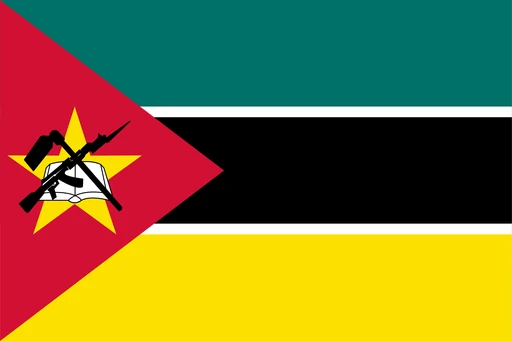
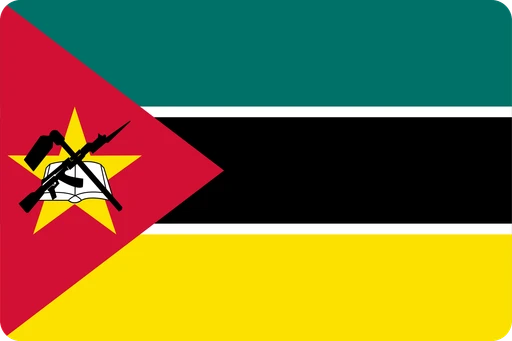
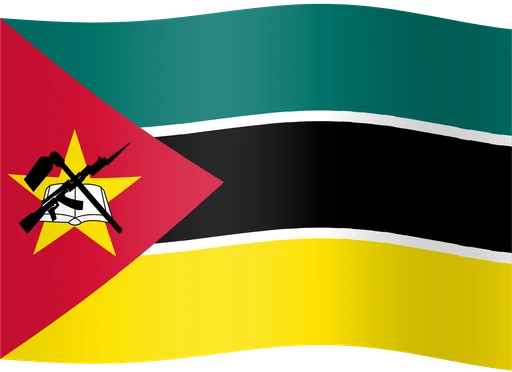
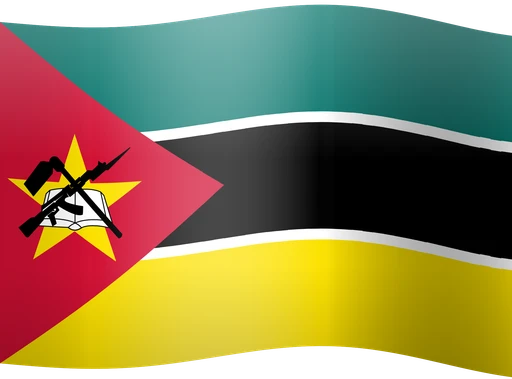
The flag of Mozambique has three horizontal stripes, green, black edged in white, and yellow, with a red triangle at the hoist carrying a yellow star, a book, and a crossed hoe and AK-47 with a bayonet. The symbols stand for the country's agriculture, its education, and its fight for independence.
Mozambique's flag carries an AK-47 with a bayonet, crossed over a hoe and laid across an open book, on a red triangle at the hoist. It is one of very few national flags anywhere to show a modern rifle, and it is a direct inheritance from the liberation war.
From FRELIMO's banner to a national flag
FRELIMO, the Front for the Liberation of Mozambique, led the fight against Portuguese rule, and its own flag shaped the national one. When Mozambique became independent in 1975 it adopted a flag based on FRELIMO's design, and the version in use today was adopted on 1 May 1983.
The 1983 design came out of a government that had aligned itself with socialist allies after independence, and the symbolism reflects that. The choice of colors and symbols was made deliberately to record what the country had just come through and where its new leadership intended to take it.
Reading the design
Three horizontal stripes of green, black, and yellow run across the flag, with the black stripe separated from the others by narrow white fimbriations. Green is the land and its fertility. Black is the African continent and its people. Yellow is the country's mineral wealth. At the hoist, a red triangle stands for the liberation war and the sacrifices made during it.
Four symbols sit on the triangle. The yellow star is international solidarity. The open book is education and literacy, which the new government treated as the foundation of national development. The hoe is agriculture, which most Mozambicans depended on. The AK-47 is defense and vigilance.
Arguments about the rifle
The rifle is the element that draws attention, and it has been argued over for decades. There have been recurring discussions about removing it in favor of a design that presents a more peaceful future. None of those proposals have gone anywhere, and the flag has stayed essentially as it was in 1983.
Part of the reason is that the flag carries the memory of the liberation struggle for a great many Mozambicans, and altering it means arguing about how the country wants to remember that period rather than about graphic design.
Where the flag is used
The flag flies at government buildings, civil gatherings, and military functions, with display governed by government protocols. Special versions exist for maritime use, including a naval ensign, and further adaptations for ceremonial occasions, all set out in law. It appears at national ceremonies, sports events, and cultural celebrations.
Other liberation-movement flags
The national flag closely resembles FRELIMO's, which is part of a wider pattern among African states that came out of liberation movements: their flags tend to carry the symbols and colors of the struggle and of the alliances that supported it.
The AK-47 belongs to a Soviet-influenced visual vocabulary and marks the support Mozambique received during the war against colonial rule. The flags of other former Portuguese colonies share related themes of post-colonial identity and socialist orientation.
References
[1] Government of Mozambique Official Publication (URL)
[2] Vexillological Association Website (URL)
[3] History of Mozambique's Independence (URL)
[4] Interviews and Articles by Political Historians (URL)
Common questions
- Why is there an AK-47 on Mozambique's flag?
- The AK-47 stands for defense and vigilance, and for the commitment to protecting the independence Mozambique won from colonial rule.
- What do the colors on Mozambique's flag mean?
- Green is fertile land, black is Africa, yellow is mineral wealth, and red is the fight for independence.
Featured in these articles
- The Cedar, the Clove, and the Wheat: Why Some Flags Chose a Crop Over a Crest
- The Crown Without a Kingdom: How Lesotho's Mokorotlo Became Africa's Most Radical Flag Symbol
- Stripes That Tell the Wrong Story: How the Horizontal Band Became the Default, and What Countries Lost When They Copied It
- The Sword on the Flag: How Arabia's Most Loaded Symbol Became a Statement of Holy Authority
Download this flag
Free in 12 styles, from 32px icons up to 2000px, as SVG, PNG, WebP and JPG.