The Flag of Guinea
Republic of Guinea
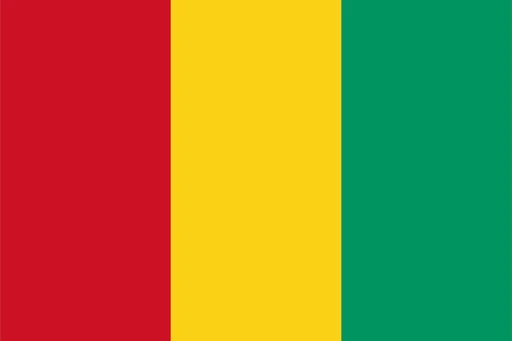
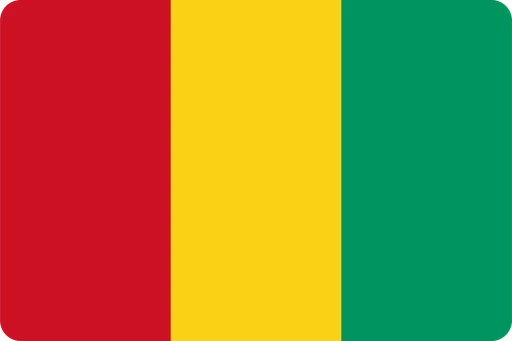
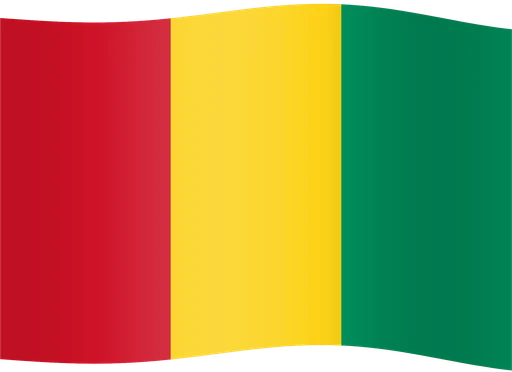
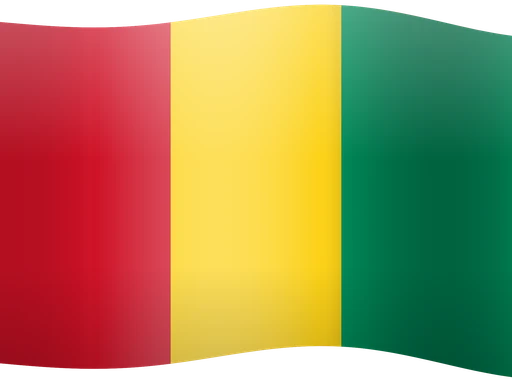
The flag of Guinea is a vertical tricolor of red, yellow, and green in three equal bands, red at the hoist. The colors are the Pan-African palette. Red is for the sacrifice made for independence, yellow for the sun and the country's mineral wealth, and green for its vegetation and farmland.
Guinea's flag is a tricolor of red, yellow, and green, adopted weeks after independence from France in 1958. It was one of the first on the continent to take up the Pan-African colors, and it borrows the structure of the French tricolor, three equal vertical bands, while swapping the colonizer's blue, white, and red for the palette Ghana's Kwame Nkrumah had made a symbol of liberation the year before.
The 1958 vote and the French withdrawal
In September 1958, Charles de Gaulle offered France's African colonies a choice: join a new French Community with limited autonomy, or leave entirely. Every colony voted "Yes" except one. Guinea, under the leadership of trade unionist turned politician Ahmed Sékou Touré, voted a thunderous "No." It wasn't close. Over 95% of Guinean voters rejected the offer.
The consequences were swift and punitive. France pulled out everything it could. Administrators packed their bags. Equipment was dismantled. Telephone lines were ripped out. Medical records were destroyed or carted away. By some accounts, departing officials even smashed light bulbs and removed office furniture. The message was clear: if Guinea wanted independence, it could have it bare.
Guinea declared independence on October 2, 1958, and adopted the flag five weeks later, on November 10. There was no committee deliberating for months over design proposals. The country needed something to hoist over government buildings before the dust of the French withdrawal had settled.
Sékou Touré's fingerprints are all over it. A committed socialist and Pan-Africanist, he treated Guinea's independence as the opening move in a continental struggle rather than an isolated event, and the colors were chosen to say so. His declaration to de Gaulle, "We prefer poverty in freedom to riches in slavery," is the sentiment the flag was meant to carry.
Guinea's boldness sent shockwaves through the French Community. Other colonies watched closely. Within two years, nearly all of France's African territories had followed Guinea's path to independence, though most negotiated softer landings. Guinea had gone first, and it had gone alone.
Red, yellow, green
The three colors trace back to the Ethiopian flag. Ethiopia was the oldest independent nation in Africa and a reference point for anti-colonial movements across the continent, and its green, yellow, and red had become shorthand for African sovereignty by the late 1950s.
In Guinea's version red sits at the hoist, the position closest to the pole and traditionally the most prominent. It stands for the blood of those who died for independence and, more broadly, for the labor of Guinea's people. Yellow fills the center band and stands for mineral wealth. Guinea sits on roughly a third of the world's known bauxite reserves, the ore used to make aluminum, and its gold has been mined for centuries. Yellow also stands for the West African sun. Green at the fly is for vegetation, farmland, and hope.
The vertical orientation is the same three-band format as the French tricolor, and the echo is deliberate. Where France flew blue, white, and red, Guinea answered with red, yellow, and green: the colonizer's template turned into a declaration of independence from it.
Ghana matters here too. When Kwame Nkrumah led Ghana to independence in 1957, its red, gold, and green became the template for Pan-African symbolism, and Guinea and Ghana formed a brief political union in November 1958, weeks after Guinea's independence. Mali and Senegal adopted similar palettes, which is how West Africa ended up with a family of tricolors that confuses casual observers and reflects a genuine shared political history.
Why there is no emblem
Three equal vertical stripes. Red at the hoist, yellow in the center, green at the fly. No coat of arms, no star, no emblem of any kind.
The 2:3 aspect ratio is standard. The bare surface is not. Senegal places a green star in its yellow band and Ghana sets a black star against gold; Mali, like Guinea, leaves the field empty. Guinea's designers let the colors do the work.
The simplicity had practical value. In 1958 Guinea was building a state from almost nothing, remember those smashed light bulbs. A flag without emblems could be printed on fabric, painted on walls, or sewn by hand in villages with no access to specialized materials, and during the first years of independence that mattered.
Early unofficial versions turned up with slightly different proportions or shades, which is what you would expect from a chaotic transition, but the core design has not changed since 1958.
Telling it apart from its neighbors
Which West African country flies a green-yellow-red vertical tricolor? That would be Mali. Flip the order to red-yellow-green and you have Guinea. Add a green star to the middle band of the green-yellow-red version and that is Senegal. The similarities are real, and the confusion is frequent.
At international events, documented mix-ups have occurred. Wrong flags displayed at sporting competitions, shipping containers mislabeled, diplomatic protocols muddled. Vexillologists, the scholars who study flags, have long noted West Africa's "flag family" as one of the trickiest disambiguation challenges in the field.
The key to telling Guinea's flag apart is straightforward: red comes first (at the hoist), and there's nothing in the center band. No star, no emblem, nothing. Mali reverses the color order to green-yellow-red. That single difference, which stripe is red and which is green, is all that separates them.
Then there's the "three Guineas" problem. Guinea, Guinea-Bissau, and Equatorial Guinea are completely different nations with completely different flags, but the shared name creates an extra layer of confusion for general audiences. Guinea-Bissau's flag features a vertical red band with a black star alongside horizontal yellow and green stripes. Equatorial Guinea's flag looks nothing like either. Yet the naming overlap persists, a leftover of European colonial geography.
The flag in Guinean life
Guinea's political history since 1958 has been anything but stable. Sékou Touré ruled as an increasingly authoritarian figure until his death in 1984. A military coup followed immediately. Another coup came in 2008 after the death of longtime president Lansana Conté. A brief experiment with elected civilian government ended with yet another military takeover in 2021.
Through all of it the flag has not changed. Every government, elected or self-appointed, has kept the original tricolor, which means it has outlasted both the man who championed it and the regime that first flew it.
On October 2 each year, Independence Day brings the flag to the center of public life. Military parades wind through Conakry, civic ceremonies fill schools and government buildings, and the red, yellow, and green go up on balconies and around shoulders.
The colors turn up in ordinary life too, in market textiles and in the work of clothing designers. Guinea's national team, Le Syli National (The National Elephant), plays in them, and fans fill stadiums with the tricolor. Guinean supporters abroad turned out in numbers for the 2024 Africa Cup of Nations.
The diaspora dimension has an edge to it. Tens of thousands of Guineans live in France, the former colonial power, and a Guinean flag in an apartment window in Paris or Marseille is not only patriotism. It is an echo of Sékou Touré's "No" in 1958.
References
[1] République de Guinée, Official Government Portal (gouvernement.gov.gn). Current flag specifications and national symbols documentation.
[2] Flags of the World (FOTW), "Guinea" entry (flagsoftheworld.net). Maintained by the international vexillology community with historical variant documentation.
[3] Schmidt, Elizabeth. Cold War and Decolonization in Guinea, 1946-1958. Ohio University Press, 2007. Foundational text on Guinea's independence vote, Sékou Touré, and the French withdrawal.
[4] Nkrumah, Kwame. Africa Must Unite. Frederick A. Praeger, 1963. Primary source on Pan-African symbolism and the Guinea-Ghana union.
[5] Appiah, Kwame Anthony & Gates, Henry Louis Jr. (eds.). Africana: The Encyclopedia of the African and African American Experience. Basic Civitas Books, 1999. Pan-African color symbolism and regional flag heritage.
[6] Smith, Whitney. Flag Lore of All Nations. Millbrook Press, 2001. Accessible vexillological reference covering West African flag families and disambiguation.
[7] United Nations Dag Hammarskjöld Library. Member State flag records, including Guinea's 1958 admission documentation.
[8] BBC Africa. Archival coverage of Guinea's 1958 independence vote and its immediate aftermath.
Common questions
- What do the colors of Guinea's flag represent?
- Red is for the fight for independence, yellow for the country's mineral wealth, and green for its vegetation and farmland.
- When was Guinea's flag officially adopted?
- Guinea's flag was officially adopted on November 10, 1958, right after gaining independence from France.
- What do the colors on Guinea's flag represent?
- Red represents the blood and sacrifice of those who fought for independence. Yellow stands for Guinea's mineral wealth, especially bauxite and gold, plus the West African sun. Green represents the country's vegetation, agriculture, and hope for the future. Together, these colors connect to the Pan-African movement and were inspired by Ethiopia's flag.
- Why doesn't Guinea's flag have any symbols or emblems on it?
- Guinea's designers kept it simple on purpose. Just three solid colors, no stars or coat of arms. Practically speaking, when Guinea became independent in 1958 after France pulled out suddenly, the country needed a flag people could reproduce by hand without special materials. Simplicity actually worked in their favor.
Featured in these articles
- Why Rwanda's New Flag Has No Red: The Flag It Announced in 1999 and Never Raised
- Four Colors, One Island: How Mauritius Built the World's Most Mathematically Honest Flag
- Borrowed Glory: How Ethiopia's Colors Became the Grammar of Black Liberation
- Same Colors, Different Flags: How Ethiopia's Tricolor Became Africa's Blank Canvas
Download this flag
Free in 12 styles, from 32px icons up to 2000px, as SVG, PNG, WebP and JPG.