The Flag of Sri Lanka
Democratic Socialist Republic of Sri Lanka
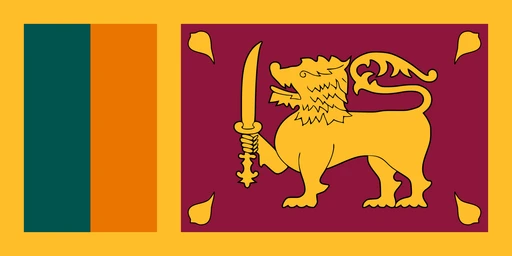
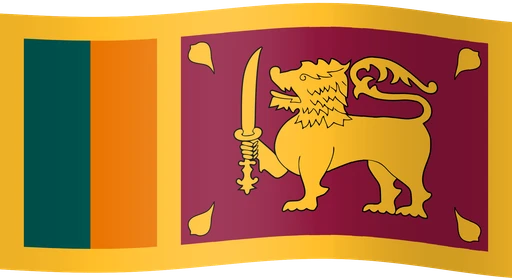
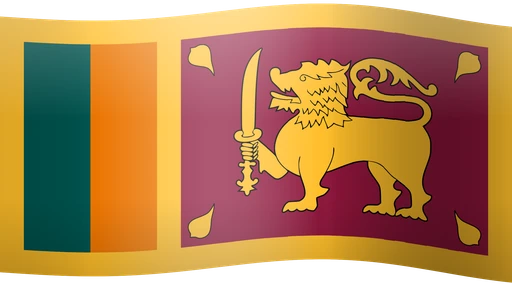
The flag of Sri Lanka, also called the Lion Flag or Sinha Flag, shows a gold lion holding a kastane sword in its right fore-paw on a maroon field, with a gold bo leaf in each corner. A yellow border runs around it, and two vertical stripes of green and saffron sit at the hoist. The lion is for the courage of the Sinhalese, the four bo leaves for four Buddhist virtues, and the stripes for the country's other main religious communities.
The Lion Flag puts a gold lion with a drawn sword on a crimson field, adds four bo leaves at the corners, and then places two vertical stripes at the hoist for the communities the lion does not represent. That last decision is what makes the flag interesting.
The lion and the committee
The lion emblem is traditionally traced to Vijaya, the first king and the founder of the Sinhalese, around 486 BC. Kingdoms across the island used versions of it for centuries, and it survived British rule in modified form, absorbed into colonial designs.
Sri Lanka adopted the Lion Flag at independence in 1948: the crimson field and the lion, without the stripes. A committee appointed that same year was asked what to do about the fact that the flag represented one community out of several, and its recommendation, the green and saffron stripes, was eventually incorporated. In 1951 the border was redefined to carry the bo leaves. The design reached its present form in 1972, when the country became a republic.
What is on it
The gold lion holds a kastane sword. The lion means bravery, the sword sovereignty and the defense of the island. The crimson behind it stands for the Sinhalese.
At the corners are four gold bo leaves, for Karuṇā (compassion), Mettā (loving-kindness), Upekkhā (equanimity), and Muditā (sympathetic joy). They mark Buddhism's place in Sri Lankan public life.
The green and saffron stripes at the hoist stand for the Tamil and Muslim communities. Few national flags allocate space to minorities so explicitly, and the choice was a deliberate answer to a design that otherwise spoke only for the majority.
Flying it
The Lion Flag has been the national flag since 1948. It is flown at government buildings and state events, and widely on national holidays such as Independence Day. Protocol covers when it should be hoisted and requires it to be lowered before sunset. During periods of mourning it is flown at half-mast.
It also appears in processions and at religious and cultural ceremonies, where it carries the same weight it does in official settings.
Other lions
Lions are a common flag motif. Historical flags of Iran and the United Kingdom both use them, generally for the same reasons: royal authority and courage. Sri Lanka's version is distinctive for the standards of the Sinhala kingdoms it descends from, rather than for the animal itself.
References
[1] "National Flag of Sri Lanka." Government of Sri Lanka. URL
[2] "The Heraldic Tradition of Flags in Ancient Sri Lanka." World Vexillological Research Institute. URL
Common questions
- Why does the Sri Lankan flag feature a lion with a sword?
- The lion and sword stand for bravery and for the courage attributed to King Vijaya. The sword is also read as sovereignty and the defense of the island's independence.
- What do the bo leaves on the Sri Lankan flag represent?
- The four gold bo leaves stand for four Buddhist virtues: compassion, loving-kindness, equanimity, and sympathetic joy.
Featured in these articles
- The Flag of Ceylon: How a Lion Banner Captured in 1815 Was Rebuilt From a Sketch to Become Sri Lanka's Flag
- The Dragon, the Lion, and the Eagle: Why Mythical Beasts Still Guard the World's Flags
- The Parrot, the Sisserou, and the Rose: How Dominica Put a Rare Bird on Its Flag, and What It Cost
- The Dragon That Had to Be Tamed: Why Bhutan's Druk Is the Most Precisely Controlled Symbol in Flag History
Download this flag
Free in 12 styles, from 32px icons up to 2000px, as SVG, PNG, WebP and JPG.