The Flag of Eritrea
State of Eritrea
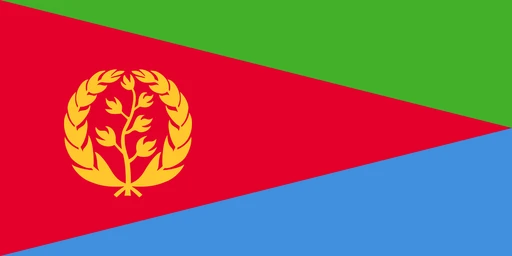
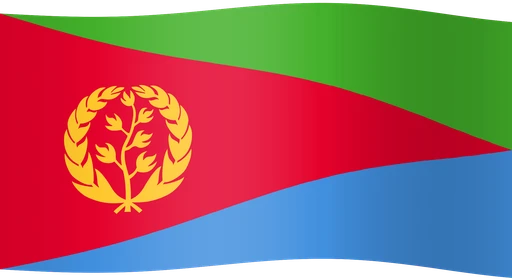
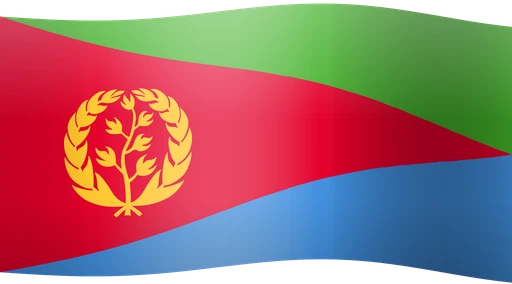
The flag of Eritrea features a red isosceles triangle pointing towards the fly side of the flag, based on a green, blue, and red tricolor. The red triangle is bordered by two thinner stripes, green above and blue below. Centered in the red triangle is a gold wreath encircling a single gold olive branch. The green color symbolizes the agriculture and livestock of the country, blue stands for the ocean, and red represents the blood shed for Eritrea's independence. The wreath with the olive branch signifies peace.
The flag of Eritrea is one of Africa's youngest national flags, born from one of the continent's longest independence struggles. Adopted on May 24, 1993, the day Eritrea officially became a sovereign state after a 30-year war with Ethiopia, it was adapted directly from the banner of the Eritrean People's Liberation Front (EPLF), the guerrilla force that fought and ultimately won that independence. Few national flags carry such an unbroken line between the flag of a resistance movement and the flag of the state that movement built.
Thirty years in the making
Eritrea's armed struggle began on September 1, 1961, when Hamid Idris Awate fired the opening shots against Ethiopian forces in the western lowlands. What followed was one of Africa's longest and bloodiest liberation wars, stretching across three decades and outlasting two Ethiopian regimes: Haile Selassie's imperial government and the Derg military junta that replaced it.
During the conflict, the Eritrean People's Liberation Front developed its own flag, a tricolor of green, blue, and red with a golden olive wreath set against the red field. That banner flew over liberated territories, field hospitals, and underground schools carved into mountain trenches. When the war ended and a UN-supervised referendum was held in April 1993, 99.8% of voters chose independence. On May 24, the new nation raised a flag that was, in all essential respects, the same one fighters had carried through three decades of war. Keeping it unchanged was a deliberate act of honor toward the martyrs.
Before the EPLF banner, Eritrea had known other flags. Under British administration from 1941 to 1952, the territory flew the Union Jack. During the brief federation period with Ethiopia (1952-1962), Eritrea had its own autonomous flag: a light blue field with a green olive wreath at its center. Emperor Haile Selassie dissolved that federation and annexed Eritrea outright in 1962, hauling down the federal flag and replacing it with Ethiopia's. That act of erasure made the later resurrection of the olive wreath on the EPLF flag, and then on the national flag, feel less like a design choice and more like a historical correction.
May 24 is now celebrated as Independence Day, and the flag plays a central ceremonial role. The transition from guerrilla banner to state flag gives it a dual identity few national flags possess: it's both a war trophy and a peace symbol, carried from the battlefield into the halls of government without alteration.
Reading the colors
The design breaks from the standard African stripe format. A large red isosceles triangle sits on the hoist side, its apex reaching the fly end, while green fills the upper portion and light blue fills the lower. The triangle gives the flag a sense of forward momentum, as though it's pointing at something.
Green speaks to the agricultural and pastoral wealth of the country, the fertile highlands where teff and barley grow and the lowland plains where livestock graze. Blue represents the Red Sea, and this is no mere geographic nod. Eritrea's coastline stretches roughly 1,200 kilometers, and control of that coast was a core reason Ethiopia fought so fiercely to keep Eritrea. The blue band carries geopolitical weight that most flag colors don't. Red, the dominant color by area, represents the blood shed by Eritrean fighters during the liberation war. It's a direct, unflinching acknowledgment of sacrifice, not softened by euphemism.
These colors echo those of the 1952 Eritrean autonomous-region flag, creating a thread of historical legitimacy that predates the war itself. One detail often missed in reproductions: the blue is distinctly light, closer to sky blue than to the royal or navy blues common on other flags. Official specifications maintain this distinction, and it matters. The light blue connects visually to the UN flag and to older Ethiopian emblems, threading Eritrea's identity through layers of history. The flag's proportions follow a clean 1:2 ratio, standard for many African nations.
The olive wreath
Centered in the red triangle sits a golden olive wreath encircling an upright olive branch. It's the flag's most nuanced symbol, and arguably its most deliberate.
The wreath mirrors the one that appeared on the 1952 Eritrean autonomous-region flag, anchoring the current design to a pre-occupation identity. By reaching back past the decades of Ethiopian annexation, the wreath says: we existed before the war, and we'll exist after it. Olive branches carry a universal message of peace, and their inclusion was a pointed signal to the international community at the moment of independence. This was a nation saying, in cloth and thread, that it intended to move beyond the violence that created it.
What's striking is what the wreath replaced. Many liberation movement flags lean into martial imagery: stars, torches, rifles, machetes. The EPLF could have gone that route. Instead, they chose a peace symbol and, when the national flag was formalized, the wreath was actually enlarged relative to its size on the EPLF version. That's a small design decision with outsized meaning, shifting the flag's visual emphasis from conflict to aspiration.
The wreath also subtly echoes United Nations emblems, perhaps a nod to the UN's role in overseeing the independence referendum. And in a country split roughly evenly between Christians and Muslims, the olive wreath carries no religious connotation. It's one of the few purely secular symbols on the flag, a unifying image in a nation where unity was hard-won.
Protocol and variants
The flag flies over the State House in Asmara, all government ministries, embassies abroad, and military installations. Two dates bring it out in force: May 24, Independence Day, and September 1, marking the anniversary of the armed struggle's launch in 1961.
Variants exist for specific official functions. The naval ensign adapts the core design for maritime use, while the presidential standard incorporates additional elements denoting the head of state. On Eritrean Airlines aircraft, the flag's colors appear prominently in the livery, and the olive wreath marks official passports and government documents.
For the Eritrean diaspora, one of Africa's largest per capita, the flag functions as a cultural identity marker at community gatherings, festivals, and sporting events worldwide. There are no widely documented civilian restrictions on displaying it, though the single-party state context under the PFDJ government means public flag use tends to cluster around official occasions. The flag's 1:2 proportions keep it consistent in reproduction, whether on a flagpole in Asmara or a bumper sticker in Stockholm.
Eritrea's flag among its neighbors
Eritrea's flag consciously steps away from the Pan-African color tradition of red, black, and green popularized by Marcus Garvey. The use of light blue is distinctive on the African continent and ties the flag visually to the UN flag and, interestingly, to Ethiopia's older historical banners. That connection is complex. Both Ethiopia and Eritrea use green and red, but Eritrea's replacement of yellow with blue and its triangle format mark a clear visual declaration of difference. Two neighbors, two flags, deliberately not alike.
Djibouti's flag offers a fascinating parallel. It also uses light blue prominently and features a triangle on the hoist, making for an interesting visual rhyme between two Red Sea neighbors. The shared geography of the coast seems to have produced shared instincts in flag design.
The EPLF lineage places Eritrea in a small group of nations, alongside Zimbabwe and Mozambique, whose national flags descend directly from liberation movement banners. In vexillological terms, the triangle-on-hoist design, also seen in Cuba, Jordan, and South Africa, tends to signal nations that emerged from revolution or dramatic political transformation. It's a shape with a history of its own.
The flag as national memory
For Eritreans, the flag carries an emotional weight that is large even by national-flag standards. It stands for the survival of an identity that came close to being extinguished entirely.
The martyrs referenced by the red field are not abstract. Estimates suggest between 65,000 and 150,000 Eritreans died during the independence war. In a small nation, that scale of loss means virtually every family has a direct, personal connection to the sacrifice the flag symbolizes. When the 1998-2000 border war with Ethiopia erupted, the flag became a rallying point for diaspora communities worldwide, proving how quickly a young flag can accumulate new layers of meaning.
There are tensions, too. Under President Isaias Afwerki's government, which has ruled without elections since independence, the flag is simultaneously a genuine symbol of hard-won freedom and an emblem closely associated with the ruling party. Diaspora communities navigate this duality carefully. Some wave it with uncomplicated pride; others do so with ambivalence, honoring what it was meant to represent while questioning what it has come to represent.
The design was born in mountain trenches and guerrilla camps. Today it's printed on school textbooks, stitched onto sports jerseys, and painted on the walls of Asmara's cafes.
References
[1] Eritrean Ministry of Information, Official Government Publications on National Symbols. (https://shabait.com)
[2] United Nations, "Report of the UN Observer Mission to Verify the Eritrean Referendum, 1993." UN Document A/47/1001.
[3] Flags of the World (FOTW), "Eritrea." (https://www.crwflags.com/fotw/flags/er.html)
[4] Pool, David. From Guerrillas to Government: The Eritrean People's Liberation Front. James Currey, 2001.
[5] Connell, Dan. Against All Odds: A Chronicle of the Eritrean Revolution. Red Sea Press, 1993.
[6] Smith, Whitney. Flag Lore of All Nations. Millbrook Press, 2001.
[7] Encyclopaedia Aethiopica, Entry on Eritrean Symbols and Political History. Harrassowitz Verlag.
[8] Human Rights Watch / Amnesty International, Reports on Eritrea (for context on the flag's political dimensions).
Common questions
- What do the colors on Eritrea's flag mean?
- Green stands for agriculture and livestock, blue for the Red Sea, and red for the sacrifices made during the fight for independence.
- What do the colors on the Eritrea flag represent?
- The green represents the country's agricultural wealth. Blue symbolizes the Red Sea coastline, which is really important to Eritrea's identity. Red honors the blood shed by fighters during the 30-year liberation war. These colors actually came from the Eritrean People's Liberation Front banner and connect back to Eritrea's 1952 autonomous-region flag.
Featured in these articles
- One Nation, Two Flags: How Myanmar's 2010 Redesign Erased a Socialist Past Overnight
- Why Zambia Puts Its Eagle in the Corner: The Case for Flags That Break the Grid
- Born from War: How South Sudan Designed a Flag for the World's Newest Country
- The Sun Disc on the Flag of Bangladesh: How a Blood-Red Circle Became the Symbol of a Nation Born in War
Download this flag
Free in 12 styles, from 32px icons up to 2000px, as SVG, PNG, WebP and JPG.