If you laid out the flags of all 193 UN member states on a table, you could sort nearly all of them into a handful of color families. Red-white-blue tricolors over here. Pan-African greens and golds over there. Pan-Arab blacks and reds in another pile. You'd move through the exercise with satisfying speed, slotting each rectangle into its tribe.
Then you'd pick up Kazakhstan's flag, and your hand would hover.
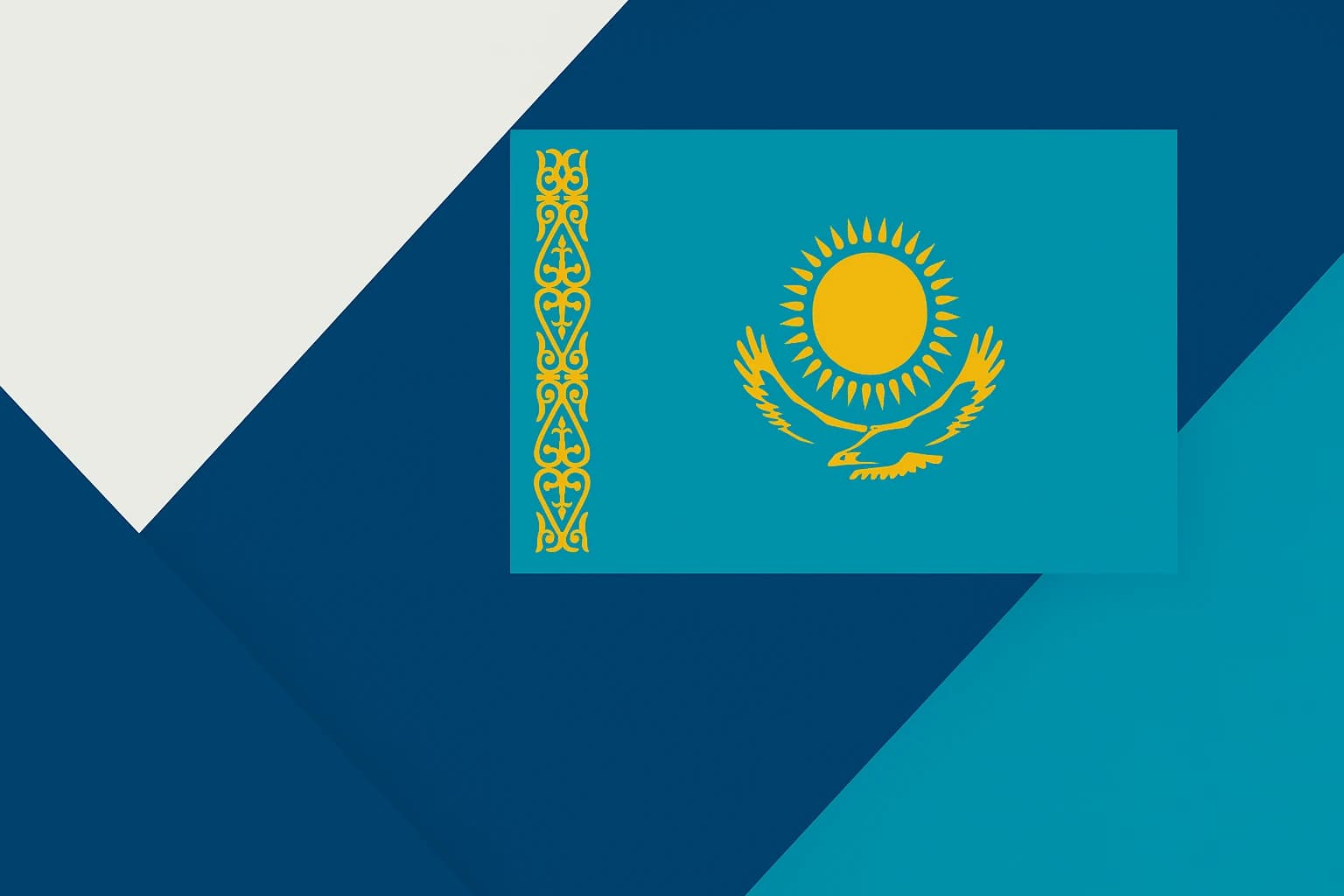
Its field is a shock of light turquoise. Not navy, not royal blue, but the specific, luminous blue of an endless steppe sky. A golden sun radiates 32 rays. A soaring eagle glides beneath it. An ornamental stripe runs down the hoist side, dense with the curling geometry of ram's horns. It looks like nothing else at the United Nations. That is entirely by design.
When artist Shaken Onlasyn submitted his winning entry in 1992, he wasn't designing a nice piece of cloth. He was making an argument about who the Kazakhs were, where they came from, and who they were not.
The unwritten rules Kazakhstan ignored
Red appears on roughly 75% of all national flags. Blue shows up on about 50%, white on 45%, green on 35%, and yellow or gold on around 30%. These are the "big five" of flag colors, and most nations draw from them like a painter working a limited palette.
Light turquoise or sky blue as a dominant field color? Essentially unheard of among sovereign states.
The North American Vexillological Association (NAVA) outlines five principles of good flag design: simplicity, meaningful symbolism, two to three basic colors, no lettering or seals, and distinctiveness. Kazakhstan obeys some of these. There's no lettering, and the symbolism is anything but arbitrary. But the ornamental koshkar-muiz pattern along the hoist is extraordinarily complex by any flag standard. Try drawing it freehand and you'll see the problem.
The closest comparisons in color are telling. Palau uses a light blue field. The Federated States of Micronesia borrows the UN's blue. But these are small Pacific island nations, not major continental powers spanning 2.7 million square kilometers.
Argentina and Guatemala use light blue in stripes, not as a full field. Kazakhstan is alone in its weight class.
Whether that was recklessness or nerve depends on what was happening in 1992.
1992: designing a nation from scratch
On December 16, 1991, Kazakhstan became the last Soviet republic to declare independence. President Nursultan Nazarbayev moved quickly on a new flag, emblem and anthem. Everything Soviet had to go. A national competition drew over 600 entries.
The winner was Shaken Onlasyn (1933-2017), a Kazakh artist and set designer who had spent decades in theater and the visual arts. His original submission had a blue field with a strip of sky blue and gold. The final version was refined with Nazarbayev, who reportedly suggested changing a red ornamental strip to gold and using a single unified sky-blue field.
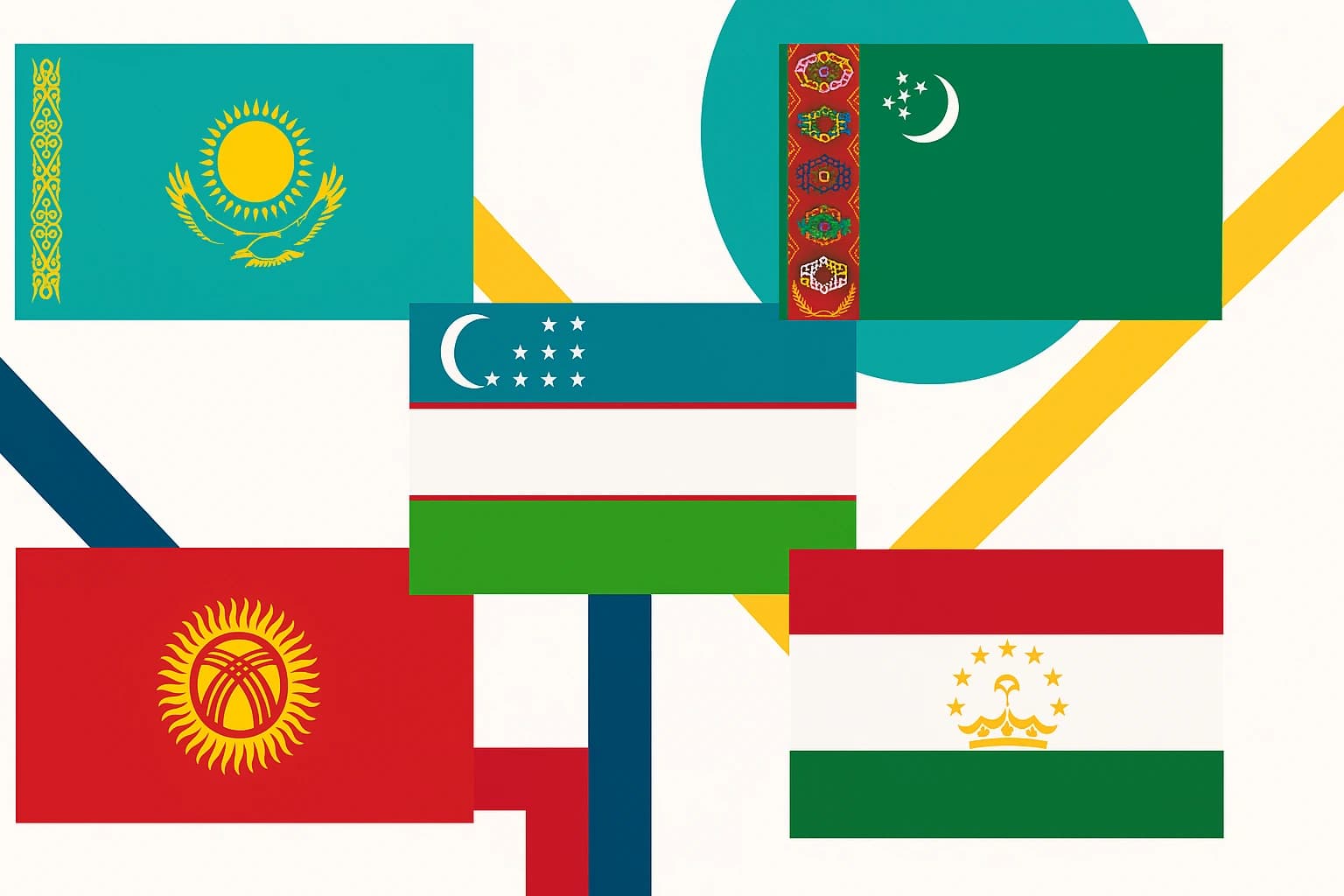
The political pressure was real. Other newly independent Central Asian states were all choosing flags at the same time. Uzbekistan adopted its flag in November 1991. Turkmenistan followed in February 1992. Kyrgyzstan in March. Tajikistan in November.
There was a genuine risk of visual blending. Uzbekistan went with blue-white-green stripes. Kyrgyzstan chose a bold red field with a golden sun. Each republic was staking out chromatic territory. Kazakhstan needed to be unmistakable.
The flag was adopted on June 4, 1992, less than six months after independence. Speed was part of the nation-building imperative. You don't get to deliberate for years when your country needs a face.
The color of Tengri
Kazakhstan's sky blue (officially a turquoise-cyan, roughly Pantone 2935 or hex #00AFCA in common reproductions) is nothing like the navy of France or the royal blue of Australia.
This is not a "Western" heraldic blue. It is something far older.
Tengriism is the ancient spiritual system of the Turkic and Mongolic steppe peoples. Tengri, the Eternal Blue Sky, was the supreme deity. The color of the sky was, quite literally, the color of God. For Kazakh nomads, the open sky was the ceiling of the yurt of the universe. That sounds poetic, but it was also practical theology. When you live on a steppe so flat that the horizon curves visibly in every direction, the sky isn't background. It's everything.
The connection runs even deeper historically. The term "Kök Türk," meaning Blue Turks or Celestial Turks, was used by the First Turkic Khaganate (552-603 CE). Blue was a political and cosmological color over 1,400 years ago. Kazakhstan's flag reaches past the Soviet era, past the Russian Imperial era, all the way back to that deep Turkic identity.
And the specific shade matters for another reason. Kazakhstan is the ninth-largest country in the world and famously flat. The sky dominates the visual landscape in a way that is psychologically and culturally central to Kazakh self-understanding. If you've never stood on the Kazakh steppe, picture the biggest sky you've ever seen, then double it.
The contrast with what came before is hard to miss. The Kazakh SSR flag was a standard red field with a blue horizontal stripe, a cookie-cutter Soviet design. Nobody picks the opposite of their colonizer's color by accident.
What Tajikistan did instead
Tajikistan adopted its flag on November 24, 1992, choosing a red-white-green tricolor with a golden crown and seven stars. The colors draw from the Pan-Iranian tradition and also echo, whether intentionally or not, the red of the former Soviet flag.
By vexillological standards, Tajikistan's design is "safer": familiar tricolor geometry, traditional heraldic colors, a centered emblem. It's handsome. But whether it's immediately distinguishable from, say, Hungary or Iran at a distance is a harder argument to make.
Kazakhstan's flag, by contrast, is identifiable from across a stadium or in a thumbnail image. The turquoise field is so unusual that it functions as an instant identifier, much the way Nepal's double-pennant shape does through geometry alone.
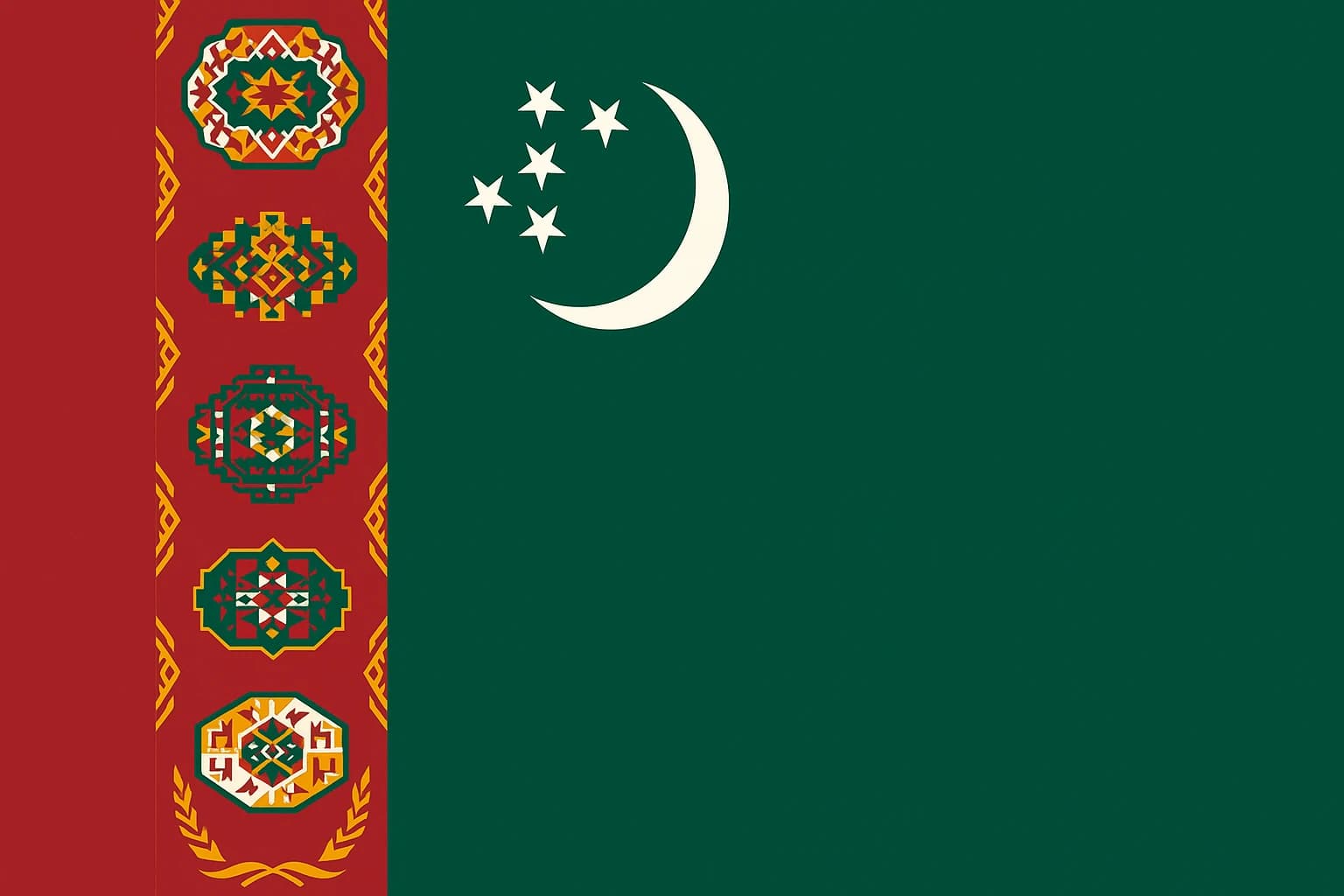
The other republics made their own claims. Uzbekistan's flag nods to the Timurid past. Turkmenistan's carpet-gul stripe is maximalist in a way that would make most vexillologists twitch. Kyrgyzstan's red field with tunduk recalls yurt architecture. Kazakhstan's claim was the most radical on color alone.
Both flags, Kazakhstan's and Tajikistan's, have drawn praise and critique. Kazakhstan's ornamental stripe is sometimes called too complex to reproduce. Tajikistan's crown has been revised. But one of them you'd recognize from 200 meters away, and the other you might not.
Eagle, sun, and ornament
The 32-ray sun represents abundance, life, and energy. Some interpretations link the number 32 to the tribal clans of Kazakhstan. Others connect it to grain sheaves symbolizing prosperity. The sun also echoes the concept of the shanyrak, the circular opening at the top of a yurt through which the sky, and thus Tengri, is visible. The shanyrak is so central to Kazakh identity that it appears on the national emblem too.
Beneath the sun, the steppe eagle (Berkut, the golden eagle) is shown in flight. It stands for power, freedom, and the aspirations of a young state, but calling it symbolic undersells it. The tradition of berkutchi, eagle hunting, is a UNESCO-recognized Intangible Cultural Heritage practice still alive in western Kazakhstan, and hunters bond with individual birds over years. The eagle is on the flag because Kazakhs actually keep eagles.
Then there's the koshkar-muiz (ram's horns) ornamental pattern running down the hoist. This traditional Kazakh motif appears on felt carpets, yurt decorations, and jewelry, and it runs in a direct line from the folk craft of the steppe to the flagpole outside the UN building in New York.
That ornament is the most contested element from a design standpoint, since it is far too complex to draw freehand and so violates one of NAVA's core principles. The defense is that every element is gold on blue: a two-color palette, technically three if you count thin outline work. That restraint gives the flag its visual unity. From a distance you don't see the individual curves of the ram's horns. You see a golden band against turquoise, and that's enough.
What the color buys
Flags are identification tools, and Kazakhstan's color pays off in practice.
At international sporting events, from the 2024 Paris Olympics to FIFA World Cup qualifiers, the flag is spotted instantly. Kazakh athletes like cyclist Alexey Lutsenko or boxer Gennadiy Golovkin carry a banner that needs no caption.
Branding people have a name for this. Owning a color creates a cognitive shortcut: Tiffany's robin-egg blue, T-Mobile's magenta, Cadbury's purple. None of those companies picked a common color. Kazakhstan did the same thing with a national flag and effectively trademarked turquoise.
The flag now anchors the rest of Kazakhstan's self-presentation, from Expo 2017 in Astana to the Baikonur Cosmodrome heritage and the new capital's architecture. The color reads as forward-looking rather than historically burdened.
The critiques are real, though. Some flag scholars argue the ornamental stripe makes the design too busy, and the shade of blue is genuinely difficult to reproduce consistently across media. Manufacturers sometimes render it too dark or too green. When your whole identity depends on a specific shade, getting that shade wrong matters.
What Onlasyn got right
Go back to that table of 193 flags. Kazakhstan's turquoise rectangle is still the only one of its kind.
Whether by instinct or calculation, Onlasyn and the Kazakh leadership treated a new nation's flag as an act of differentiation rather than a passive symbol. Reaching past the Soviet palette, and past the safe conventions of flag design, to the old blue of Tengri gave them something both traditional and modern. Rules like NAVA's exist to be understood first. Ignoring them only works when you know exactly what you're giving up.