The Flag of Guatemala
Republic of Guatemala
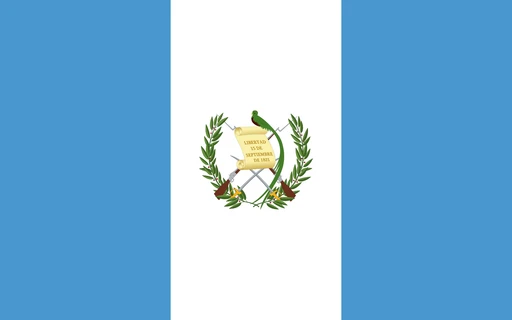
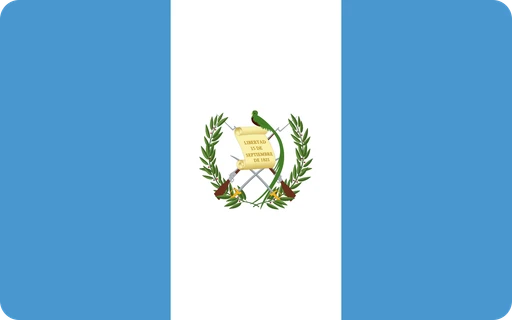
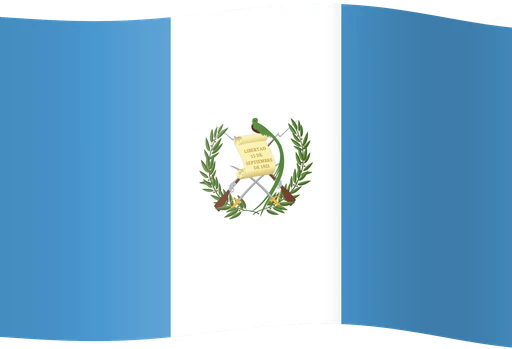
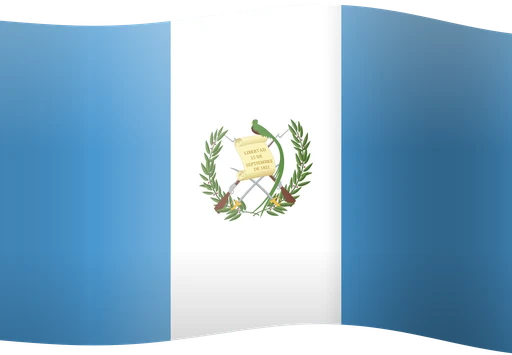
The flag of Guatemala has three vertical stripes, sky blue at the sides and white in the middle. The blue stands for peace and justice, the white for purity. At the center is Guatemala's coat of arms: the resplendent quetzal, the national bird and a symbol of liberty; a parchment scroll carrying the date of Central America's independence from Spain; crossed rifles for the country's readiness to defend itself; and a laurel crown for victory.
Guatemala's flag is a sky-blue and white vertical triband, colors it shares with several Central American neighbors, distinguished by its centerpiece: the resplendent quetzal perched on a scroll inscribed with the date of Central American independence. The bird, the rifles, and the scroll pack a lot of the country's history into a small space.
Central American origins
Guatemala didn't start out alone. From 1823 to 1841, it was part of the Federal Republic of Central America, a short-lived political experiment that united Guatemala, El Salvador, Honduras, Nicaragua, and Costa Rica under one government and one flag: a blue-white-blue horizontal triband derived from the earlier United Provinces of Central America. When the federation collapsed and Guatemala struck out on its own, it kept those shared colors but rotated them. The horizontal bands became vertical stripes, a subtle but meaningful distinction that set Guatemala apart from El Salvador, Honduras, and Nicaragua, all of which retained the horizontal layout.
Why vertical? The change is usually attributed to the French tricolor, whose design was circulating through Latin American intellectual circles at the time. The result is a flag that claims both the Central American inheritance and a separate national identity.
The timeline is short. The first flag appeared in 1825, blue and white in horizontal bands, flown by Guatemala as a state of the federation. In 1843 the conservative government adopted a flag of Guatemala's own, with its own arms. The liberal revolution of 1871 brought the redesign that stripped that symbolism away: the vertical triband was decreed on August 17, and the coat of arms carrying the quetzal followed on November 18. In 1968 the current proportions and design were codified.
The quetzal
The resplendent quetzal (Pharomachrus mocinno) dominates Guatemala's coat of arms. Ancient Maya and Aztec civilizations revered the bird as a deity of the air, and its iridescent green tail feathers, which can grow over two feet long, were more valuable than gold. Killing a quetzal was punishable by death; priests plucked feathers from live birds and released them.
The bird works as a symbol of liberty because of a widely held belief that it dies in captivity. Whether that is strictly true or partly romantic, it stuck, and Guatemala adopted the quetzal as its national bird on exactly that basis. On the coat of arms it faces left from its own perspective, the viewer's right, perched on the scroll.
The quetzal's reach extends beyond the flag. It gives its name to the national currency. You can't buy a bag of coffee in Antigua without handling a reminder of what the bird stands for.
The species is now listed as Near Threatened by the IUCN, its cloud forest habitat shrinking year by year, which has given the flag an ecological reading nobody intended in 1871.
The coat of arms
Beneath the quetzal sits one of the more complex coats of arms in the Western Hemisphere. Three elements anchor it: the bird, a parchment scroll, and crossed rifles and swords framed by laurel branches.
The scroll reads "15 de Septiembre de 1821," the date Guatemala and most of Central America declared independence from Spain. It is a shared birthday, which is part of the point. The crossed Remington rifles and swords behind it stand for the country's willingness to defend itself by force. Unlike Costa Rica, which abolished its army in 1948, Guatemala keeps an active military, so the weapons are not purely historical.
Two laurel branches frame the whole thing, a Greco-Roman motif for victory and honor. Republican heraldry of this kind was popular across 19th-century Latin America, where newly independent nations borrowed European conventions to legitimize themselves.
All this detail makes the flag hard to reproduce accurately, a complaint vexillologists raise often. One distinction gets overlooked: the civil flag, flown by private citizens and merchant vessels, leaves the coat of arms off entirely and shows only the plain triband. The state and war flag carries the full emblem. The version most people picture is the government's.
Sky blue and white
The two sky-blue stripes and the central white band have been explained in more than one way. The official line is that blue stands for the Pacific and the Caribbean, which bracket Guatemalan territory, and white for peace and purity.
The more historically grounded reading points back to the Federal Republic of Central America. The colors were inherited, which makes them a marker of regional history rather than geography. Both readings circulate, and neither is wrong.
The shade matters. It is lighter than the navy or royal blue on many national flags, closer to cerulean. El Salvador, Honduras, and Nicaragua all use the same blue-white-blue palette horizontally, which makes a recognizable Central American family; Guatemala's vertical layout and lighter hue are what break it out. The coat of arms sits on the white center stripe on the state flag.
Protocol and variants
Guatemala celebrates Flag Day, Día de la Bandera, on August 17th each year. The flag's dimensions are legally specified at an aspect ratio of 5:8, and Guatemalan law governs how the national flag may and may not be used commercially or modified.
As mentioned, the civil flag is the plain triband without the coat of arms, used by ordinary citizens and on merchant ships. Government buildings, military installations, and official functions fly the state flag with the full emblem. Both versions are out in force during Independence Day celebrations on September 15th, often displayed alongside traditional Maya textiles. The republican flag next to Indigenous weaving is a fair picture of the country's dual heritage. The flag also appears on national ID documents, passports, and official seals.
The flag in a divided country
Guatemala is one of the most ethnically diverse countries in the Western Hemisphere. Roughly 40% of the population identifies as Indigenous Maya, yet the national flag's symbolism draws primarily from a mestizo and criollo republican tradition shaped by 19th-century European ideas. The quetzal bridges this divide somewhat, given its deep pre-Columbian Maya significance, but scholars and Indigenous rights advocates have long noted the tension between the flag's imagery and the lived experiences of Maya communities, who were systematically marginalized for centuries.
During the Guatemalan Civil War (1960 to 1996), one of the longest and bloodiest conflicts in Latin American history, both the state military and resistance movements claimed the flag. That dual appropriation complicated its meaning profoundly, and for many Guatemalans, particularly in Indigenous highland communities where the worst atrocities occurred, the flag still carries ambivalent associations.
Outside Guatemala the flag is a rallying point for the large diaspora, particularly in the United States, where it turns up at cultural festivals, soccer matches, and community gatherings from Los Angeles to Brooklyn.
The quetzal's endangered status has pulled the flag into environmental arguments too. And the older question has not gone away: who does this flag represent, and who does it leave out.
References
- [1] Guatemalan Ministry of Foreign Affairs (Ministerio de Relaciones Exteriores de Guatemala), official flag specifications and protocols: https://www.minex.gob.gt
- [2] Constitución Política de la República de Guatemala (1985, with amendments), legal provisions governing national symbols.
- [3] Smith, Whitney. Flags Through the Ages and Across the World. McGraw-Hill, 1975.
- [4] Flags of the World (FOTW), Guatemala entry: https://www.crwflags.com/fotw/flags/gt.html
- [5] IUCN Red List: Resplendent Quetzal (Pharomachrus mocinno) species assessment: https://www.iucnredlist.org
- [6] Woodward, Ralph Lee. Central America: A Nation Divided. Oxford University Press, 1999.
- [7] Herrera, Robinson A. Natives, Europeans, and Africans in Sixteenth-Century Santiago de Guatemala. University of Texas Press, 2003.
- [8] CIA World Factbook, Guatemala: https://www.cia.gov/the-world-factbook/countries/guatemala/
Common questions
- Why is there a quetzal on the Guatemalan flag?
- The quetzal stands for liberty. Ancient Maya and Aztec civilizations revered the bird, and it is widely believed to die in captivity, which is how it came to mean freedom.
- What do the colors on the Guatemalan flag stand for?
- The blue stripes stand for the Pacific Ocean and the Caribbean Sea, and the white for peace and purity. The colors are also inherited from the Federal Republic of Central America.
- What does the date on the Guatemalan flag mean?
- The scroll reads 15 de Septiembre de 1821, the day Guatemala and most of Central America declared independence from Spain.
- Why are there crossed rifles and a laurel wreath on the flag?
- The crossed rifles stand for readiness to defend freedom, and the laurel wreath for victory, honor, and peace.
Featured in these articles
Download this flag
Free in 12 styles, from 32px icons up to 2000px, as SVG, PNG, WebP and JPG.