The Flag of Kyrgyzstan
Kyrgyz Republic
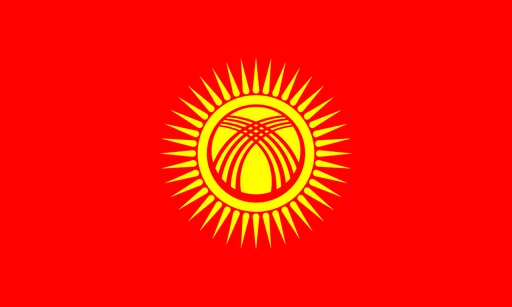
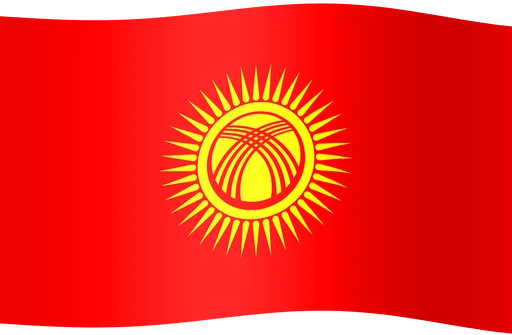
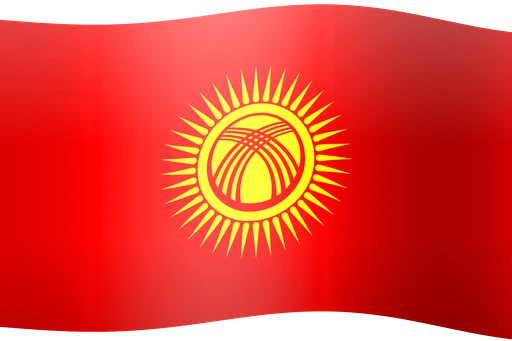
The flag of Kyrgyzstan is a red field with a yellow sun at the center, its 40 rays evenly spaced. Inside the sun is a tündük, the cross-shaped crown of a traditional Kyrgyz yurt. Red stands for bravery and valor, the sun for peace and wealth, and the tündük for the origin and home of the Kyrgyz people.
Kyrgyzstan's flag is a red field with a golden sun at the center, and inside the sun sits an abstract circular motif that appears on no other flag in the world. That motif is the tunduk, the crown of a traditional Kyrgyz yurt, seen from inside looking up. Adopted on March 3, 1992, months after the Soviet Union's dissolution, it was a deliberate reach past the Soviet period for something older.
The tunduk at the center
If you've ever stepped inside a Kyrgyz yurt and looked straight up, you've seen it: a circular wooden crown at the very top of the structure where the curved roof poles converge. It's functional and beautiful at once. Light pours through it, smoke escapes, and fresh mountain air drifts in.
On the flag, the tunduk is a stylized lattice pattern at the center of a golden sun, surrounded by 40 evenly spaced rays. The image captures what you'd see lying on your back inside a yurt, gazing up through the opening at the sky. The 40 rays represent the 40 tribes said to have been united by Manas, the legendary hero of Kyrgyz oral epic poetry and the single most important figure in the nation's cultural memory.
The yurt itself carries enormous weight as a symbol. For centuries the Kyrgyz were seminomadic, moving through the high valleys and passes of the Tian Shan mountains with their felt-covered homes packed onto horses. The yurt meant warmth, shelter, kinship, and survival.
What makes the design rare in world vexillology is that almost no other national flag uses an architectural or domestic interior element. Plenty of flags have stars, crescents, animals, or shields. Kyrgyzstan chose the view from inside a home. The tunduk turns up well beyond the flag too: on Kyrgyz banknotes, the state emblem, official seals, and traditional decorative arts.
Adoption in 1992
During the Soviet era, Kyrgyzstan's flag followed a familiar template: a red field with a horizontal blue stripe and the Soviet hammer, sickle, and star in the canton. The Kirghiz SSR flag looked like what it was, the banner of a republic whose identity was defined elsewhere.
Things shifted quickly. Kyrgyzstan declared sovereignty in October 1990, and full independence followed on August 31, 1991, in the chaotic aftermath of the failed coup against Gorbachev. The question of a new flag arose almost immediately.
A design competition was held and the debates were intense. Some proposals leaned toward pan-Turkic symbolism, others toward Islamic motifs common in the region. The winning direction went somewhere else entirely, anchoring the flag in pre-Soviet, pre-Russian nomadic Kyrgyz culture. On March 3, 1992, the day after Kyrgyzstan was admitted to the United Nations, the Supreme Council adopted the new flag with the tunduk and sun on a red field.
Kyrgyzstan wasn't alone in this. Across Central Asia, newly independent states were reaching back past seventy years of Soviet rule to reclaim older cultural identities. Kazakhstan chose a steppe eagle and sun. Turkmenistan put its carpet patterns on its flag. Kyrgyzstan's choice was the most domestic of the three: the view from inside a family's home.
Red and gold
The flag uses two colors, both with specific meanings rooted in Kyrgyz tradition. The saturated red field is linked to bravery and valor, and it is more than a generic martial color. Red was the color of the battle standard of Manas himself, according to the epic, which ties the background directly to the same literary tradition encoded in the central motif.
Gold, the color of the sun and tunduk, stands for peace, prosperity, and wealth, all of them valued in a nomadic hospitality culture where generosity to travelers was a moral obligation rather than a nicety. The sun reinforces themes of light and warmth. Kyrgyz cosmology, shaped by centuries of life under enormous open skies, places great importance on the relationship between earth and heaven, and the tunduk is the point where interior life meets the sky.
There's a practical dimension too. The deep, saturated red keeps the flag visible from great distances across open steppe and mountain terrain, which is the landscape where Kyrgyz banners were historically carried. Among its Central Asian neighbors, Kyrgyzstan's red stands out: Kazakhstan chose sky blue, Turkmenistan green, and Uzbekistan blue, white, and green stripes.
Manas and the 40 tribes
The Epic of Manas is staggering in scale. At roughly half a million lines in its fullest versions, it's one of the longest oral epic poems ever recorded, dwarfing the Iliad and Odyssey combined by a factor of twenty. For over a thousand years it has been the central pillar of Kyrgyz cultural identity, telling the story of the hero Manas and his efforts to unite the scattered Kyrgyz tribes against foreign invaders.
The 40 rays on the flag reference the 40 tribes Manas brought together. Forty is a sacred, recurring number in Kyrgyz culture. It appears in folk tales like "Kyrk Kyz" (Forty Girls), in ritual practices, and even, some scholars argue, in the country's name: "Kyrgyz" has been etymologically linked to "forty," though that derivation is debated.
The flag therefore encodes a literary and historical narrative rather than a political or religious one. You're not looking at a coat of arms designed by a committee. You're looking at a story that has been told around fires for a millennium.
UNESCO recognized the tradition of performing the Epic of Manas as part of the Intangible Cultural Heritage of Humanity in 2013. The manaschi, professional oral reciters who memorize vast portions of the epic and perform them in marathon sessions, are still active cultural figures in Kyrgyzstan, so the flag's symbolism connects to a living practice rather than a museum piece.
Usage, protocol, and variants
The flag's official proportions are 3:5, as specified in Kyrgyz law. It flies year-round on government buildings, with mandatory display on key holidays including Independence Day (August 31), Constitution Day, and other state occasions.
The Presidential Standard differs from the national flag: it's a square version with additional elements identifying it as the personal banner of the head of state. Military units carry their own ensigns, which incorporate the national flag's core elements.
Half-mast protocols are observed during official periods of mourning, as declared by presidential decree. Citizens and organizations may display the flag freely but are expected to treat it with respect, and specific regulations govern its use in advertising and commercial contexts. Internationally the flag is displayed at the United Nations, the Shanghai Cooperation Organisation, the Commonwealth of Independent States, and other bodies where Kyrgyzstan holds membership.
Where the flag sits among others
Vexillologists frequently cite Kyrgyzstan's flag as one of the most original national flags in existence. Other flags use circular central motifs: Japan has its red disc, Bangladesh its green-and-red circle, North Macedonia its radiating sun. But none uses an architectural lattice pattern drawn from the interior of a dwelling.
The design avoids every common vexillological shortcut. No crosses, no crescents, no generic five-pointed stars, no tricolor bands. It commits instead to something hyperlocal. For scholars of post-Soviet identity, the flag is a case study in how visual design can articulate national selfhood: not defined by the empire that ruled the country, nor by broader religious or ethnic categories others might assign it, but by homes, an epic, and the sky.
Pride in the flag's uniqueness runs high among Kyrgyz citizens, precisely because it looks like nothing else at the United Nations. There have been occasional debates about whether the tunduk's lattice pattern is geometrically accurate to an actual yurt crown, with some purists arguing that the current rendering simplifies the real structure.
One change has been made. In late 2023 parliament voted to straighten the sun's wavy rays, on the argument that the wavy version made the sun look like a sunflower, a plant that in Kyrgyz usage suggests a person who turns whichever way suits them. The proposal drew public criticism, and it passed anyway. President Sadyr Japarov signed the law on December 22, 2023 and it took effect four days later. The rest of the flag, the red field, the tunduk, and the count of 40 rays, stayed exactly as adopted in 1992.
References
[1] Law of the Kyrgyz Republic No. 8, "On the State Flag of the Kyrgyz Republic" (1992). Official legislative source for flag specifications and symbolism.
[2] Official website of the President of the Kyrgyz Republic, State Symbols section. www.president.kg
[3] Flags of the World (FOTW) database entry for Kyrgyzstan. www.crwflags.com/fotw/flags/kg.html
[4] Smith, Whitney. Flag Lore of All Nations. Millbrook Press, 2001.
[5] UNESCO Intangible Cultural Heritage listing, "Art of Akyns, Kyrgyz Epic Tellers" and the Epic of Manas tradition. ich.unesco.org
[6] Hatto, A.T. (ed. and trans.). The Manas of Wilhelm Radloff. Harrassowitz, 1990.
[7] Cummings, Sally N. Understanding Central Asia: Politics and Contested Transformations. Routledge, 2012.
[8] Olcott, Martha Brill. Central Asia's New States. United States Institute of Peace Press, 1996.
Common questions
- What does the center symbol on the Kyrgyzstan flag mean?
- The center symbol is the tunduk, the top view of a traditional Kyrgyz yurt. It stands for the universe and for unity, and it points back to the country's nomadic heritage.
- Why does the sun on Kyrgyzstan's flag have 40 rays?
- The 40 rays stand for the 40 tribes united by Manas, a legendary hero from Kyrgyz folklore.
- What's the symbol in the center of Kyrgyzstan's flag?
- It's a tunduk, the circular wooden opening at the very top of a traditional Kyrgyz yurt as you see it looking up from inside. It stands for home, family, and the nomadic life that's central to Kyrgyz identity. It sits inside a golden sun with 40 rays, which makes it one of the most distinctive symbols on any flag.
- What do the 40 rays on the sun represent?
- They represent the 40 tribes united by Manas, a legendary hero from the Epic of Manas, one of the longest oral epics ever created. The number 40 matters a great deal in Kyrgyz culture and turns up throughout the folk tales, rituals, and traditions. So those 40 rays encode over 1,000 years of storytelling into the flag.
Featured in these articles
- The Horizontal Stripe That Started a Revolution: How Haiti's Flag Was Born from a Torn Tricolor
- Blue Nation, Blue Flag: How Kazakhstan's Turquoise Sky Broke Every Rule of Flag Design
- Turkmenistan's Carpet Strip: The Most Complex Flag Design in the World and What It Encodes
- Six Central Asian Flags and the Silk Road History They Share
Download this flag
Free in 12 styles, from 32px icons up to 2000px, as SVG, PNG, WebP and JPG.