The Flag of Hungary
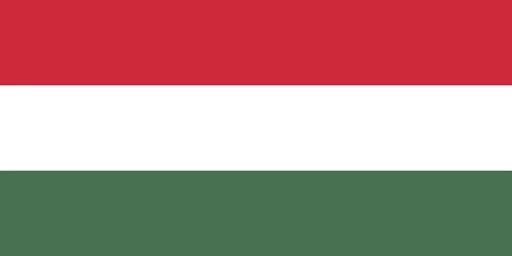
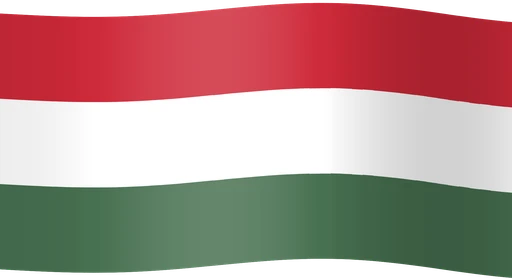
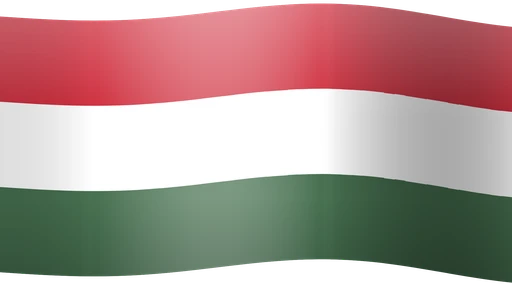
The flag of Hungary is a horizontal tricolor of three equal bands: red at the top, then white, then green. It belongs to the European tricolor tradition and carries no emblem in the center.
The Hungarian tricolor, three horizontal stripes of red, white, and green, looks simpler than it is. Its origins lie in the revolution of 1848, when Hungarian patriots sewed cockades and unfurled banners in defiance of Habsburg rule. It shares its color scheme with Bulgaria, Iran, and Italy, among others, it was overwritten by two authoritarian regimes in the space of a decade, and the coat of arms on its state version has roots in medieval crusader symbolism. What reads as minimalism is the result of centuries of layering political meaning onto the cloth and then stripping it off again.
Born in the revolution of 1848
The flag's direct lineage traces to the Hungarian Revolution of 1848-49, when liberal nationalists rose against Habsburg Austrian rule. Red, white, and green had floated through Hungarian heraldry for centuries before that. Red and white appeared in the ancient Árpád stripes, while green had long been linked to Hungary's rolling hills and the heraldry of Transylvania. But 1848 fused these threads into a single, deliberate national symbol.
On March 15, 1848, the poet Sándor Petőfi and the "Youth of March" movement pinned tricolor cockades to their chests as they marched through the streets of Pest. That date, sometimes called Hungary's "Ides of March," remains a national holiday. The horizontal arrangement of the stripes was no accident: it echoed the French tricolor, signaling alignment with Enlightenment ideals of liberty and constitutional government.
When combined Austrian and Russian forces crushed the revolution in 1849, the flag was suppressed. Displaying it could get you arrested. That made it a symbol of defeat and of defiant memory at once, a cloth that meant more folded in a drawer than it ever could flying freely. Nearly two decades later, the Austro-Hungarian Compromise (Ausgleich) of 1867 partially rehabilitated Hungarian national symbols and allowed the tricolor to fly again within the dual monarchy. By then the flag had already acquired the gravity that only persecution can give.
What the colors actually mean
No single authoritative meaning was assigned to each color when the flag was adopted. The interpretations came later.
The most popular folk reading goes like this: red for strength and the blood shed for the homeland, white for faithfulness and Hungary's rivers, green for hope and the country's mountains and hills. It's a tidy package, and Hungarians grow up hearing it. But it's retrospective folk etymology rather than documented original intent.
The heraldic roots are more concrete. Red and white (silver, in heraldic terms) derive from the Árpád dynasty's striped coat of arms, in use since at least the 12th century. Green appears in medieval Transylvanian heraldry and in depictions of Hungary's landscape. The colors predate the revolution by hundreds of years; 1848 simply arranged them in a new format.
Modern Hungarian law has since pinned things down. Act I of 2012, the Fundamental Law, defines the shades precisely, anchoring what was once an informal symbol in constitutional text. And if you've ever placed the Hungarian and Italian flags side by side, you've noticed they use the same three colors. The similarity is coincidental: both nations drew from the broader palette of 19th-century revolutionary symbolism, and Italy arranged its stripes vertically while Hungary went horizontal.
Arrow Cross emblems, Soviet stars, and the hollow center
The 20th century turned Hungary's flag into a contested object, repeatedly altered to serve whoever held power. During the Arrow Cross (Nyilaskeresztes) fascist regime of 1944-45, a green arrow-cross emblem was imposed on the tricolor, staining the national colors with collaboration and terror. After the war, things didn't improve. The Soviet-backed People's Republic of Hungary, established in 1949, put a red star, wheat sheaf, and hammer at the flag's center, converting it into an instrument of communist propaganda.
Then came the defining moment. During the 1956 Hungarian Uprising, revolutionaries grabbed flags and cut out the Soviet-era emblem with knives and scissors, leaving a ragged hole in the middle. That "holey flag" became one of the Cold War's most reproduced images: a national symbol reclaimed through destruction, its empty center saying more than any emblem could.
After Soviet tanks crushed the uprising, the communist government quietly swapped the most reviled imagery for a subtler emblem, but a central device remained on the flag until 1989. When communism collapsed, restoring the plain tricolor was among the first symbolic acts of the new republic. The empty center is the point of the current design, not an absence in it.
The state flag and the Holy Crown
Hungary does maintain a state version of the flag bearing the national coat of arms, used in government, diplomatic, and ceremonial settings. That coat of arms is among Europe's most historically layered heraldic devices.
The shield is divided into two halves. On the left, four red and four silver (white) horizontal stripes recall the Árpád dynasty. On the right, a green triple hill supports a silver double cross on a red field. That double cross, sometimes called the apostolic cross, references Hungary's Christian conversion under King Stephen I, who ruled from 1000 to 1038. According to tradition, Pope Sylvester II granted Stephen the cross, tying the symbol to Hungary's founding national myth.
Perched above the shield sits the Holy Crown of Saint Stephen, Hungary's most sacred national relic. The communists removed it from the coat of arms in 1949, but it was restored in 1990 and now sits in a glass case inside the Hungarian Parliament building, guarded around the clock. Few national symbols have survived so many regime changes with their prestige intact. The distinction between the civil flag (plain tricolor) and the state flag (with arms) follows a broader European tradition of layered flag usage for different occasions.
Neighbors and lookalikes
Flip the Hungarian flag 180 degrees and you get something strikingly close to the flag of Iran, a quirk that has caused the occasional protocol mix-up at international events. It also closely resembles the flag of Tajikistan (red, white, green horizontal stripes) and shares colors with Bulgaria, Italy, and Mexico. The overlap isn't mysterious: 19th-century nationalist movements across Europe and beyond drew from a shared palette of revolutionary symbolism, and only so many combinations of three colors exist.
Within Central and Eastern Europe, the tricolor format became a shorthand for liberal nationalism, all of it influenced by France's 1790s original. The flags of Transylvania and Wallachia (now parts of Romania) incorporate red, yellow, and blue, a reminder that overlapping medieval kingdoms left the region with tangled heraldic traditions.
On the technical side, Hungary's flag ratio is officially 1:2, with 2:3 also used, and strict color matching to RAL or Pantone standards is specified in national regulations. Vexillologists often cite Hungary's flag as a case study in the effectiveness of "clean" national designs, since it consistently ranks well for recognizability.
The flag in Hungarian law and public life
Hungary's Fundamental Law, adopted in 2011 and in force since January 1, 2012, describes the flag in constitutional text. Act CCII of 2011 goes further, governing use, display, and misuse with specific provisions against desecration.
Three national days bring the flag out in force. March 15 commemorates the 1848 Revolution. August 20 marks Saint Stephen's Day and the founding of the Hungarian state. October 23 carries a double meaning: it honors both the start of the 1956 uprising and the moment in 1989 when Hungary proclaimed itself a republic, on the same calendar date, 33 years apart.
In football culture, fans regularly unfurl giant tricolor tifos across stadium sections. The flag has also featured in heated debates about national identity and populism throughout the 2010s and 2020s, contested once again, this time not by empires or occupiers but by competing visions of what Hungary should be. Diaspora communities in the United States, Canada, and Australia, many descended from refugees who fled after 1956, display it as a marker of heritage.
References
[1] Hungary's Fundamental Law (Alaptörvény), adopted April 25, 2011. Official constitutional text describing the national flag. Available via kormany.hu and parliament.hu.
[2] Deák, István. The Lawful Revolution: Louis Kossuth and the Hungarians, 1848-1849. Columbia University Press, 1979. Authoritative history of the 1848 revolution and the emergence of national symbols.
[3] Crampton, William. The World Encyclopedia of Flags. Lorenz Books, 2001. Vexillological overview including Hungarian flag specifications and historical context.
[4] FOTW (Flags of the World), Hungary entry. fotw.info/flags/hu.html. Comprehensive vexillological database with historical variants and technical specifications.
[5] Held, Joseph (ed.). The Columbia History of Eastern Europe in the Twentieth Century. Columbia University Press, 1992. Covers the 1956 uprising and the symbolic role of the "holey flag."
[6] Smith, Whitney. Flag Lore of All Nations. Millbrook Press, 2001. Accessible overview of flag symbolism including Central European traditions.
[7] Hungarian National Museum (Magyar Nemzeti Múzeum), Budapest. Holds original 1848 revolutionary flags and cockades. Digital archive at mnm.hu.
[8] FIAV (International Federation of Vexillological Associations). Peer-reviewed vexillological research and flag classification standards. fiav.org.
Common questions
- What do the colors on Hungary's flag mean?
- Red stands for strength and bravery, white for faithfulness, and green for hope and prosperity.
- Why was the coat of arms taken off the Hungarian flag?
- After the 1956 Revolution the coat of arms was taken off and the flag went back to the plain tricolor. The aim was to drop party symbols and leave a flag that everyone could share.
- What do the red, white, and green colors on Hungary's flag mean?
- People today often say red represents strength and sacrifice, white means faithfulness, and green symbolizes hope and the Hungarian landscape. But that's more folklore than historical fact. The real story's older: red and white come from the medieval Árpád dynasty's striped coat of arms, and green ties back to Transylvanian heraldry. The symbolic meanings came later.
- Why did revolutionaries cut holes in Hungary's flag during the 1956 uprising?
- Soviet leaders had forced a new emblem into the flag's center: a red star, wheat sheaf, and hammer. During the 1956 uprising, Hungarian revolutionaries cut those symbols right out, turning the flag back into a simple tricolor. That 'holey flag' became one of the Cold War's most widely reproduced images of resistance. When communism collapsed in 1989, the emblem went for good.
- When did Hungary officially adopt the red, white, and green flag?
- Hungary's revolutionary patriots settled on the tricolor on March 15, 1848, when they pinned red-white-green cockades on their clothing as a shared national symbol. The colors had shown up in Hungarian heraldry for centuries before that, but 1848 was when they became the flag. That date's still celebrated as Hungary's national holiday.
Featured in these articles
Download this flag
Free in 12 styles, from 32px icons up to 2000px, as SVG, PNG, WebP and JPG.