The Flag of Australia
Commonwealth of Australia
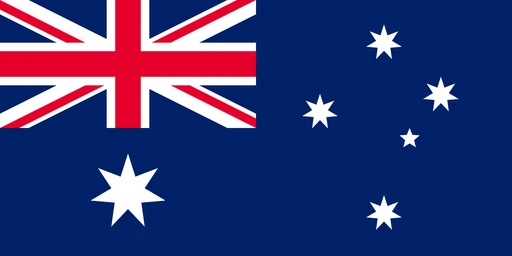
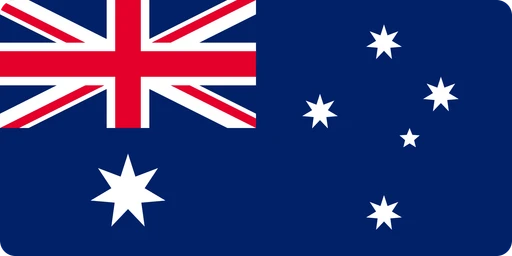
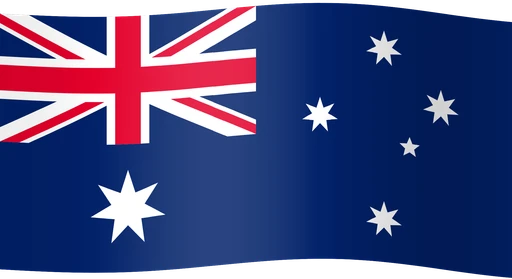
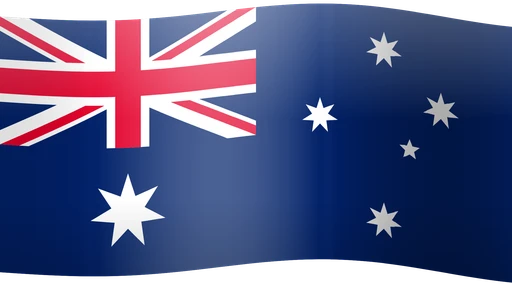
The flag of Australia is a defaced Blue Ensign: a blue field with the Union Jack in the canton (the upper hoist quarter) and a large white seven-pointed Commonwealth Star in the lower hoist quarter. The fly carries the Southern Cross, five white stars made up of four larger seven-pointed stars and one smaller five-pointed one.
Australia's national flag came out of a public design competition held in 1901, the year the six British colonies federated. Of 32,823 entries, five near-identical designs shared the prize. The result layers three elements onto a royal blue field: the Union Jack in the canton, the seven-pointed Commonwealth Star beneath it, and the five stars of the Southern Cross on the fly. Those three elements record the country's colonial origins, its federal structure, and its place in the Southern Hemisphere, and they keep the flag at the centre of arguments about national identity, Indigenous recognition, and the Crown.
The 1901 flag competition
When the Commonwealth of Australia came into being on 1 January 1901, it had a constitution, a parliament, and a prime minister, but no flag. The six former colonies each flew their own ensigns. The solution was a public design competition, sponsored jointly by the Melbourne Herald and the Commonwealth government, with prize money of £200.
A total of 32,823 entries came in from across the new federation. Schoolchildren submitted designs alongside architects, housewives, and professional artists. A 14-year-old Melbourne boy named Ivor Evans was among the winners, as were Frederick Thompson, Egbert Nuttall, Annie Dorrington, and William Stevens. All five had independently arrived at nearly identical designs, and they shared the prize.
The winning flag flew for the first time at the Royal Exhibition Building in Melbourne on 3 September 1901, a date now commemorated as Australian National Flag Day. King Edward VII granted royal approval in 1903, and the design changed in small but real ways over the following decades, mostly in the number of points on the Commonwealth Star and the arrangement of the Southern Cross.
The Commonwealth Star
Sitting directly beneath the Union Jack is the large white star that turns an otherwise standard British ensign into something particular to Australia. It is officially the Commonwealth Star, sometimes called the Federation Star.
Originally it had six points, one for each federating state: New South Wales, Victoria, Queensland, South Australia, Western Australia, and Tasmania. In 1908 a seventh point was added for the territories, meaning the Territory of Papua at the time. Today that point covers all current and future Commonwealth territories, including the Northern Territory and the Australian Capital Territory.
The seven points work as a diagram of the federation: six states plus the territories, in one symbol.
The Southern Cross on the fly
The right half of the flag belongs to the Southern Cross, or Crux, drawn as five white stars of different sizes. They are Alpha, Beta, Gamma, and Delta Crucis, each with seven points, and the smaller Epsilon Crucis with five. The size difference tracks their relative brightness as seen from Earth.
The constellation was part of Australian identity well before federation. It appeared on the Eureka Flag of 1854, flown by rebellious gold miners at the Eureka Stockade in Ballarat during one of the most famous acts of civil disobedience in Australian history. By 1901 putting it on the national flag was close to inevitable.
The Southern Cross is visible year-round from every part of Australia. For Aboriginal and Torres Strait Islander peoples it carries its own significance, woven into astronomical traditions tens of thousands of years old. In some Indigenous traditions the dark spaces between the stars of the Milky Way form an emu in the sky, with the Coalsack Nebula near the Southern Cross as its head. Putting a constellation on a flag also places Australia in a small group with New Zealand, Papua New Guinea, Brazil, and Samoa, each of which renders the Cross differently.
The Union Jack in the canton
The Union Jack occupies the upper-left quarter, and it draws the most argument. It reflects Australia's origins as a set of British colonies and the continuing constitutional link to the Crown. At federation its inclusion was essentially uncontested. Australians overwhelmingly identified as British subjects, and the flag was designed to be read within the British ensign system: blue for government use, red for civil and merchant purposes.
For decades there was genuine confusion about which version was the national flag. Private citizens more commonly flew the red ensign, while the blue ensign was reserved for official government use. The Flags Act 1953 settled it, formally establishing the blue ensign as Australia's national flag.
Since the late twentieth century the Union Jack's presence has become contentious. Republican movements and advocates for Indigenous recognition argue that it stands for colonialism and excludes First Nations peoples. Defenders counter that the design has been sanctified by military sacrifice, particularly at Gallipoli in 1915 and along the Kokoda Track in 1942.
Changing it would not be simple either. The Flags Act 1953, as amended in 1998, requires any change to the national flag to be approved by a national plebiscite.
Variants and the other official flags
Australia maintains several official variants beyond the blue ensign. The Australian Red Ensign is used for merchant shipping. The Royal Australian Navy flies the Australian White Ensign, and the RAAF and civil aviation have their own ensigns. Each state and territory has its own flag, most following the British blue ensign pattern with a distinctive badge on the fly.
Two other flags stand apart. The Aboriginal Flag, designed by Harold Thomas in 1971, is a horizontal split of black over red with a yellow circle at the centre. The Torres Strait Islander Flag, designed by Bernard Namok in 1992, shows a white dhari (headdress) and star on a background of green and blue. Both were proclaimed official flags of Australia in 1995, giving them formal standing alongside the national flag. In 2022 the Australian government acquired copyright to the Aboriginal Flag from Harold Thomas, resolving years of licensing disputes and making it freely available.
Flag protocol is governed by guidelines from the Department of the Prime Minister and Cabinet. The national flag takes precedence over all others when flown together, and the Aboriginal and Torres Strait Islander flags are typically displayed alongside it at government buildings. Australian National Flag Day on 3 September marks the anniversary of the 1901 flying, though it is a quieter observance than Australia Day.
The case for changing it
Periodic campaigns to change the flag have produced dozens of alternative designs. Common proposals feature the kangaroo, the golden wattle, or a simplified Southern Cross on a green-and-gold field, Australia's national sporting colours. Ausflag, a non-profit founded in 1981, has been the most prominent advocate for a new design, arguing that the current flag is too easily confused with New Zealand's and does not reflect modern multicultural Australia.
New Zealand's experience hangs over the conversation. In 2015 and 2016 New Zealanders held a two-stage binding referendum on their flag and kept the old one, an outcome frequently cited in Australian debates as evidence that flag change is politically difficult even where appetite exists.
Polls have shown fluctuating support, generally between 25% and 40% in favour of a new design, and the numbers tend to track broader sentiment about republicanism.
References
[1] Flags Act 1953 (Cth), as amended. Federal Register of Legislation, Australian Government. www.legislation.gov.au
[2] Australian Government Department of the Prime Minister and Cabinet, "Australian Flags." Official protocol and history resource. www.pmc.gov.au/government/australian-national-flag
[3] Australian War Memorial, "The Australian Flag." Historical context of the flag in wartime. www.awm.gov.au
[4] Kwan, Elizabeth. Flag and Nation: Australians and Their National Flags Since 1901. University of New South Wales Press, 2006.
[5] Smith, Whitney. Flags Through the Ages and Across the World. McGraw-Hill, 1975.
[6] Ausflag, "The Flags of Australia: A Brief History." www.ausflag.com.au
[7] National Museum of Australia, "Defining Moments: Australian Flag First Flown, 1901." www.nma.gov.au/defining-moments/resources/australian-flag
[8] Hamacher, Duane W. and Norris, Ray P. "Australian Aboriginal Astronomy: Overview." Proceedings of the International Astronomical Union, 2011.
Common questions
- Why does the Australian flag have the Union Jack on it?
- Australia began as a group of British colonies that federated in 1901. At the time Australians saw themselves as British subjects, and the flag was built on the British ensign system, which is why the Union Jack sits in the upper left corner. It remains a live argument. Republicans and Indigenous advocates see it as a colonial holdover, while others read it as a nod to the country's historical and military ties.
Featured in these articles
- New Zealand Spent $26 Million Voting on a New Flag. Then Chose the Old One.
- The King Who Wouldn't Pick a Side: How the Union Jack Ended Up on an American State Flag
- Black Is Not Nothing: The Radical Political Statement Hidden in Jamaica's Flag
- Counted, Not Forgotten: How Four Island Nations Turned Their Flags Into Maps
Download this flag
Free in 12 styles, from 32px icons up to 2000px, as SVG, PNG, WebP and JPG.