The Flag of Micronesia
Federated States of Micronesia
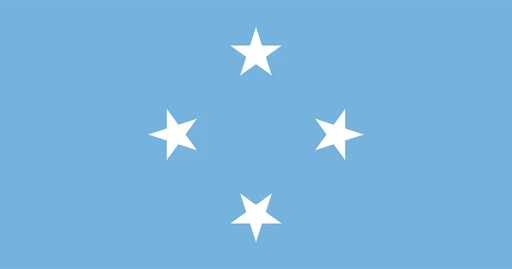
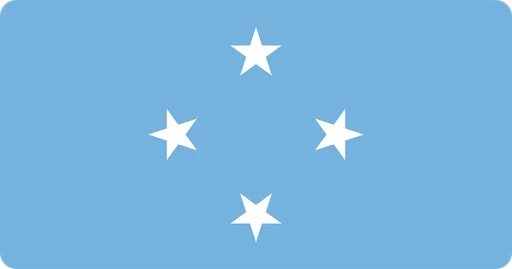
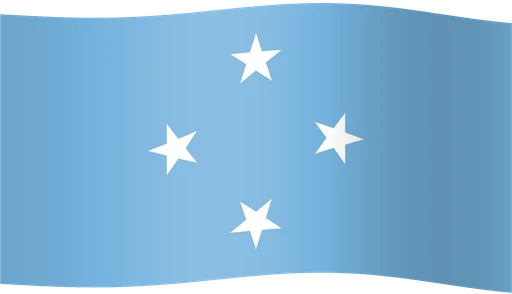
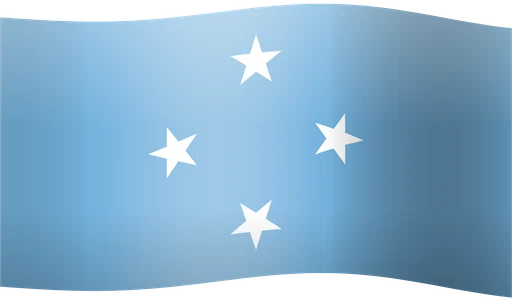
The flag of Micronesia consists of a light blue field with four white stars arranged in a diamond pattern in the center. The blue represents the Pacific Ocean, while the four stars represent the four states of Micronesia: Yap, Chuuk, Pohnpei, and Kosrae.
The flag of the Federated States of Micronesia is a field of United Nations blue with four white five-pointed stars in a diamond, and it looks almost too simple to carry much meaning. But the specific shade of blue and the number of stars both come out of the negotiations that brought four scattered archipelagos together into one nation. There used to be six stars.
From trust territory to sovereign nation
Micronesia didn't win its flag through revolution or receive it as a parting gift from a colonial power. It was negotiated into existence, step by careful step, through the machinery of international law. After World War II, the United States administered the Trust Territory of the Pacific Islands (TTPI) under a United Nations mandate, governing a vast expanse of the western Pacific that included dozens of culturally distinct island groups. The TTPI had its own flag, but as its constituent districts began moving toward self-governance in the 1970s, they needed symbols of their own.
On November 30, 1978, the FSM constitution came into effect, and with it, a new flag. That first version bore six white stars on a blue field, one for each of the six districts that had been invited to join the federation. But politics intervened quickly. The Marshall Islands and Palau declined to ratify the constitution, choosing their own paths to sovereignty. By 1979, two stars had been removed, leaving the four that fly today: one each for Chuuk, Pohnpei, Kosrae, and Yap.
Subtraction of that kind is unusual. Most flags accumulate symbols over time: the United States added stars as states joined the union, and Australia's flag gained elements as its identity settled. Micronesia's shed stars to reflect a political fracture. The Marshall Islands and Palau each went on to become independent nations under their own Compacts of Free Association with the United States, and each designed flags that, in their own ways, echo the blue Pacific origins they share with the FSM. The timeline tells the whole story in miniature: six stars in 1978, four in 1979, full sovereignty in 1986 when the Compact of Free Association was signed.
What the diamond of stars represents
Each of the four stars corresponds to one of the FSM's constituent states: Chuuk (formerly Truk), Pohnpei, Kosrae, and Yap. These aren't administrative abstractions. Each state is a distinct archipelago with its own language, its own customs, and its own sense of identity. Yapese stone money is nothing like Pohnpeian sakau ceremony, and Chuukese navigational traditions diverge sharply from Kosraean ones. The stars hold these differences together without erasing them.
Their arrangement in a diamond pattern isn't decorative. It loosely mirrors the geographic spread of the four island groups across the western Pacific, with their rough north-south and east-west relationships suggested by the spacing. Turn a map of the FSM sideways, and you can almost see it.
The blue field is the most politically loaded element. It's explicitly derived from the United Nations flag, specifically Pantone 279, a direct nod to the UN trusteeship that shaped Micronesia's path to nationhood. No other sovereign nation's flag borrows UN blue so transparently. For an international audience, it signals peace and cooperation. For Micronesians, it's also simply the color of daily life: sky above, ocean in every direction.
White for the stars was deliberate too. Against the blue, the white points stand for individual island identities preserved within the larger whole. The five-pointed star form carries traces of the American administrative period and follows a convention common across Pacific and American-influenced flags. Set this against nearby Papua New Guinea or Fiji, whose flags are packed with shields, birds, and complex imagery, and the restraint reads as a political choice.
The ocean in the flag
The FSM's exclusive economic zone spans roughly 2.7 million square kilometers of ocean. Its total land area is about 702 square kilometers, a ratio of nearly 4,000 to 1. On the flag the blue overwhelms and the stars are tiny, deliberate pinpoints, which makes the design close to cartographic.
For Micronesians, especially in Yap and the outer islands, the ocean has never been a barrier. It's a highway. Traditional open-water navigation, reading swells, stars, and bird flight patterns to cross hundreds of miles without instruments, remains a cornerstone of cultural identity. The flag's vast blue field resonates with this worldview even though its blue was chosen for political rather than oceanic reasons. Locals have come to read it both ways, and both readings are true.
Across the Pacific, blue fields and stars recur on flag after flag: Nauru's blue with a yellow stripe and star, Palau's golden disc on blue, the Marshall Islands' rising diagonal bands on blue. These flags form an informal visual family, linked by shared geography and, in some cases, shared colonial histories. The FSM flag fits squarely within this tradition while distinguishing itself through sheer restraint. No stripes, no circles, no crescents. Just blue, and four white stars floating in it like atolls in open water.
Protocol and display
The FSM's federalist structure means the national flag shares space with four distinct state flags. Chuuk, Pohnpei, Kosrae, and Yap each maintain their own banners, and local pride in these state symbols runs deep. Official protocol, codified in FSM law, gives the national flag precedence in federal contexts, but in practice the two levels of identity coexist comfortably.
Internationally, the flag has flown at the United Nations since the FSM joined in 1991, and it appears at Pacific Islands Forum summits, embassy buildings, and consular offices. Schools and government buildings across the four states display it daily. National sporting events bring it out in force, particularly during the Pacific Games.
Perhaps the most globally visible moments for the flag come at the Olympics. The FSM has participated since the 1988 Seoul Games, and opening ceremony appearances have given a nation of fewer than 115,000 people a stage watched by billions. On the water, the flag travels even further. The FSM maintains one of the world's notable ship registries, and vessels flying the Micronesian flag move through ports worldwide, giving this small nation's banner an unexpectedly vast maritime reach.
Micronesia among its Pacific neighbors
The three nations that emerged from the TTPI, the FSM, the Marshall Islands, and Palau, form a kind of vexillological family tree. All three use blue fields. All three chose minimalist designs. But their flags diverged as their political paths did.
The Marshall Islands opted for a blue field crossed by rising diagonal orange and white stripes, with a large white star in the upper left. Palau went even more minimal: a single golden disc, slightly off-center, on a field of blue, representing the full moon over the Pacific. Nauru, while not a TTPI member, rounds out the "blue Pacific" family with its own blue field, yellow stripe, and white star.
What sets the FSM flag apart is its documented lineage. The original six-star flag and its reduction to four is a rare, clearly traceable case of flag inheritance within a decolonization process. No other sovereign nation acknowledges its administrative origins quite so openly through color choice. The UN blue is not hidden or reinterpreted: this nation was born from a trusteeship, a constitution, and a compact rather than from conquest or revolution, and the flag says so.
References
[1] Federated States of Micronesia Official Government Website (https://www.fsmgov.org). Constitutional and legal provisions regarding national symbols.
[2] FSM Code, Title 1, National Symbols. Official flag specifications, protocol, and legal framework.
[3] Smith, Whitney. Flags Through the Ages and Across the World. McGraw-Hill, 1975. Foundational vexillology reference covering Pacific island flags.
[4] Flags of the World (FOTW). Federated States of Micronesia (https://www.fotw.info/flags/fm.html). Detailed vexillological documentation including historical variants and the six-to-four star transition.
[5] United Nations Trusteeship Council Records. Trust Territory of the Pacific Islands flag history and decolonization documentation.
[6] Compact of Free Association (1986), U.S. Public Law 99-239. Legal context for FSM sovereignty and relationship with the United States.
[7] International Olympic Committee, FSM Country Profile (https://www.olympics.com). Flag usage and national participation history in the Olympic Games.
[8] Neubecker, Ottfried. Heraldry: Sources, Symbols and Meaning. McGraw-Hill, 1976. Comparative analysis of star and blue-field symbolism in national flags.
Common questions
- What do the stars on the Micronesian flag stand for?
- The four stars on the Micronesian flag represent the four states: Yap, Chuuk, Pohnpei, and Kosrae. They signify unity and equality among these states.
- What does the light blue mean on the Micronesian flag?
- The light blue stands for the Pacific Ocean that surrounds and connects Micronesia's islands.
- What do the four stars on the Micronesia flag mean?
- Each star represents one of the four states that make up the Federated States of Micronesia: Chuuk, Pohnpei, Kosrae, and Yap. They're arranged in a diamond pattern that roughly reflects how these island groups are scattered across the western Pacific Ocean.
Featured in these articles
- Counted, Not Forgotten: How Four Island Nations Turned Their Flags Into Maps
- Borrowed Blue: Why Island and Coastal Nations Didn't Choose the Ocean. They Chose the 20th Century
- Stars at the Bottom of the World: Why Pacific Island Nations Put Constellations on Their Flags
- Blue Nation, Blue Flag: How Kazakhstan's Turquoise Sky Broke Every Rule of Flag Design
Download this flag
Free in 12 styles, from 32px icons up to 2000px, as SVG, PNG, WebP and JPG.