The Flag of Argentina
Argentine Republic
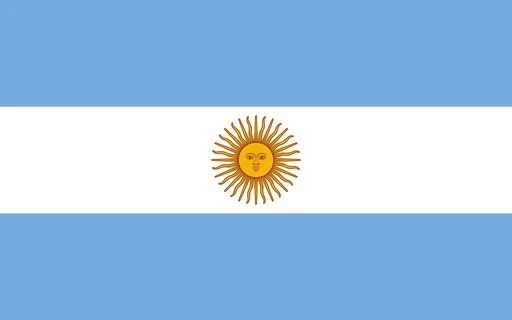
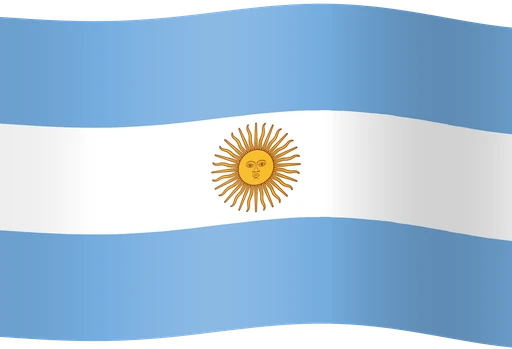
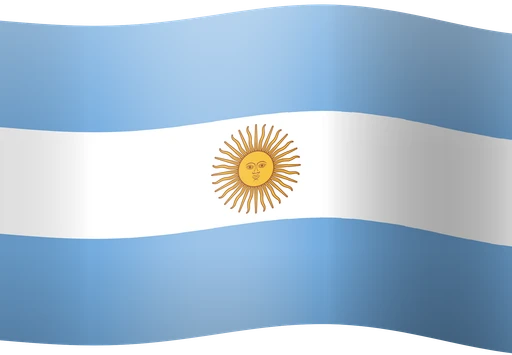
Argentina's flag has three horizontal bands of equal width, light blue at the top and bottom and white in the middle, with a golden sun and a human face, the 'Sun of May', at the center of the white band. The colors are usually read as the sky and the clouds, and the sun refers to the sun breaking through cloud during the May Revolution of 1810.
Argentina's celeste y blanca is one of the few national flags said to have been taken from the sky. Manuel Belgrano created it during the revolutionary upheaval of 1812, and two centuries of political turmoil, dictatorship, and democratic renewal have left it essentially unchanged. Its origins are less tidy than the story suggests: the colors have been traced to the robes of the Virgin Mary and to the Bourbon dynasty as readily as to the weather, and the sun at its center refers to a single day in 1810.
Belgrano on the riverbank, 1812
On February 27, 1812, General Manuel Belgrano stood on the banks of the Paraná River near Rosario and raised a flag nobody had authorized him to create. The war against Spain was grinding forward and Belgrano had a practical problem: revolutionary and royalist troops both wore Spanish cockades and carried Spanish-style insignia, which was getting men killed. He needed something unmistakably different, so he made one.
The provisional government in Buenos Aires, the First Triumvirate, was not pleased. It reprimanded him and ordered him to stop using the unauthorized banner, worried that it would provoke Spain before the revolutionaries were ready for a full break. Belgrano, by then marching north toward Upper Peru, claimed he never received the order. Historians still argue about whether that was true.
For four years the flag sat in political limbo. Only on July 20, 1816, eleven days after Argentina formally declared independence at the Congress of Tucumán, was the celeste y blanca adopted as the national flag. By then the revolution had its own momentum and the flag had become the emotional center of the independence cause.
Belgrano did not get a happy ending. He died on June 20, 1820, impoverished and largely forgotten, and the Buenos Aires newspapers barely noted his passing; they were busy with the political chaos of the day. Recognition took decades. Today February 27 is Día de la Bandera, a national holiday, and Belgrano's face is on the 200-peso bill.
Where the celeste came from
Ask an Argentine where the colors come from and you will probably hear that Belgrano looked up at the sky, saw pale blue and white, and chose those. It is a good story and it may be partly true.
The historical record points in several directions. The most grounded theory traces the colors to the blue-and-white cockades worn by patriots during the May Revolution of 1810, two years before Belgrano raised his flag. Those cockades may in turn have borrowed their palette from the royal colors of the Spanish Bourbons, which would make a revolutionary emblem out of royalist material.
A third theory ties the colors to the Virgin Mary, whose robes are traditionally blue and white. Marian devotion ran through everyday life in colonial Argentina, and religious symbolism plausibly bled into political iconography. None of the three explanations rules out the others, and the truth probably involves all of them.
The stripes themselves are about as simple as a triband gets: celeste on top and bottom, white between. The exact shade of blue has been more contentious than you might expect. The original celeste drifted toward a darker ultramarine on many unofficial versions over the years, and Argentina settled the question legislatively in 2012 by fixing the shade at Pantone 284 C.
The Sun of May
At the center of the flag sits a golden sun with a human face, an expression somewhere between serene and unsettling. This is the Sol de Mayo, and it refers to May 25, 1810, when crowds gathered in the Plaza de Mayo in Buenos Aires to demand self-governance from the Spanish viceroy.
Popular tradition holds that the sun broke through heavy clouds at the moment the crowd assembled and was read as a sign that the cause was righteous. Whether the weather cooperated that precisely hardly matters now; the story is what got attached to the symbol.
The sun's design draws on the Inca sun god Inti, a choice that linked the new nation to the pre-Columbian history of the continent rather than only to its European inheritance. The face is surrounded by 32 rays, 16 straight and 16 wavy, alternating around the disc. The straight rays are sunlight, the wavy ones heat.
The Congress of Tucumán added the sun in 1818, producing the Bandera Oficial de la Nación, the official ceremonial flag. The plain version without the sun is the ornamental flag, which any citizen may fly. That distinction still matters in Argentine protocol and gives the country two legally recognized versions of the same flag.
The Sol de Mayo also appears on the national coat of arms, on Argentine coins, and across government buildings, which makes it arguably the single most important visual symbol of the Argentine state.
Two official versions
The Bandera Oficial, with the Sun of May, was historically reserved for government buildings, military installations, and official ceremonies. Private citizens could fly only the plain Bandera de Ornato.
That restriction carried real weight during the years of military dictatorship. When President Raúl Alfonsín lifted it by decree in 1985, during the democratic transition after the junta's collapse, the gesture was about returning the full symbol of nationhood to the people rather than about protocol.
Argentine flag etiquette is specific and taken seriously. The flag is raised and lowered with formal ceremony. It may never touch the ground. When flown at half-staff it is first raised to the peak of the pole, then lowered. Commercial use of the design is officially prohibited, though enforcement gets creative during World Cup years, when the celeste y blanca turns up on everything from car mirrors to empanada packaging.
The center of flag culture is the Monumento a la Bandera in Rosario, a memorial completed in 1957 on the spot where Belgrano first raised his creation. Every June 20, on the anniversary of his death, thousands gather there for the main Flag Day ceremony.
Influence across the region
The design did not stay inside Argentina's borders. The flags of El Salvador, Honduras, Guatemala, and Nicaragua are all horizontal blue-and-white tribands, derived from the flag of the Federal Republic of Central America (1823-1841), which was itself influenced by the Argentine banner.
The closest relative is Uruguay's. It shares the celeste-and-white scheme and carries its own Sol de Mayo, virtually identical to Argentina's. Uruguay was originally part of the same independence movement in the Río de la Plata region, and the two flags are among the most closely linked in the world.
Paraguay's flag, red, white, and blue, also traces back to the same early 19th-century Spanish American revolutions. And José de San Martín, Argentina's other great independence figure, physically carried a version of the Argentine flag across the Andes into Chile and Peru.
The flag in Argentine life
During the Falklands and Malvinas War of 1982, the celeste y blanca carried both genuine patriotic feeling and cynical manipulation by the ruling junta. That double legacy still shadows the flag's meaning in certain contexts.
In football the connection is more direct. Argentina's national team is La Albiceleste, "The White and Sky Blue," a nickname taken from the flag. When Diego Maradona scored the Goal of the Century in 1986, the flag in the stands was part of the moment.
During the economic crisis of 2001, protesters filled the streets of Buenos Aires waving it, using it to claim democratic legitimacy against a government that had lost the public's trust.
Every Argentine schoolchild takes part in a formal flag-pledging ceremony, the Promesa de Lealtad a la Bandera, in fourth grade, around age ten. It is a civic ritual that carries real emotional weight for many Argentines and cuts across class, region, and politics.
And in the Church of San Francisco in Tucumán, behind glass, sits what is believed to be a fragment of Belgrano's original flag.
References
[1] Ministerio del Interior de la República Argentina. "Símbolos Nacionales." Official government page on national symbols. (https://www.argentina.gob.ar/interior/asuntos-politicos-y-electorales/simbolos-nacionales)
[2] Ley 27.118 (2012) and Decreto 10.302/1944. Argentine legislation codifying the flag's design, official shade of blue (Pantone 284 C), and display protocol.
[3] Smith, Whitney. Flags Through the Ages and Across the World. New York: McGraw-Hill, 1975. Foundational vexillological reference with extensive coverage of Argentine flag history.
[4] Flags of the World (FOTW). "Argentina." (https://www.crwflags.com/fotw/flags/ar.html). Peer-reviewed vexillological reference maintained by the Flags of the World association.
[5] Busaniche, José Luis. Historia Argentina. Buenos Aires: Solar/Hachette, 1969. Standard Argentine history reference covering the independence period and Belgrano's role.
[6] Instituto Nacional Belgraniano. Argentine government institute dedicated to the study of Manuel Belgrano's life, writings, and legacy, including primary source material on the flag's creation.
Common questions
- Why do Argentina and Uruguay have such similar flags?
- Both countries came out of the same independence movement in the Río de la Plata region, so they share the celeste-and-white colors and the Sun of May. Uruguay was caught up in the same revolutionary war against Spain, and the two flags are effectively siblings.
- Who created the Argentine flag?
- General Manuel Belgrano, on February 27, 1812, on the banks of the Paraná River near Rosario. He needed a way to tell revolutionary troops apart from royalist forces. The government scolded him for making it without permission, but the flag stuck, and it was officially adopted on July 20, 1816, just after Argentina declared independence.
Featured in these articles
- The Only Flag in the World That Lies to You Depending on Which Side You're Standing On
- Four Suns on Four Flags, and Not One of Them Means the Same Thing
- The Flag That Needed a Compass: Why Uruguay's Sun Has a Face, and What That Face Is Actually Saying
- The Sun That Rises Differently: How Japan's Rising Sun Flag Became the World's Most Contested Military Symbol
Download this flag
Free in 12 styles, from 32px icons up to 2000px, as SVG, PNG, WebP and JPG.