The Flag of Tajikistan
Republic of Tajikistan
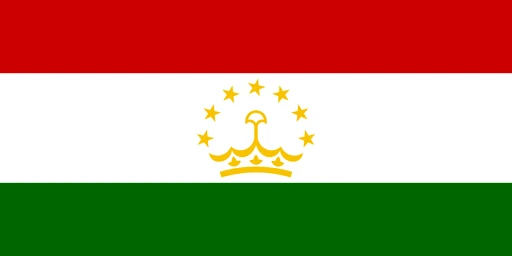
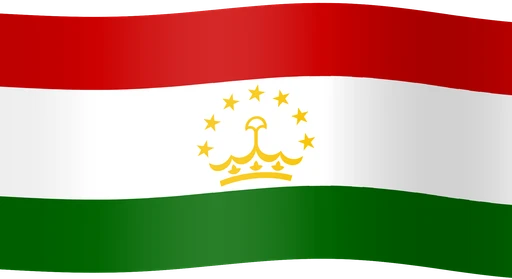
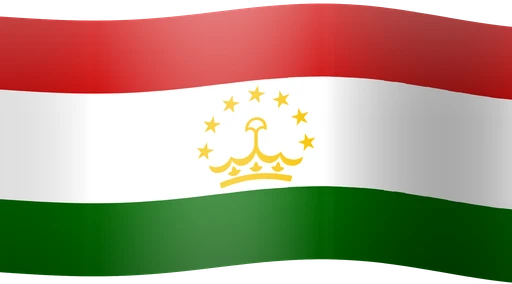
The flag of Tajikistan has three horizontal stripes of red, white and green, with the white stripe slightly wider than the other two. A gold crown topped by an arc of seven stars sits at the center of the white band. The colors and the emblem refer to the country's heritage, its natural wealth and its independence.
Tajikistan's flag was adopted a year after independence, and it carries traces of both the Soviet period and what came before it.
Adopted in 1992
The flag dates to November 24, 1992, following independence in September 1991 and the dissolution of the Soviet Union. Under Soviet rule Tajikistan flew a variant of the Soviet flag: a red field with green and white stripes added to mark out the Tajik SSR.
The new flag was part of a wider effort to assert a distinct national identity and move away from Soviet imagery, while keeping enough of the old palette that the break was not total.
The stripes and the crown
Red runs along the top and stands for unity and for the nation's sun, and by extension for bravery and vital force. White in the middle is the purity of the people, the cotton crop and the snow on the mountains. Green at the bottom is the fertile valleys and the farming they support.
At the center of the white stripe is a gold crown beneath an arc of seven stars. The crown signals sovereignty and independence. Seven is a number of some weight in local tradition and religious belief, and here it is read as prosperity and happiness.
In use
The flag hangs on government buildings, schools and public offices, and it has a fixed place in national and state ceremonies. Protocol covers the usual matters: half-mast during mourning, and rules for how worn or damaged flags should be handled and disposed of. There are no major variants, though military and maritime versions occasionally add insignia to the basic design.
Beyond official use, the flag turns up at festivals and in literature and music, and it is displayed heavily on Independence Day.
Central Asian neighbors
Tajikistan's flag has plenty in common with those of the other Central Asian republics, which is what a shared Soviet inheritance and a shared region produce. The red field and the structured tricolor are the clearest Soviet holdovers. What sets it apart is the combination of the crown and the seven stars, which none of its neighbors use.
Common questions
- What do the crown and stars mean on the Tajikistan flag?
- The crown stands for sovereignty and independence. The seven stars carry cultural and historical weight in the region and are read as a sign of prosperity and happiness.
- What do the red, white, and green stripes on the Tajikistan flag represent?
- Red is for unity and bravery, white for purity and the snow on the mountains, and green for the fertile valleys and what grows in them.
- When did Tajikistan adopt its current flag?
- On November 24, 1992, after independence from the Soviet Union.
Featured in these articles
Download this flag
Free in 12 styles, from 32px icons up to 2000px, as SVG, PNG, WebP and JPG.