The Flag of Iran
Islamic Republic of Iran
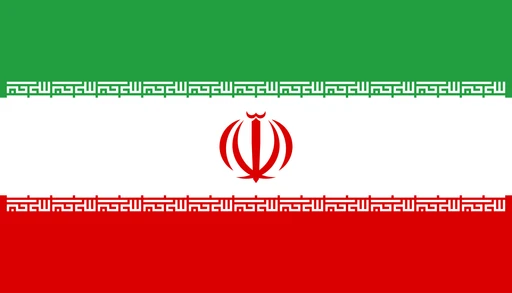
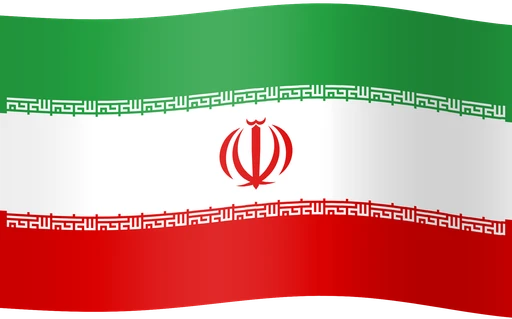
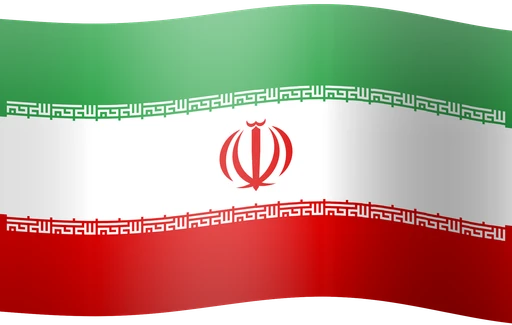
The flag of Iran has three horizontal bands of green, white, and red, with the national emblem at the centre of the white band and the takbir written 11 times along the bottom edge of the green band and the top edge of the red band, in white Kufic script. Green stands for growth, happiness, unity, nature, vitality, and the Persian language. White stands for freedom, peace, and cleanliness. Red stands for martyrdom, courage, love, and warmth. The emblem is said to represent the five principles of Islam.
Iran's flag is a tricolor that survived a revolution, was redrawn by calligraphy, and carries at its centre an emblem coded densely enough to work as a political manifesto in miniature. What looks at a glance like a straightforward green, white, and red banner turns out to be a flag whose every element was reengineered after the 1979 Islamic Revolution to erase a monarchy and set out a new idea of the state. Few national flags have been redesigned so deliberately and so completely within living memory.
How 1979 rewrote the flag
The horizontal tricolor of green, white, and red long predates the Islamic Republic. Versions of it flew under both the Qajar and Pahlavi dynasties, giving today's flag a quiet layer of continuity beneath its transformation. Under the Pahlavi shahs, the central emblem was the Lion and Sun, an ancient Persian symbol associated with royalty and with the Shia Imam Ali.
When the Islamic Revolution of 1979 overthrew Shah Mohammad Reza Pahlavi, one of its first symbolic acts was eliminating the Lion and Sun. The emblem had become inseparable from imperial rule and Western alignment, and the revolutionaries wanted no trace of it on the nation's banner. In its place came a new emblem and the Takbir inscription, both formally adopted in the constitution of the Islamic Republic in 1980. This was not a bureaucratic tweak. It was written into the founding document of the new state.
What makes the transition unusual is how total it was. Most post-revolutionary states modify their flags incrementally: a stripe changed here, an emblem swapped there. Iran's was overhauled with ideological precision, every detail reconsidered through the lens of revolutionary Islam. Yet the tricolor itself was kept. Partly this was practical, since the world already recognized the green, white, and red arrangement as Iranian. It was also a nod to pre-Islamic Persian colour traditions, an acknowledgment that the revolution claimed continuity with a civilization even as it broke with a regime.
The emblem at the centre
The central emblem, designed by Hamid Nadimi and adopted in 1980, is one of the most complex national emblems anywhere. At first glance it resembles a stylized tulip, or perhaps a sword. Both readings are intentional. The tulip is a traditional Persian symbol of martyrdom, a flower said to grow from the blood of the fallen. The sword evokes strength and jihad.
Look more carefully and the emblem reveals another layer: it abstractly renders the Arabic word "Allah" (God). Four crescents and a central vertical line, which doubles as a sword, together form the letters of the word. The overall shape also suggests a globe, standing for the universality of Islam and Iran's self-perception as a leading Islamic nation. The five components of the design, four crescents plus the central sword-spine, are said to represent the Five Pillars of Islam.
Nadimi reportedly spent considerable effort ensuring the emblem could be read simultaneously as calligraphy, as geometry, and as a figurative image. Most national emblems do one thing well. This one tries to do at least four at once, and largely succeeds. The deliberate ambiguity has drawn criticism too. Some see it as propagandistic obscurantism, an emblem designed to say so many things that its meaning becomes slippery. Others consider it a masterpiece of graphic design, and where people land on that question tends to track where they stand on the revolution.
The Takbir border and the politics of script
Iran's flag is unusual among world flags in using a repeated phrase of written text as a formal design element. The phrase "Allahu Akbar" (God is Greatest), known as the Takbir, runs in white along the edges where the stripes meet: 11 repetitions along the bottom edge of the green stripe, 11 along the top edge of the red stripe. Twenty-two in total.
The number isn't arbitrary. It commemorates the 22nd of Bahman in the Iranian calendar, which corresponds to February 11, 1979, the day the revolution triumphed. The flag counts out the date of its own birth.
The script is a stylized Kufic calligraphy, chosen for its look and for its roots in early Islamic visual tradition. Kufic is angular, geometric, almost architectural. It turns what could be simple text into something that reads as pattern from a distance and only resolves into words up close, which blurs the line between national symbol and sacred inscription.
There's a practical consequence too. Reproducing legible Kufic calligraphy at small scales is difficult, so official guidelines exist for simplified versions used on lapel pins, small printed flags, and digital contexts where the individual repetitions can't be rendered clearly.
Colours older than the republic
The tricolor arrangement dates to the Constitutional Revolution of 1906, when Iran adopted its first constitution and formalized the horizontal green-white-red design. The colours themselves carry meanings that predate any single political era.
Green, in both Persian and Islamic tradition, represents Islam, growth, and paradise. It's also associated with Sayyids, descendants of the Prophet Muhammad. White historically stands for peace, honesty, and purity of intent, a meaning that carries particular weight in Persian poetic tradition, where whiteness often signifies sincerity. Red speaks to bravery, martyrdom, and the blood of those who defend the nation. After the revolution, which elevated martyrdom to a central political and religious virtue, the red stripe's symbolism intensified.
The specific shades are constitutionally defined to ensure consistency across official uses. The same green-white-red combination appears in the flags of Italy and Mexico, though the symbolism and proportions differ entirely.
The Lion and Sun and what was lost
The Lion and Sun is one of the oldest continuously used emblems in Iranian history, appearing on coins, royal seals, and flags for over a millennium. Its origins are disputed. Some scholars trace it to astrological symbolism, the zodiac sign Leo paired with the Sun. Others connect it to Shia religious iconography, linking the lion to Imam Ali, the first Shia imam. Both interpretations have historical support, and the symbol likely absorbed multiple meanings as it passed through successive dynasties.
Under the Safavid dynasty (1501-1736) and especially the Qajar dynasty (1789-1925), the Lion and Sun became the definitive symbol of Iranian sovereignty. By the twentieth century it was as closely identified with Iran as the eagle is with the United States. So when the Islamic Republic removed it in 1979, many Iranians, particularly those who fled into exile, experienced the change as a cultural rupture rather than a design decision.
Today, Iranian monarchists and large parts of the diaspora continue to fly the Lion and Sun flag in opposition to the Islamic Republic. At any large Iranian diaspora gathering, the flag someone carries is itself a political statement, and there is no neutral option.
Some scholars have argued that the removal was counterproductive for the Islamic Republic itself. The Lion and Sun connected Iran to deep pre-Islamic Persian roots, roots the new republic otherwise sought to claim when convenient. By cutting that thread, the revolutionaries may have handed a powerful piece of cultural heritage to their opponents.
Official use and everyday presence
Article 18 of the Constitution of the Islamic Republic of Iran defines the flag's design, making it one of relatively few flags with direct constitutional specification. Official uses span government buildings, embassies, military and naval contexts, and state ceremonies, each with specific proportional and display guidelines.
The flag is flown at half-mast during national periods of mourning, particularly for the deaths of senior clerics or on commemorations of wartime martyrs. Naval ensigns and military variants exist, built on the same core design with minor adjustments. During the Iran-Iraq War of 1980 to 1988, the flag took on heightened significance as a rallying symbol, and images of it draped over the coffins of fallen soldiers became a fixture of Iranian visual culture through state media and public murals.
Iran maintains strict laws against desecration of the national flag, and its respectful use is treated as both a civic and a religious obligation. Walk through Tehran or any major Iranian city and you'll see the flag on public murals, in religious processions, and at political demonstrations. It is one of the most visually present national symbols in daily life anywhere.
References
[1] Constitution of the Islamic Republic of Iran (1980), Article 18. Official text available via the Islamic Parliament Research Center (rc.majlis.ir).
[2] Shahrokh Razmjou, "The Lion and Sun Emblem: A Study of an Ancient Persian Symbol," Iran: Journal of the British Institute of Persian Studies, Vol. 43 (2005).
[3] Whitney Smith, Flags Through the Ages and Across the World (McGraw-Hill, 1975). Foundational vexillology reference covering pre-revolutionary Iranian flags.
[4] Flags of the World (FOTW), Iran entry. fotw.info/flags/ir.html. Detailed vexillological database with historical variants.
[5] Pierre Centlivres & Micheline Centlivres-Demont, "The Afghan, Iranian and Other Muslim Flags in the Light of the Arab Spring," Iran and the Caucasus (Brill, 2012).
[6] Homa Katouzian, The Persians: Ancient, Mediaeval and Modern Iran (Yale University Press, 2009). Historical context for national symbolism.
[7] Hamid Dabashi, Iran: A People Interrupted (The New Press, 2007). Cultural and political analysis of post-revolutionary Iranian identity symbols.
[8] The Flag Institute (flaginstitute.org). UK-based vexillology organization with peer-reviewed flag histories.
Common questions
- What does the symbol in the center of the Iranian flag represent?
- The symbol at the centre of the Iranian flag renders the word "Allah" in stylized Arabic script. It stands for divine unity and for the founding ideals of the Islamic Republic.
- Why is "Allahu Akbar" written on the Iranian flag?
- "Allahu Akbar," meaning "God is Great," appears 22 times on the Iranian flag. The number marks the date of the 1979 revolution, the 22nd of Bahman in the Iranian calendar.
- Why was the Lion and Sun removed from the Iranian flag?
- After the 1979 revolution the Lion and Sun emblem was taken off the flag. It was a royal symbol, and the new state replaced it with one drawn from Islamic tradition.
- Why was the Lion and Sun emblem removed from Iran's flag?
- After the 1979 Islamic Revolution, the new government dropped the Lion and Sun emblem because it represented the old Pahlavi monarchy and its ties to the West. The revolutionaries replaced it with Islamic symbols instead. Even today, some Iranian exiles and monarchists still use the old flag with the Lion and Sun as a statement against the Islamic Republic.
- What do the colors on Iran's flag mean?
- Green means Islam, growth, and paradise. White represents peace and purity. Red is for bravery and sacrifice, especially martyrdom. After the revolution, that meaning of red became even more important to the country's identity. The three-colour design goes back to 1906 and Iran's Constitutional Revolution, so it's older than both the Pahlavi dynasty and the current Islamic Republic.
Featured in these articles
- The Flag Designed to Mean Nothing: How the Red Crystal Solved the Red Cross's Israel Problem
- The Sword on the Flag: How Arabia's Most Loaded Symbol Became a Statement of Holy Authority
- Guilty by Association: How Libya, Saudi Arabia, and Algeria Put Sacred Text on Their Flags, and Why Almost No One Else Dared
- Green Flags and the Prophet's Color: How Islam Shaped the Palettes of Saudi Arabia, Mauritania, and Beyond
Download this flag
Free in 12 styles, from 32px icons up to 2000px, as SVG, PNG, WebP and JPG.