In August 1962, as the Union Jack came down for the last time over Kingston, Jamaica became the first Caribbean nation to gain independence from Britain in the postwar era. Across Africa and Asia, newly sovereign states were hoisting flags that looked remarkably alike: horizontal tricolors in green, red, and black, studded with stars and crescents, each one a visual pledge of allegiance to Pan-African or Pan-Arab solidarity. Jamaica did something no one expected.
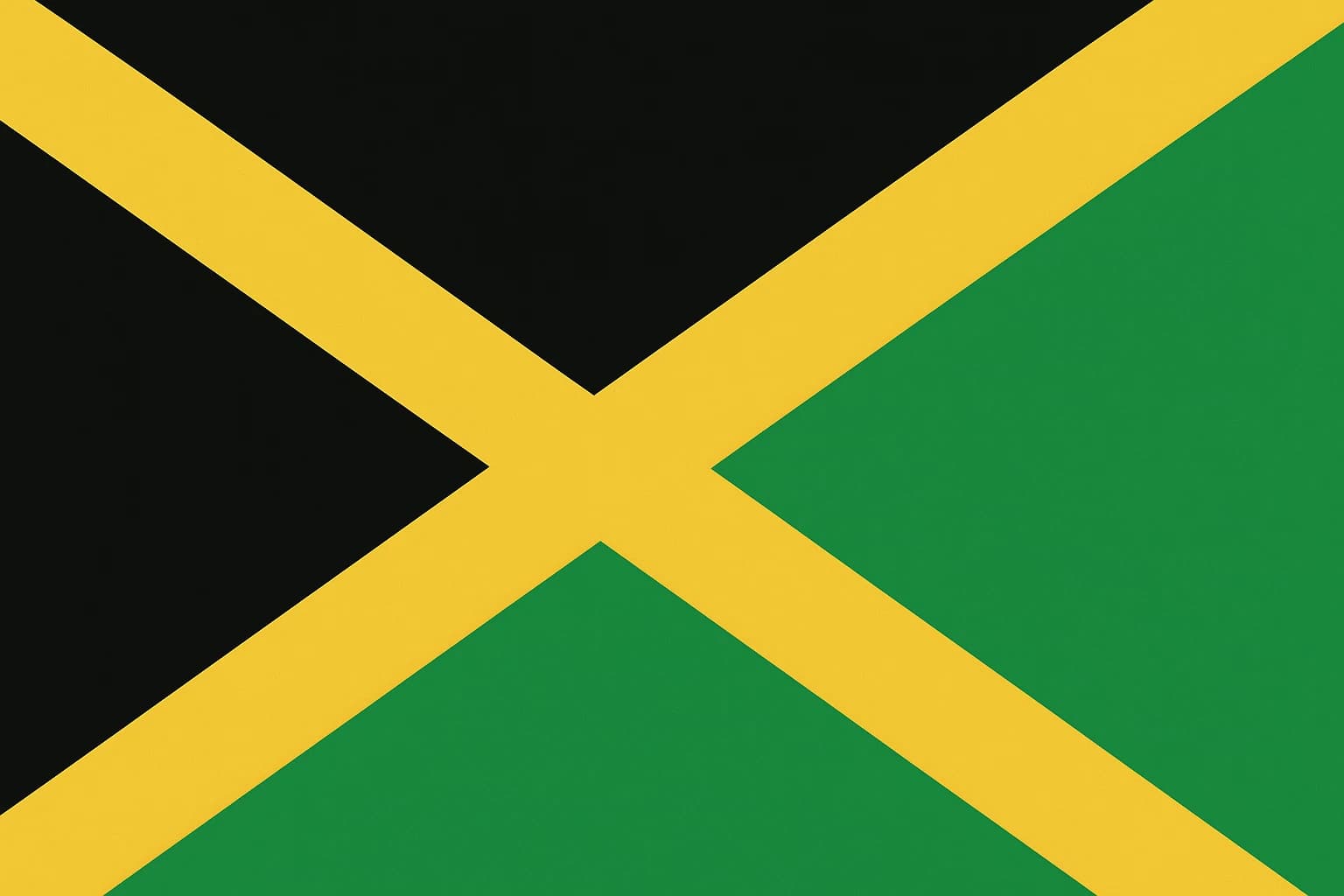
Its new flag featured a gold diagonal cross, a saltire, splitting fields of green and black. No red. No star. No coat of arms. No stripes. The design had no obvious precedent in any decolonization movement and one unmistakable precedent in European heraldry: Scotland's St. Andrew's Cross.
How did a Caribbean island, forged in the brutality of the Atlantic slave trade, end up flying a flag that looked like it belonged on a medieval Scottish battlefield? The answer involves a bipartisan committee, a rejected design that would have made Jamaica look like every other new nation, and one of the more improbable branding accidents of the twentieth century.
The year of flags: what independence looked like in 1962
Between 1960 and 1964, over 25 nations gained independence. Nearly all adopted flags rooted in Pan-African (green, gold, red, black) or Pan-Arab (green, white, black, red) color palettes. Algeria, Uganda, Rwanda, Trinidad and Tobago: the list goes on. The horizontal tricolor had become visual shorthand for sovereignty.
Ghana's 1957 red-gold-green tricolor, modeled on Ethiopia's, set the template. Mali, Guinea, and Cameroon followed. New nations signaled legitimacy by echoing each other's designs, and that was strategy rather than laziness.
Adopting Pan-African colors was a statement of racial solidarity, a rejection of colonial aesthetics, and a bid for membership in the Non-Aligned Movement and the Organization of African Unity. A flag that didn't fit the template risked looking politically ambiguous, or worse, politically suspect.
Jamaica occupied an unusual position. It was a majority-Black Caribbean nation with deep African roots, but also with significant Indian, Chinese, European, and mixed-heritage populations. It belonged to the Commonwealth Caribbean, not the African independence movement. It had just been extracted from the failed West Indies Federation, which dissolved in 1962 and had its own now-obsolete flag. Jamaica needed a symbol that spoke to all of its people without pledging loyalty to someone else's movement, which is a difficult brief for any designer.
The committee, the rejected designs, and the fight over stripes
Jamaica's House of Representatives appointed a bipartisan committee to design the flag in early 1962. Members came from both the Jamaica Labour Party and the People's National Party, two parties that agreed on almost nothing else. That they had to collaborate on a single visual symbol is, in retrospect, remarkable.
Their first approved design was a horizontal tricolor of gold, green, and black. It was clean and dignified, and it also looked like the flag of Tanganyika, now Tanzania, which had gained independence in 1961.
When someone pointed this out, the committee went back to the drawing board. That near-miss is the part of the story nobody tells. Had nobody noticed the resemblance, Jamaica would today fly a flag indistinguishable from a dozen others. Instead the awkward coincidence forced a creative breakthrough.
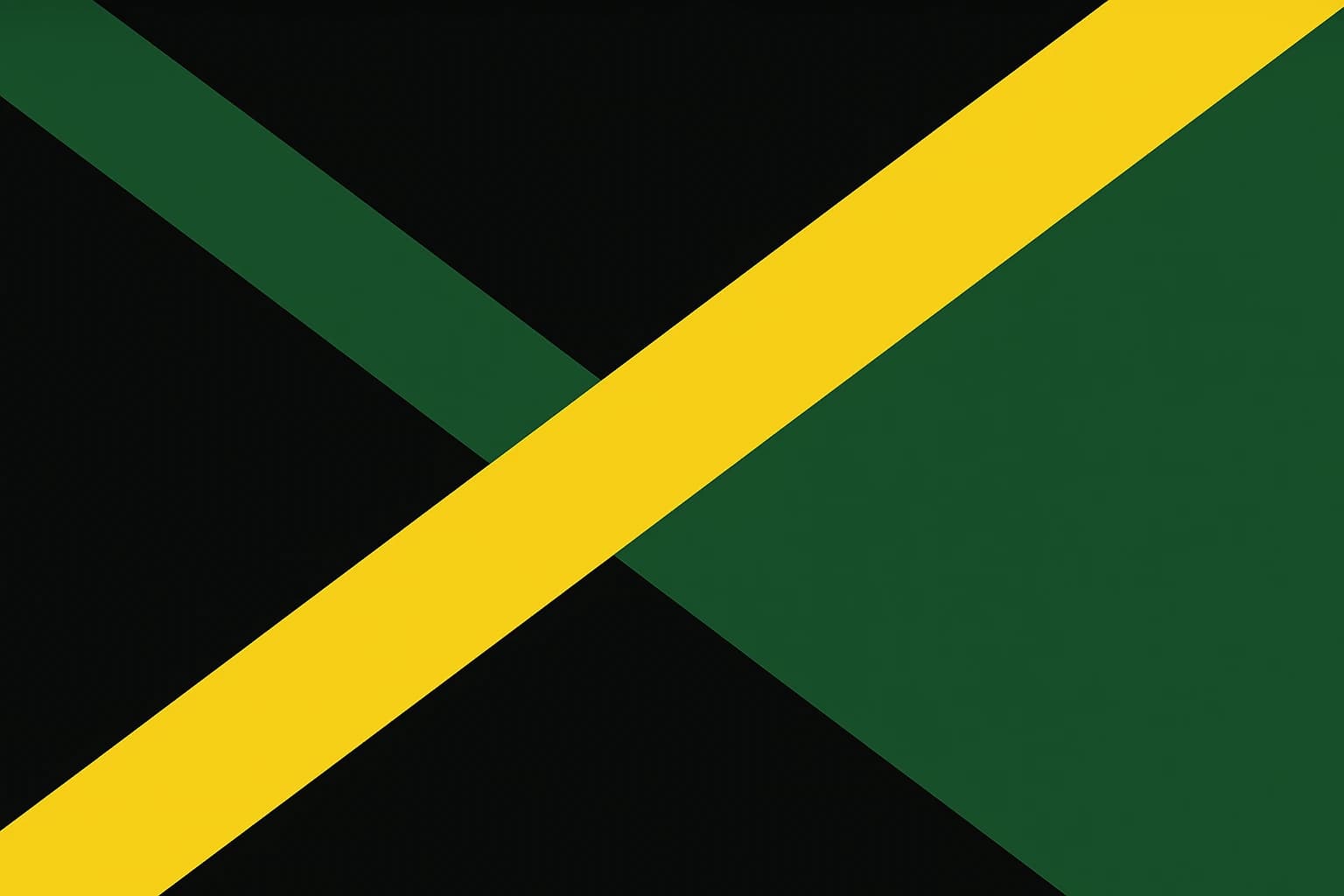
The gold-green-black palette was retained because the symbolism worked: gold for sunlight and natural wealth, green for lush vegetation, black for the hardships overcome and yet to be faced. But the committee needed a layout that was unmistakably its own. Someone proposed the saltire, a diagonal cross dividing the flag into four triangles. It preserved the colors while creating a silhouette unlike any other national flag in the world.
The national motto, "Out of Many, One People," informed the desire for a unifying geometric form rather than a partisan symbol. The X-shape pulls four separate fields into a single integrated composition, letting the geometry do the political work.
The decision to exclude red was deliberate and contentious. Red appeared on nearly every other flag in the region. It was associated with bloodshed and political violence, and both parties wanted to move past that. Jamaica's flag remains one of very few national flags worldwide that contains no red, white, or blue.
The saltire problem: why a European heraldic form?
The saltire has deep roots in European heraldry. Scotland's flag, the St. Andrew's Cross, dates to at least the 12th century.
The Confederate battle flag uses the same X-shape. So does the flag of Burgundy. So does Russia's naval ensign. For a post-colonial nation, borrowing this form seems counterintuitive.
But the saltire also appears in non-European contexts. The Tuareg people use it. Various West African Adinkra and Nsibidi symbols feature X-shaped forms. Taino and Maroon visual culture in Jamaica itself contains diagonal cross motifs. The committee did not explicitly cite these precedents, but the form was not as alien to Caribbean visual culture as it first appears.
There is a practical dimension too. The saltire is one of the most legible flag forms at a distance. Horizontal stripes blur together when a flag hangs limp, and from far away they all look the same. A diagonal cross stays identifiable even in dead calm, which is a real advantage in a tropical climate where wind is unpredictable. Vexillologists have noted this for decades.
Jamaica's choice also carries an implicit argument about post-colonial design: that independence means the freedom to draw from any visual tradition rather than the obligation to conform to a counter-colonial template. The flag refuses to be read as belonging to any bloc, and the refusal is itself a political statement.
Two flags, two philosophies, one independence year
Trinidad and Tobago gained independence just weeks after Jamaica, on August 31, 1962. Its flag, a red field with a diagonal black stripe edged in white, was designed by the artist Carlisle Chang.
The contrast is instructive. Trinidad's flag uses a diagonal element but embeds it in a red field that connects it visually to the broader Caribbean and Pan-African tradition. Jamaica's flag omits red entirely and makes the diagonal the entire structural principle. Same region, same year, opposite design philosophies.
Both flags are well-designed and recognizable, and they have had wildly different afterlives. Jamaica's has become a global pop-culture icon. Trinidad's, while beloved domestically, has far less international visibility.
A few factors explain the gap. Jamaica's color combination is unique: no other country uses gold-green-black without red. The X-shape has graphic simplicity that works at any scale. And Jamaican music, reggae, dancehall, ska, and sporting culture, Usain Bolt and the bobsled team, have carried the flag's image around the world in ways that Trinidad's calypso and cricket traditions, for all their richness, have not matched in raw global reach.
From national symbol to global brand
By the 1970s, Bob Marley and the global reggae explosion had turned Jamaica's flag into a countercultural emblem. The gold, green, and black palette became synonymous with Rastafari, even though the Rastafari colors are technically red, gold, and green, borrowed from Ethiopia's flag.
The conflation amplified the flag's reach and created a misreading that persists to this day. Walk into any souvenir shop in Berlin or Tokyo and you'll find Jamaica's flag colors on items marketed as "Rasta" merchandise. The national symbol and the religious movement got tangled up in the global imagination and have never been fully separated.
In the 1990s and 2000s the flag crossed into mainstream fashion and commercial design. Puma's collaborations with Usain Bolt. The 1993 film Cool Runnings, which told the story of the Jamaican bobsled team. The explosion of Caribbean-themed streetwear. All used the flag as a central graphic element.
A 2016 study by the Flag Institute noted Jamaica's flag among the top five most recognized national flags globally, alongside the United States, the United Kingdom, Japan, and Canada. That is an extraordinary distinction for a nation of under three million people.
The flag's commercial ubiquity has raised questions about intellectual property and national dignity. Jamaica has no equivalent of the U.S. Flag Code, and its colors and design appear freely on everything from bikinis to rolling papers. Some Jamaicans celebrate this as cultural influence. Others view it as commodification. The tension is real and unresolved.
The design's simplicity is key to its reproducibility. The saltire and three-color palette render in any medium: beadwork, face paint, nail art, tattoos. Most tricolor flags lose their identity when translated to a circular sticker or a fingernail. Jamaica's doesn't, and that has enormous commercial consequences.
What Jamaica's flag taught the world about post-colonial design
Jamaica's flag challenged the assumption that decolonization required visual conformity. Its success showed that a new nation could forge an original symbol without referencing any existing flag tradition, whether Pan-African, Pan-Arab, or European.
Later flags echoed that willingness. South Africa's 1994 flag, designed by Fred Brownell, uses a Y-shape and six colors that defy every tricolor convention.
Mozambique's flag, featuring an AK-47, rejected conventions in a different direction entirely.
Neither replicated Jamaica's specific form, but both share its refusal to conform.
In vexillological analysis, Jamaica's flag is frequently cited as a near-perfect design. It follows the five principles of good flag design laid out by the North American Vexillological Association: simplicity, meaningful symbolism, limited colors, no lettering or seals, and distinctiveness. Very few national flags score well on all five. Jamaica's does.
Because it tied itself to no specific political movement, ideology, or leader, Jamaica's flag has survived changes in government, economic crises, and cultural shifts without ever being challenged or redesigned. Compare that to the flags of Libya, Myanmar, and Malawi, all of which have been altered or replaced as political winds shifted.
In 1962, a bipartisan committee in Kingston faced a deceptively simple question: what should a free Jamaica look like? Their answer, a gold X on green and black with no star, no stripe, no coat of arms, and no allegiance to any existing flag tradition, was unusual enough that it risked being dismissed as an anomaly. More than six decades later, it is one of the most recognized pieces of graphic design in the world, and it still belongs to no tradition except its own.