The Flag of Canada
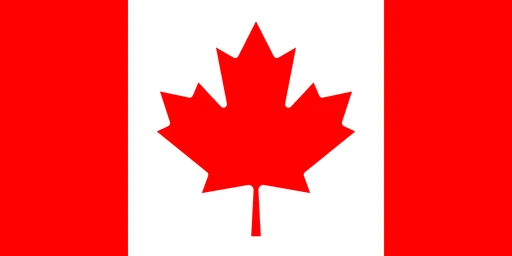
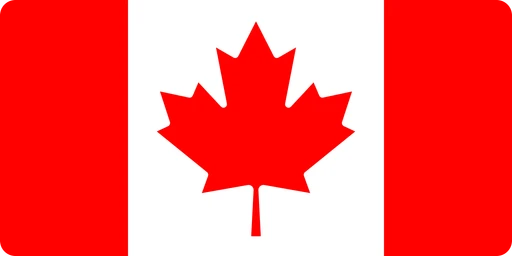
The flag of Canada, also known as the Maple Leaf, is a red field with a white square at its center holding a stylized 11-pointed red maple leaf. The proportions are 1:2. Red and white are Canada's official colors.
Canada waited nearly a century after confederation to adopt a flag of its own, then produced one of the most recognizable in the world. The National Flag of Canada, known as the Maple Leaf or l'Unifolié ("the one-leafed"), was adopted on February 15, 1965, after one of the most bitter parliamentary debates in Canadian history, a fight between national identity and colonial loyalty that ran along generational lines and nearly finished a prime minister. What came out of it was severe in its simplicity: no empire, no monarch, no heraldry, just two colors and a leaf.
The Great Flag Debate
For decades, Canada flew the British Red Ensign, modified with the Canadian coat of arms, as its de facto national flag. English Canadians largely embraced it as a badge of imperial loyalty. French Canadians, Indigenous peoples, and waves of newer immigrants felt no such attachment. By the early 1960s, the flag had become a fault line in the country's identity.
Prime Minister Lester B. Pearson decided to close that fault line. A Nobel Peace Prize laureate and a veteran who had himself served under the Red Ensign, Pearson made replacing it a personal mission. In May 1964, he presented his proposal to a Canadian Legion audience in Winnipeg. They booed him. Pearson pressed on anyway.
What followed was the Great Flag Debate: 33 sitting days of parliamentary argument stretched over six months. Opposition leader John Diefenbaker fought with everything he had to keep the Red Ensign, casting the change as a betrayal of every soldier who'd died under the old flag. The rhetoric was fierce, personal, and sometimes ugly.
Pearson's own preferred design didn't help matters. His "Pearson Pennant" featured three red maple leaves sandwiched between two blue borders. It was widely mocked and never gained real support. To break the deadlock, a 15-member all-party parliamentary committee was struck. They sifted through over 3,000 designs submitted by ordinary Canadians, everything from beavers to fleurs-de-lis to wild abstract geometries.
The winning concept came from historian George Stanley, who drew inspiration from the flag of the Royal Military College of Canada. His single maple leaf on a white square flanked by red bars was selected by the committee in a dramatic final vote. Queen Elizabeth II proclaimed the new flag, and it was first raised on Parliament Hill at noon on February 15, 1965. Thousands stood in freezing temperatures to watch. Pearson reportedly said, "May the land over which this new flag flies remain united in freedom and justice." Diefenbaker wept.
The geometry of the leaf
The proportions are 1:2, which makes the flag longer than most. A central white square, called a "Canadian pale," takes up exactly half the width, with two red bands of a quarter each on either side. That is the whole composition.
The 11-pointed maple leaf is not a botanical reproduction. The point count came out of wind-tunnel testing: Jacques Saint-Cyr at the National Research Council found that fewer points reduced blurring and "bleeding" when the flag flew in strong winds.
Red and white had been Canada's official national colors since 1921, when King George V declared them so. The red goes back to the cross of St. George for England, the white to the French royal emblem. The specified red is close to Pantone 032, bright and slightly warm, with minor revisions to the specification over the years.
The reduction is what vexillologists like about it. Bilateral symmetry, two colors, one symbol. It reads at a distance, holds up at thumbnail size, and carries nothing from the colonial past.
The maple leaf before the flag
The maple leaf didn't arrive with the 1965 flag. It had been linked to Canada since at least the 1700s, when French Canadians along the St. Lawrence adopted it as an emblem. By 1876, it appeared on Canadian coins. Alexander Muir's 1867 song "The Maple Leaf Forever" functioned as an unofficial English-Canadian anthem for decades, drilling the symbol into the national consciousness.
Canadian athletes wore it at the 1904 Olympics. Soldiers in both World Wars painted it on helmets and equipment. It's carved into the memorial at Vimy Ridge.
The choice to use a single stylized leaf rather than a realistic sugar maple leaf was deliberate. The abstracted form belongs to no single species, which means it represents all of Canada's maple-growing regions equally. By 1964, the maple leaf was arguably already the country's most universal symbol. The flag simply formalized what popular culture had long established.
Protocol and etiquette
The National Flag of Canada takes precedence over all other flags on Canadian territory. Detailed rules govern its display alongside provincial, territorial, and foreign flags, all administered through Canadian Heritage.
February 15 is celebrated as National Flag of Canada Day, established in 1996 by Governor General Roméo LeBlanc. The flag flies at half-mast on the death of the sovereign, the governor general, or a prime minister, and on Remembrance Day. Half-masting has occasionally sparked controversy. The extended lowering during the 2021 revelations about residential schools prompted public debate about when, and for whom, a nation mourns.
Unlike the United States, Canada has no law against flag desecration. Flag use and misuse are considered matters of free expression, though official guidelines discourage disrespectful treatment. The flag flies permanently on the Peace Tower of Parliament, and since 1966 it's been required at every federal government building. It's also, of course, a ubiquitous feature on Canadian travelers' backpacks abroad, a phenomenon so widespread it's generated its own body of cultural commentary and more than a few jokes.
The flag's cultural afterlife
For all the bitterness around its adoption, the flag reached near-universal acceptance within a single generation. Polls consistently rank it among the most recognized and best-liked national flags in the world.
That backpack maple leaf patch became a cliché of the late 20th century: Canadians abroad, quietly distinguishing themselves from Americans. The graphic design has spread through Canadian visual culture too, into corporate logos such as Air Canada's stylized leaf and sports branding like Hockey Canada and the Toronto Maple Leafs' updated imagery.
During Canada's 150th anniversary celebrations in 2017, the flag was central to national branding and public art installations across the country. Then, in 2022, the Freedom Convoy protests in Ottawa placed it in an entirely different context. Protesters draped themselves in the Maple Leaf, prompting uncomfortable public discourse about who "owns" a national symbol and whether its meaning can be contested or co-opted.
Flag design guides routinely use the Canadian flag as the standard other flags are measured against, on the grounds that it is simple and legible at any size.
Flags that almost were
Pearson's three-leaf, blue-bordered "Pearson Pennant" remains the most famous rejected design. It's occasionally displayed as a historical curiosity, a reminder of how close Canada came to a very different flag.
Among the 3,000-plus citizen submissions were designs featuring beavers, northern lights, Indigenous symbols, wheat sheaves, and ambitious attempts to combine the Union Jack with the fleur-de-lis. Some were earnest. Some were bizarre.
The Red Ensign did not disappear quietly. Provinces and nostalgic citizens went on flying it for years, and Manitoba and Ontario worked its elements into their provincial flags, a quiet and permanent protest. It still appears at veterans' memorials and cenotaphs as a historical flag for those who served under it.
Official variants of the maple leaf exist across Canadian institutions. The Canadian Armed Forces ensign, the RCMP flag, and the Royal Canadian Navy's naval jack each use the leaf in a different configuration.
References
[1] Government of Canada, "The National Flag of Canada," Canadian Heritage official website. canada.ca
[2] Stanley, George F.G., The Story of Canada's Flag: A Historical Sketch. Ryerson Press, 1965.
[3] Champion, C.P., The Strange Demise of British Canada: The Liberals and Canadian Nationalism, 1964-1968. McGill-Queen's University Press, 2010.
[4] Archbold, Rick, I Stand for Canada: The Story of the Maple Leaf Flag. Macfarlane Walter & Ross, 2002.
[5] Fraser, Alistair B., "A Canadian Flag for Canada," The Journal of the Flagstaff Institute, 1998.
[6] Smith, Whitney, Flags Through the Ages and Across the World. McGraw-Hill, 1975.
[7] Library and Archives Canada, "The Canadian Flag Debate, 1964." Digitized parliamentary records and submitted designs.
[8] North American Vexillological Association (NAVA), flag survey results and design analysis publications.
Common questions
- Why is there a maple leaf on the Canadian flag?
- The maple leaf had stood for Canada's landscape and natural resources since the 1700s, long before the 1965 flag put it at the center of the design.
- What do the colors on the Canadian flag mean?
- Red and white are Canada's national colors, chosen by King George V in 1921. Red stands for bravery and strength, white for peace and honesty.
- Why does the maple leaf on Canada's flag have 11 points?
- It's not symbolic at all. Researcher Jacques Saint-Cyr used wind-tunnel testing and found that fewer points reduced blurring and "bleeding" when the flag flew in strong winds. The stylized leaf was designed to look sharp and clear from a distance, not to be botanically accurate.
- Why did it take Canada so long to get its own flag?
- After confederation in 1867, Canada used the British Red Ensign for nearly a century. English Canadians felt loyal to it, but French Canadians and newer immigrants didn't. In 1964, PM Lester Pearson pushed for a distinctly Canadian flag, which kicked off the "Great Flag Debate," six months of bitter parliamentary argument. The maple leaf flag was finally adopted on February 15, 1965.
- What do the colors on the Canadian flag represent?
- Red and white have been Canada's official national colors since 1921, when King George V declared them. The red traces back to England's cross of St. George, and the white comes from the French royal emblem. Together they reflect Canada's two founding colonial nations. If you're curious, the specific red is close to Pantone 032.
- Who designed the Canadian flag?
- Historian George Stanley came up with the core concept, inspired by the Royal Military College of Canada's flag. A 15-member all-party parliamentary committee picked his single maple leaf on white, flanked by red bars, out of over 3,000 submissions. Fun fact: PM Pearson's own preferred design, the "Pearson Pennant" with three leaves and blue borders, was widely mocked and rejected.
- What was on Canada's flag before the maple leaf?
- Canada flew the Canadian Red Ensign, a red flag with the British Union Jack in the upper left corner and the Canadian coat of arms. It was the de facto national flag from the late 1800s until 1965. Some provinces, like Ontario and Manitoba, later worked Red Ensign elements into their own provincial flags.
Featured in these articles
- New Zealand Spent $26 Million Voting on a New Flag. Then Chose the Old One.
- Four Colors, One Island: How Mauritius Built the World's Most Mathematically Honest Flag
- The Map That Became a Flag: Why Kosovo and Cyprus Broke Vexillology's Most Sacred Rule
- The Coat of Arms Nobody Can Draw: Why Some National Flags Are Legally Perfect and Practically Impossible
Download this flag
Free in 12 styles, from 32px icons up to 2000px, as SVG, PNG, WebP and JPG.