The Flag of Algeria
People's Democratic Republic of Algeria
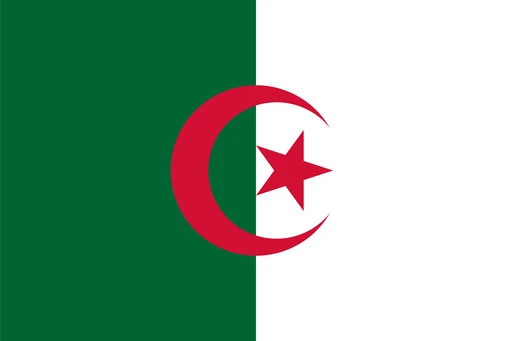
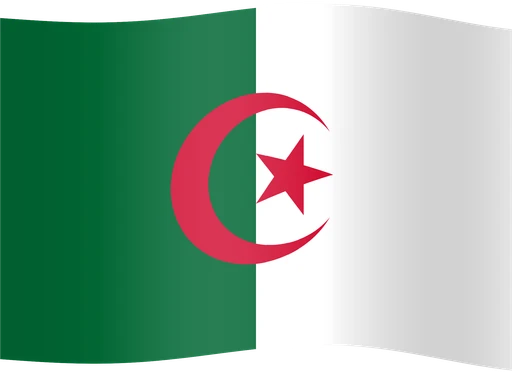
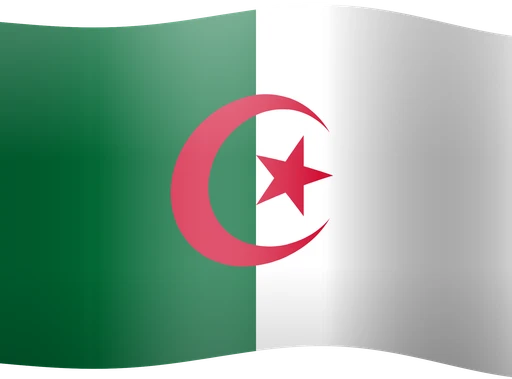
The national flag of Algeria consists of two equal vertical halves, green on the hoist side and white on the fly side, separated by a red, five-pointed star centered within a red crescent. The green represents Islam, the white symbolizes purity and peace, the red crescent and star are traditional symbols of Islam, which is the nation's predominant religion.
Algeria's national flag, two equal vertical bands of green and white charged with a red crescent and star at the center, is one of the most recognizable symbols of anti-colonial struggle in the modern world. Unlike many post-independence flags, which were designed by committee or borrowed from colonial-era imagery, Algeria's flag came out of one of the 20th century's longest and bloodiest wars of liberation. Its origins run back further than independence itself, into the resistance movements of the 19th century, and its symbolism speaks to Islam, the sacrifices of revolution, and a hard-won sovereignty. It was officially adopted on July 3, 1962, two days before Algeria declared independence from France, and it has not changed since.
Born in resistance: the flag's revolutionary origins
The story starts more than a century before independence, in the 1830s, when Emir Abdelkader rallied Algerian tribes against the French invasion. Abdelkader's banners used green and white with Islamic calligraphy and symbols, setting up a visual vocabulary that would echo through generations of Algerian resistance. He lost his war, but the colors survived him.
In the 1920s and 1930s, Messali Hadj, an Algerian labor organizer in Paris, founded the Étoile Nord-Africaine (North African Star), one of the first movements to explicitly demand Algerian independence. Under his leadership the movement adopted a green-and-white flag with a red crescent and star that looks almost identical to today's national flag. It was Messali Hadj's wife, Émilie Busquant, a French-born woman from Lorraine, who is widely credited with sewing the first version of that flag in 1934: a French woman stitching together the banner that would come to represent everything anti-French colonialism stood for.
The flag's meaning deepened in blood on May 8, 1945. In the towns of Sétif and Guelma, Algerians took to the streets to celebrate the Allied victory in Europe and to press their own demands for freedom. Demonstrators carried the green-and-white flag. French police opened fire on them. The massacres that followed killed thousands, with estimates ranging from 6,000 to 45,000 Algerians, and turned the flag into a martyr's banner. What had been a political symbol became something closer to sacred.
When the Front de Libération Nationale (FLN) launched the armed struggle on November 1, 1954, the flag went with them. Guerrilla fighters carried it in the mountains of Kabylia and the Aurès. Diplomats displayed it at the United Nations and in the halls of Bandung. It appeared on FLN publications, armbands, and coffins. By the time the Algerian Constituent Assembly formally adopted it on July 3, 1962, and raised it as a sovereign flag on July 5, the design needed no introduction. It had already been consecrated by nearly 130 years of resistance.
Green, white, and red: design specifications and layered symbolism
The layout is deceptively simple. Two equal vertical bands, green at the hoist side, white at the fly, split the flag down the middle. A red crescent and five-pointed star sit centered on the boundary between the two halves. The proportions are fixed at a 2:3 ratio, and the Algerian government specifies exact color values: a deep green (close to Pantone 348) and a blood red for the crescent and star (close to Pantone 186).
The green carries at least three associations at once. It is the traditional color of Islam, linked to the Prophet Muhammad. It evokes the fertile Tell region of northern Algeria, the agricultural heartland between the coast and the Saharan Atlas. And it signals hope for the future, layered onto religious and geographic identity.
The white band connects to purity and peace, with a subtler resonance underneath. Algeria's Arabic name, al-Jazāʾir al-Bayḍāʾ, is sometimes translated as "the white islands" or associated with "the white city," a reference to the whitewashed buildings of Algiers above the Mediterranean. The white is architectural as much as abstract.
The crescent and star are pan-Islamic symbols, but in Algeria the red is inseparable from the blood of martyrs. Look closely and the crescent's horns are longer and more slender than those on the Turkish or Tunisian flags, a deliberate distinction that marks the flag as specifically Algerian rather than a generic borrowing from Ottoman heraldry. Article 6 of the 1963 Algerian Constitution, and every constitution since, enshrines the design, making it a matter of constitutional law rather than executive decree.
The Ottoman shadow and the Maghreb family: influences and similar flags
Algeria was part of the Ottoman Empire from the 16th century until the French conquest in 1830, and that's how the crescent-and-star motif entered North African visual culture in the first place. But each nation that inherited it made the symbol its own. Tunisia's flag places a red crescent and star inside a white circle on a red field, a design that predates Algeria's by nearly a century. Turkey's white crescent and star on red dates to the Ottoman military standards. Algeria's version, red on a green-and-white bicolor, is visually distinct from both.
There is a whole family of related flags across the Maghreb and the Arab world. Morocco uses a green pentagram on red. Mauritania recently added red stripes to its green-and-gold crescent design. Libya returned to a tricolor with a crescent and star after the 2011 revolution. Algeria's vertical bicolor format, though, remains unusual in the region, where horizontal bands dominate.
The influence hasn't only flowed inward. During the wave of decolonization that swept sub-Saharan Africa in the 1960s and 1970s, Algeria's flag and its revolution became reference points for liberation movements from Guinea-Bissau to Mozambique. The green-and-white palette, paired with the crescent and star, carried a specific message: sovereignty is something you fight for and win.
Protocol, usage, and the flag in Algerian life
Official protocol is strict. The flag flies at every government building, military installation, and embassy. Specific rules govern its display during national holidays, particularly Revolution Day on November 1 and Independence Day on July 5, when the entire country seems to turn green and white. Algerian law criminalizes desecration of the national flag, with penalties that can include imprisonment. Given the flag's association with an estimated 1.5 million people who died during the war of independence, the severity of these protections makes emotional sense, whatever one thinks of the legal principle.
In daily life, the flag is most visible at football matches. During Africa Cup of Nations tournaments and World Cup qualifiers, Algerian fans transform stadiums into seas of green and white. The 2019 AFCON victory in Egypt saw the flag draped over every conceivable surface, from cars in Algiers to apartment balconies in Marseille's Algerian diaspora neighborhoods.
Official variants exist too. The presidential standard incorporates the national flag's elements, and the naval ensign adapts the design for maritime use. Air Algérie's livery, the logos of national sports federations, and government ministry branding all draw on the flag's color palette. In Algiers, the Maqam Echahid, the Martyrs' Memorial, towers over the city: a concrete monument shaped like three palm fronds that renders the flag's revolutionary symbolism in three dimensions.
A flag that cannot be changed: constitutional permanence and national identity
Algeria's 2020 amended constitution contains a clause you won't find in many other countries. Article 8 states explicitly that the national flag and anthem "are gains of the November 1, 1954 Revolution and are not subject to any revision." The flag is constitutionally unamendable, outside the reach of any future parliament or president.
That permanence reflects the weight Algerians place on the flag's connection to the war of independence, and on the roughly 1.5 million people who died in it.
During the Hirak protest movement of 2019 and 2020, when millions of Algerians took to the streets demanding political change, the national flag became the movement's primary visual symbol. Protesters carried it everywhere, pointedly reclaiming it from the ruling establishment. The same banner that was carried through the streets of Sétif in 1945, stitched together by a French seamstress in 1934, and raised over guerrilla camps in the Aurès mountains was now waving above a new generation demanding the revolution's unfinished promises.
References
[1] Constitution of the People's Democratic Republic of Algeria (2020 amended text), Articles 6 and 8. Official government source for flag specifications and constitutional status.
[2] Smith, Whitney. Flags Through the Ages and Across the World. McGraw-Hill, 1975. Comprehensive vexillological reference with detailed entries on North African flags.
[3] Stora, Benjamin. Algeria, 1830-2000: A Short History. Cornell University Press, 2001. Authoritative historical context for the flag's revolutionary origins and the broader arc of Algerian nationalism.
[4] Horne, Alistair. A Savage War of Peace: Algeria 1954-1962. NYRB Classics, 2006. Detailed account of the independence war, including the flag's role as a rallying symbol for the FLN.
[5] Connelly, Matthew. A Diplomatic Revolution: Algeria's Fight for Independence and the Origins of the Post-Cold War Era. Oxford University Press, 2002. Covers the flag's role in international diplomacy during the independence struggle.
[6] FOTW (Flags of the World) database entry on Algeria. https://www.crwflags.com/fotw/flags/dz.html. Widely referenced online vexillological resource with technical details and historical notes.
[7] Flag Bulletin (journal of the Flag Research Center), various issues. Covers Algerian flag specifications and comparisons with other Maghreb flags.
Common questions
- What do the colors on the Algerian flag mean?
- Green stands for Islam, the fertile farmland of northern Algeria, and hope. White represents purity and peace, and it's also a nod to Algeria's Arabic name (al-Jazāʾir al-Bayḍāʾ, meaning "the white"), a reference to the whitewashed buildings of Algiers. The red crescent and star are Islamic symbols. The red itself honors the blood of martyrs who died fighting for independence.
- Why does Algeria's flag look so similar to Turkey's and Tunisia's?
- All three use the crescent and star, a motif that spread across the region during centuries of Ottoman rule. But each country made it their own. Algeria's crescent has longer, more slender horns than Turkey's or Tunisia's, and it sits in red on a green-and-white vertical bicolor. That's a deliberately unique layout that separates it from other Ottoman-influenced designs.
Featured in these articles
- Guilty by Association: How Libya, Saudi Arabia, and Algeria Put Sacred Text on Their Flags, and Why Almost No One Else Dared
- The Saltire That Crossed the Atlantic: How Jamaica's X-Shaped Flag Broke Every Rule of Post-Colonial Design
- The Crescent Faces Left, the Crescent Faces Right: Why Orientation Matters More Than You Think
- Guns, Machetes, and Spears: The Flags That Refused to Hide Their Violent Origins
Download this flag
Free in 12 styles, from 32px icons up to 2000px, as SVG, PNG, WebP and JPG.