The Flag of Trinidad and Tobago
Republic of Trinidad and Tobago
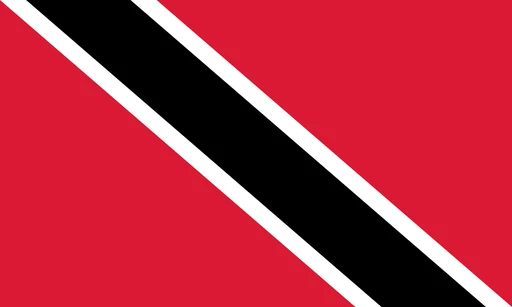
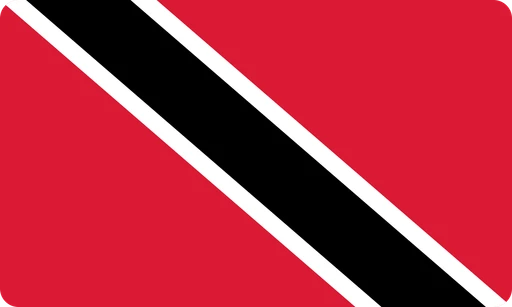
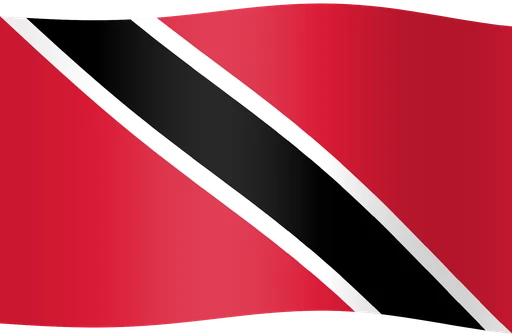
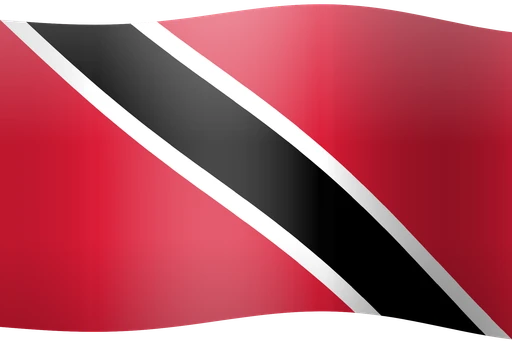
The flag of Trinidad and Tobago is a red field crossed by a white-edged black diagonal band running from the upper hoist to the lower fly. Red is for the sun, the land, and the warmth of the people, black for the wealth of the land and the dedication of those who work it, and the white bands for the sea between the two islands.
Trinidad and Tobago adopted its flag on August 31, 1962, the day it became independent from the United Kingdom.
Chosen for independence
Before 1962 the islands flew a British colonial flag, a Union Jack with a local badge. Independence required something else. A national competition was held, an Independence Committee took charge of the selection, and the winning design came from the artist Carlisle Chang. The choice was part of the wider work of settling what the new country would look like to itself and to everyone else.
Red, black, and white
The flag is a red field with a black diagonal band edged in white. Red carries the most in the design: the island sun, the energy of the people, and the struggle for freedom. The black band stands for strength and unity, and for the resources of the land. The white edging represents the sea around the islands and the purity of the country's aims.
Where it is flown
The flag is displayed on government buildings, at national events, and in schools, and there is protocol for how it is raised, lowered, and flown during periods of mourning. A naval ensign exists for maritime use, keeping the core design with changes for its particular role.
The flag is at its most visible during Independence Day and Carnival, and abroad it stands in for the country at sporting events and diplomatic occasions. At home it is one of the few symbols shared across the islands' many ethnic communities.
References
[1] Government of Trinidad and Tobago Ministry of Foreign and CARICOM Affairs. Flag of Trinidad and Tobago. Retrieved from gov.tt
[2] International Federation of Vexillological Associations (FIAV) Vexillology Resources. Retrieved from vexillology.org
[3] Historical Archives, National Library and Information System Authority of Trinidad and Tobago (NALIS) Records. Retrieved from nalis.gov.tt
Common questions
- What do the colors on the Trinidad and Tobago flag represent?
- Red stands for the energy of the people and the warmth of the sun. The black diagonal band is for unity and the wealth of the land, and the white edges are for the surrounding sea and the purity of the country's aspirations.
- Why is there a diagonal band on the Trinidad and Tobago flag?
- The black diagonal stands for strength, unity, and the resources of the islands. Running it corner to corner rather than straight across is what makes the flag hard to mistake for any other.
Featured in these articles
- Black Is Not Nothing: The Radical Political Statement Hidden in Jamaica's Flag
- Dressed for the Coronation: Why So Many Caribbean Flags Are Still Wearing Britain's Blue
- The Diagonal That Refuses to Be Ignored: What Trinidad, Tanzania, and Namibia's Bold Stripes Are Really Saying
- The Diagonal That Changed Everything: How Saint Kitts and Nevis Turned a Simple Black Stripe Into a Masterclass in Flag Geometry
Download this flag
Free in 12 styles, from 32px icons up to 2000px, as SVG, PNG, WebP and JPG.