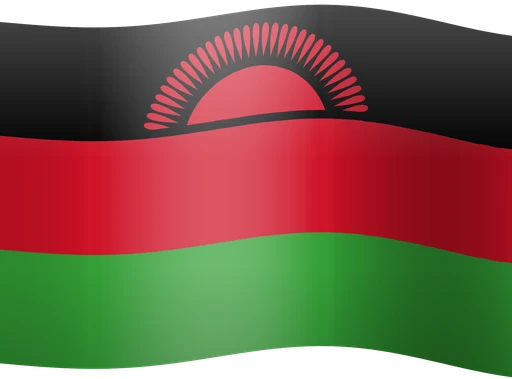
The Flag of Malawi
Republic of Malawi
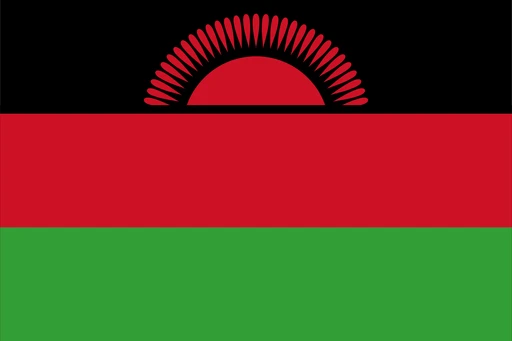
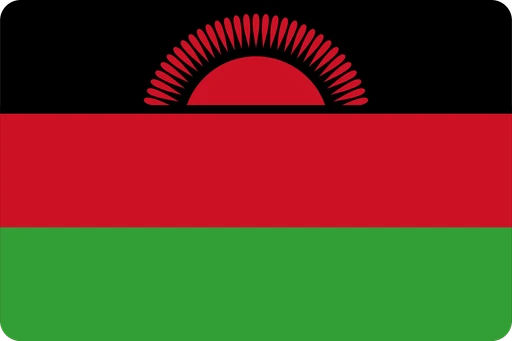
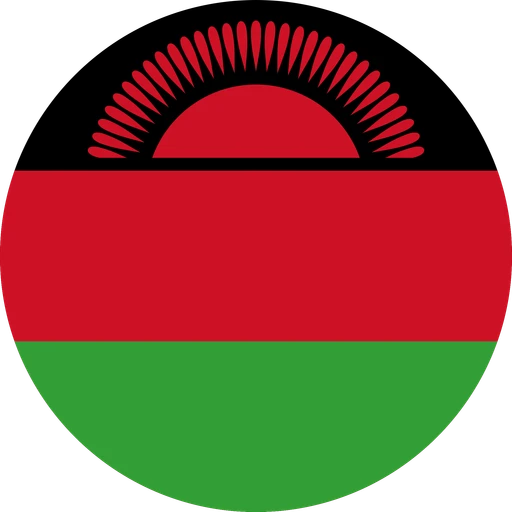
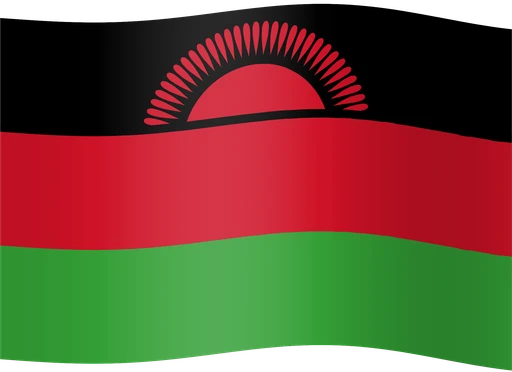
The flag of Malawi consists of three horizontal stripes of black, red, and green, with a rising sun in the center of the black stripe. The black stripe represents the African people, the red symbolizes the blood of their struggle for freedom, and the green represents the country's natural beauty. The rising sun signifies the dawn of hope and freedom for the continent of Africa.
Malawi's flag is a tricolor of black, red, and green with a rising sun on the top stripe. Between 2010 and 2012, a sitting president changed it, the public revolted, and the original was restored, which makes Malawi one of the few countries to have revised and then un-revised its flag within a single generation.
The sun that caused a national crisis
When Malawi gained independence from Britain on July 6, 1964, its new flag was adopted the same day. Designed under the leadership of Hastings Kamuzu Banda, the country's first president, it drew its colors directly from the Malawi Congress Party, the political movement that had driven the independence struggle. At the center of the black top stripe sat a rising half-sun in red, its rays breaking above the horizon. The message was unmistakable: a new nation was dawning.
For 46 years, nobody touched it.
Then, in 2010, President Bingu wa Mutharika ordered a redesign. The rising half-sun was replaced with a full white sun, repositioned to the center of the flag over the red stripe. Mutharika's reasoning was that Malawi had matured into a "fully-risen" nation and no longer needed to depict itself at dawn. The reaction was immediate and hostile. Opposition politicians called it an act of vanity. Traditional leaders accused Mutharika of erasing national heritage to serve his own ego. Ordinary Malawians saw it as a unilateral rewriting of the country's founding story.
The controversy simmered until Mutharika's sudden death in April 2012. His successor, President Joyce Banda, moved quickly to restore the original 1964 design. Parliament passed the reversal, and the old flag flew again. The entire episode made Malawi one of very few countries in modern history to formally restore a superseded national flag: original adopted in 1964, redesigned in 2010, restored in 2012.
Black, red, and green
Black sits on top, red in the middle, green at the bottom, and each one comes out of the pan-African movement that swept the continent in the mid-20th century. These colors were popularized decades earlier by Marcus Garvey's Universal Negro Improvement Association, which championed Black pride and self-determination across the African diaspora. By the time Malawi adopted them, they'd already become a visual shorthand for anti-colonial resistance.
Black represents the African people themselves. In a post-colonial context, placing it at the top of the flag was a deliberate, proud assertion of racial identity: Africa belongs to Africans. Red symbolizes the blood of martyrs, those who died resisting British colonial rule and fighting for the freedoms Malawi now enjoys. Green, the bottom stripe, evokes the land itself: Malawi's fertile plains, lush forests, and the life-giving landscape of a country often called "The Warm Heart of Africa."
The same colors appear across the continent. Kenya, Zimbabwe, South Sudan, and several other nations use variations of the black-red-green palette, a shared inheritance from the African liberation movements. For Malawi's founders, choosing them was a political act that placed the new country alongside a continental identity rather than an inherited colonial one.
The rising sun and its 31 rays
Look closely at the sun on Malawi's flag, and you'll notice something specific. It's a half-sun, depicted mid-rise, with exactly 31 rays radiating outward. That number isn't decorative. It represents the 31 African nations that had achieved independence by the time Malawi joined them in 1964.
The choice of a rising sun, rather than a fully risen one, was intentional and deeply considered. It acknowledged that Africa's liberation was still a work in progress. Many nations remained under colonial or minority rule, and Malawi's founders wanted their flag to express solidarity with those still fighting for freedom. The sun was a promise: dawn was breaking, but the day hadn't fully arrived yet.
This is exactly why the 2010 switch to a full sun stirred such anger. Critics argued that replacing the rising sun with a complete one didn't just change an image; it dismantled a founding philosophy. Where the original expressed collective African aspiration, the redesign seemed to announce individual national triumph. It swapped humility for self-congratulation, and Malawians weren't having it.
The sun's red ties it to the red stripe directly below, so the upper half of the flag reads as a single band of warmth: black land at the horizon, a sun breaking through, red running down from it.
Protocol, variants, and official use
Malawi's flag follows a standard horizontal tricolor format with three equal-width bands, in a ratio of approximately 2:3. It flies over all government buildings, embassies, military installations, and is prominently displayed at national ceremonies.
A Presidential Standard exists as well, typically incorporating the national coat of arms or additional presidential insignia. The coat of arms itself is a busy and symbolic composition: a lion, waves representing Lake Malawi, a rising sun echoing the flag's motif, and an eagle soaring above. While the coat of arms appears on government documents and official seals, it's generally kept separate from the civil flag.
Flag protocol in Malawi follows Commonwealth conventions. Despite becoming a republic in 1966, just two years after independence, the country has remained a member of the Commonwealth of Nations. The flag is flown with particular enthusiasm during national holidays, especially Independence Day on July 6 and Martyrs' Day on March 3, which honors those who died in the struggle against colonial rule.
Malawi among the pan-African flags
Malawi's black-red-green palette places it in a recognizable family across sub-Saharan Africa. Kenya pairs the same colors with a central Maasai shield and crossed spears. Zimbabwe uses a similar arrangement alongside a red star and the Zimbabwe Bird.
One thing that sets Malawi apart is restraint. Ghana, Senegal, and Cameroon add gold or yellow as a fourth color; Malawi sticks to three. The result is starker, with nothing competing with the sun.
That sun motif, of course, has parallels elsewhere. Japan, Uruguay, Argentina, and the Philippines all feature suns on their flags. But none of them encode a specific political count the way Malawi's 31 rays do, tying the design to a precise historical moment. Vexillologists have also taken particular interest in the 2010 to 2012 episode, citing it as one of the clearest modern case studies in democratic flag reversal: a population rejecting a top-down redesign and successfully demanding restoration of the original.
The flag in Malawian life
Malawians call their country "The Warm Heart of Africa." Walk through Lilongwe or Blantyre during a football match and you'll see the flag draped over shoulders, painted on faces, waved from car windows. At traditional ceremonies and political rallies alike, it's the one image shared across Malawi's ethnic groups: Chewa, Tumbuka, Yao, Lomwe, and many others.
The fury over the 2010 change showed how far that ownership goes. Malawians did not treat the flag as government property to be managed by whoever held office, and Mutharika's unilateral redesign was taken personally.
One notable absence from the flag is Lake Malawi, one of Africa's Great Lakes and a UNESCO World Heritage Site that dominates the country's eastern border. The lake shapes Malawian culture, economy, and daily life, yet it appears only on the coat of arms, not the flag itself. It's a curious omission for a feature so central to the nation's identity, but the flag's designers in 1964 chose to focus on pan-African symbolism over geographic specificity.
When the original flag was restored in 2012, celebrations broke out in several cities. For many Malawians the point was less about aesthetics than about proof that ordinary citizens could push back against a president's vanity project and win.
References
[1] Government of Malawi, Official State House Publications and Independence Day Records (statehouse.gov.mw)
[2] Flags of the World (FOTW), "Malawi" (https://www.crwflags.com/fotw/flags/mw.html)
[3] BBC News Africa, "Malawi Restores Old Flag After Public Outcry," 2012 (bbc.co.uk/news)
[4] Rotberg, Robert I., The Rise of Nationalism in Central Africa: The Making of Malawi and Zambia, 1873-1964 (Harvard University Press, 1965)
[5] Smith, Whitney, Flag Lore of All Nations (Millbrook Press, 2001)
[6] Flag Institute (UK), Malawi Flag Profile (https://www.flaginstitute.org)
Common questions
- What do the colors of the Malawi flag represent in Pan-Africanism?
- Malawi uses black, red, and green because they are the Pan-African colors. Black stands for African people, red for the blood shed for freedom, and green for the vegetation of the continent.
Featured in these articles
Download this flag
Free in 12 styles, from 32px icons up to 2000px, as SVG, PNG, WebP and JPG.