Run through every national flag in your head. All 197 sovereign states, plus dozens of sub-national territories. Stars, stripes, crescents, crosses, eagles, lions. Now count the ones showing a creature that has never existed in nature.
There are two.
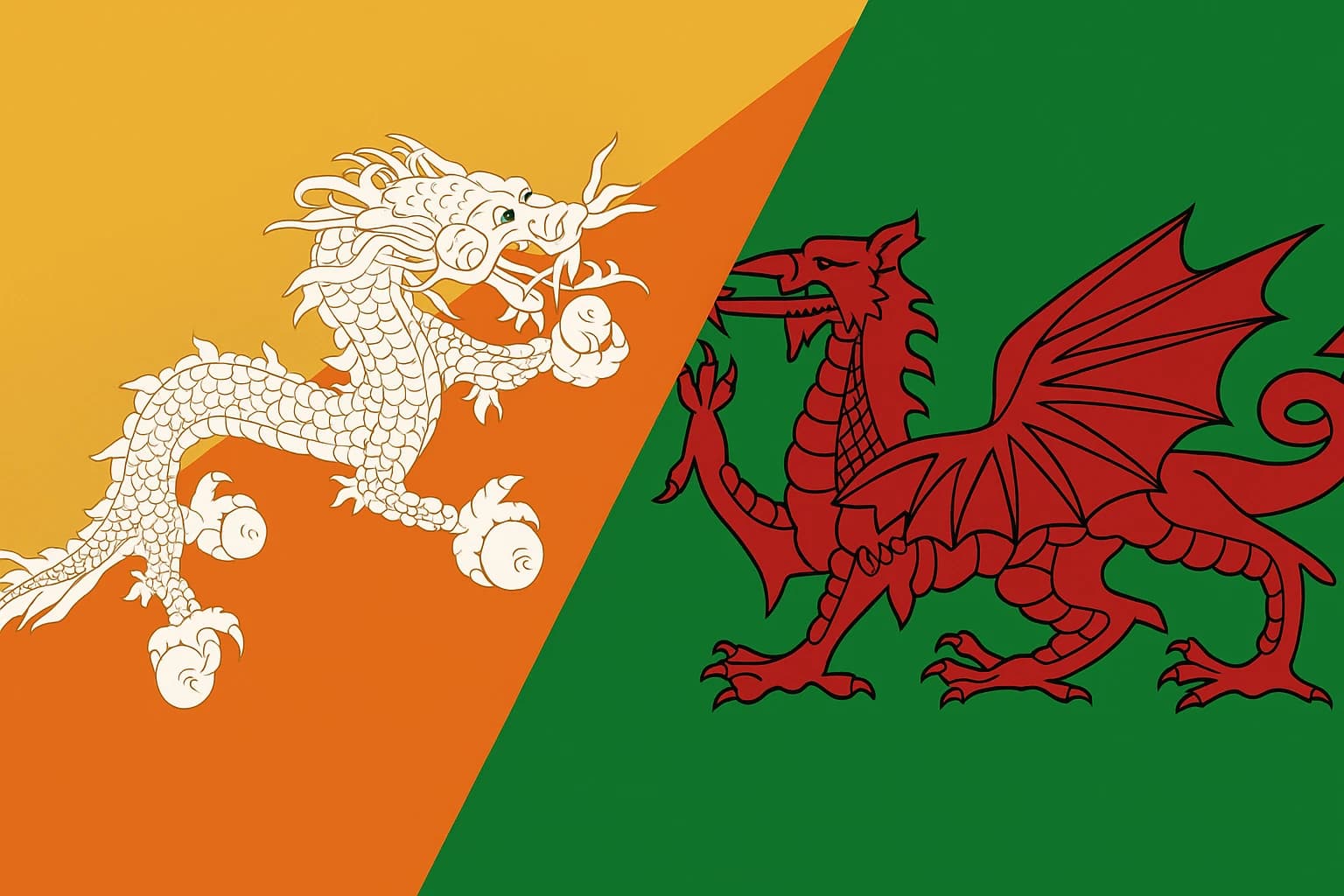
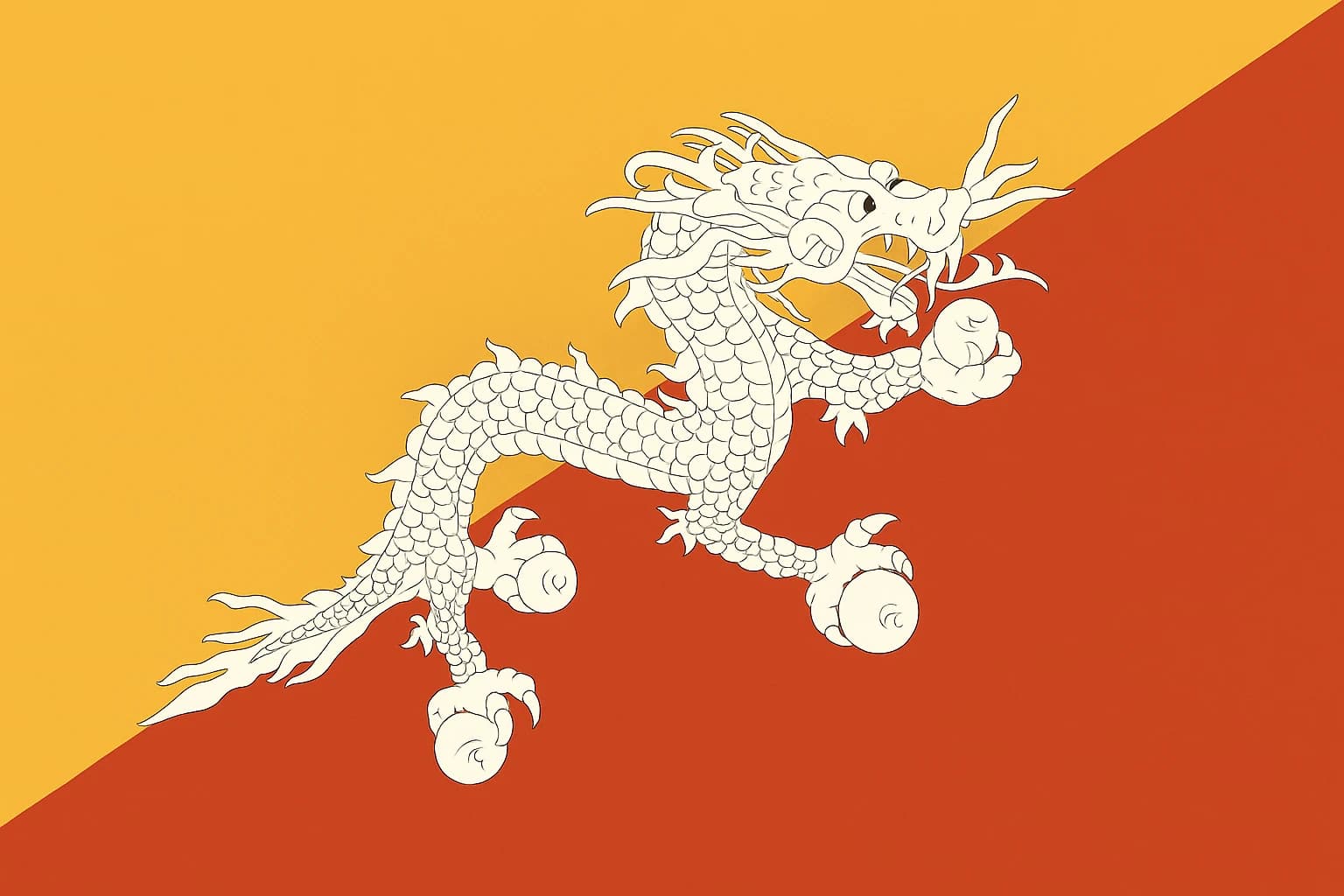
Bhutan's Druk, the Thunder Dragon, clutches jewels against a field of saffron and orange.
Wales's Y Ddraig Goch strides across a green and white field in red.
Two nations 5,000 miles apart, with no shared language, religion, or colonial history, both decided the most important thing they could put on a flag was a dragon. That says something about how nations that feel overlooked or politically invisible reach for the strongest symbol available.
Why every other nation gave up mythical beasts
Medieval heraldry was full of monsters. Dragons, griffins, wyverns, unicorns, basilisks, crawling across shields and banners from Edinburgh to Constantinople. The modern nation-state had other priorities.
After the French Revolution, flags moved toward geometric abstraction. Tricolors became the default grammar of republican sovereignty. Stars-and-stripes arrangements signaled federalism. Pan-African greens, yellows, and reds communicated solidarity across a continent, and pan-Arab colors did the same across another.
The 19th and 20th centuries pushed design toward simplicity and reproducibility. The 1906 International Maritime Signal Code rewarded clean geometry, because a flag has to be identifiable at sea, in fog, at distance. United Nations display conventions reinforced it, since your flag hangs alongside 196 others and has to read at a glance.
Real animals survived the cull. Eagles appear on the flags of Albania, Mexico, and Egypt.
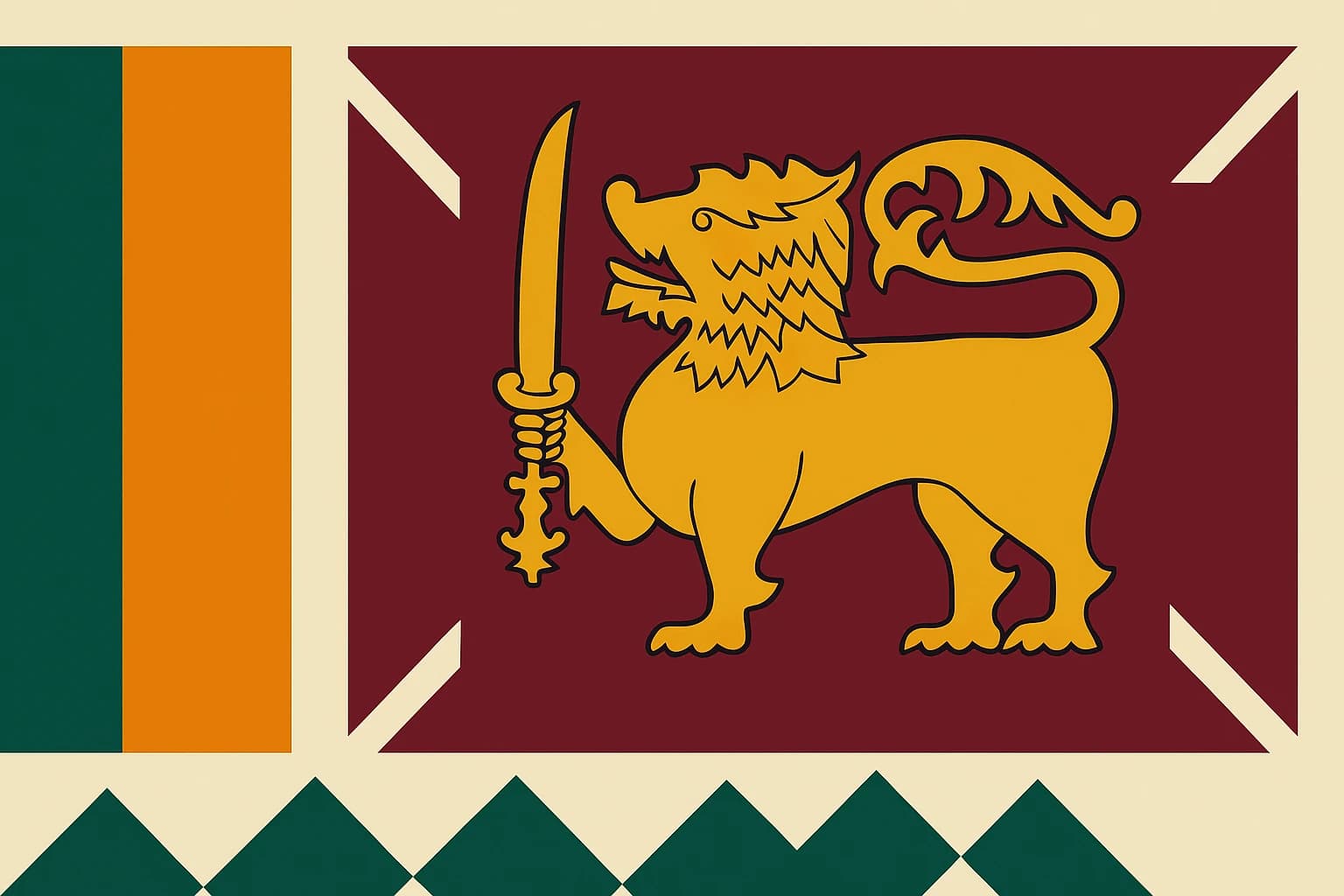
Lions held on in Sri Lanka and several African nations.
Those creatures survived because they reference something zoologically real. Mythical beasts were quietly retired as pre-modern or superstitious. Portugal's dragon disappeared from its standard. China's Qing dynasty dragon gave way to the Republic's five-color flag in 1912.
Which makes the timing of the two survivors strange. Bhutan formally adopted its dragon flag in 1969. Wales did the same in 1959. Both went mythical exactly when everyone else was going modern.
Druk: Bhutan's thunder dragon and the jewels of perfection
Druk means thunder dragon in Dzongkha, Bhutan's national language, and Bhutan itself is Druk Yul, Land of the Thunder Dragon. The name traces to the 12th-century founding of the Drukpa Kagyu school of Tibetan Buddhism by Tsangpa Gyare, who reportedly heard thunder at the site of his first monastery, Ralung, in 1206, and understood it as a dragon's roar. A country's identity grew out of that sound.
The dragon on the flag holds norbu, wish-fulfilling jewels, in its claws, standing for prosperity, perfection, and the Buddhist ideal of compassion. It faces away from the hoist, signaling forward motion, and its white color means purity of thought and deed. All of it contrasts deliberately with the fire-breathing Western dragon. This one protects rather than destroys.
The design took time to settle. Earlier Bhutanese royal standards used a green dragon on various backgrounds, and the current saffron and orange diagonal was formalized in 1969 under the third king, Jigme Dorji Wangchuck. Saffron carries the Drukpa lineage's spiritual authority, orange the Wangchuck monarchy's secular authority, and the dragon lies across the diagonal, belonging to neither half.
There is a geopolitical layer as well. Squeezed between India and China, Bhutan has used the Druk to assert an identity that is emphatically neither. It also separates Bhutan visually from Nepal, with its Hindu-influenced double pennant, and from Tibet, whose Snow Lion flag is banned in China.
In a region of contested borders, that is a useful thing for a flag to do.
Y Ddraig Goch: the red dragon and the posture of defiance
The red dragon's roots go deep. It appears in the Historia Brittonum of around 829 CE, attributed to Nennius, where a red dragon fights a white one beneath Dinas Emrys in Snowdonia, and the prophecy holds that the Britons in red will eventually drive out the Saxons in white. Geoffrey of Monmouth amplified the story around 1136, tying it to Merlin and King Arthur. The dragon was old before England had a name.
The Tudor dynasty, Welsh in origin, carried it to the English throne when Henry VII marched under it at Bosworth Field in 1485. After the Acts of Union between 1536 and 1543 merged Wales into England, the dragon was gradually sidelined, and it never appeared on the Union Jack.
That omission is still a sore point in Welsh politics. England's St. George's Cross is on the union flag. Scotland's St. Andrew's Saltire is on it. Ireland's St. Patrick's Saltire is on it. Wales is not.
The modern Welsh flag was formally recognized in 1959 after a sustained campaign by Welsh politicians and cultural organizations. The dragon appears passant, striding with one paw raised, mouth open, tongue and claws bared, which is a posture of active combat. Red for blood, courage, and ferocity. The green and white field beneath it comes from Tudor livery colors, anchoring the design to a specific historical claim to legitimacy.
The union flag omission has become a recurring rallying point. Campaigners petitioned to add the dragon in 2007, 2014, and 2024, and each petition was refused, which has done nothing but strengthen the dragon's role as shorthand for Welsh distinctiveness and for the invisibility Wales perceives within the UK.
Jewels against fire
Side by side, the contrast is sharp. Bhutan's dragon is calm, airborne, holding treasure. Wales's is grounded and aggressive. Neither posture is an arbitrary artistic decision; each encodes what its nation worries about and what it wants.
Bhutan's self-image runs on restraint. Gross National Happiness ahead of GDP, carbon-negative environmental policy, carefully limited tourism through the $100 Sustainable Development Fee, restructured in 2023. The serene dragon matches a national brand built on spirituality and quiet confidence.
Wales's self-image runs on resurgence. Welsh-medium education now covers over 25% of primary pupils. The Senedd's powers have expanded since devolution. The men's football team qualified for the 2022 World Cup, their first since 1958. The growing use of "Cymru" as the country's primary international name is a culture insisting on its own terms. The combative dragon matches a people who have had to fight linguistically, politically, and athletically for every inch of recognition.
The colors follow the same logic. White for purity and transcendence, red for blood and struggle. Both are right for their context.
Dragons as soft power
Bhutan's dragon works hard in tourism and diplomacy. It appears on Drukair aircraft, on Bhutanese passports, and on the jerseys of the national football team, which is ranked among the lowest in the world and instantly recognizable anyway. The Druk has become shorthand for a nation that values happiness over growth.
The Welsh dragon works the commercial and sporting circuits. The Welsh Rugby Union's three-feathers badge coexists with it, but the dragon is what turns up on fan gear, on murals across Cardiff, and in Visit Wales campaigns. The 2022 World Cup put Y Ddraig Goch across global media and introduced "Cymru" to audiences who had never seen the word. It now appears on craft beer labels, Transport for Wales train livery, and social campaigns aimed at younger audiences.
Both flags rank near the top of user-generated flag tier lists on YouTube, Reddit, and TikTok, largely because a dragon is legible at thumbnail size when a tricolor is not.
Contrast that with flags that modernized into anonymity. Libya's plain green flag under Gaddafi was among the least recognizable in the world before being replaced by a conventional tricolor, and many post-Soviet states adopted tricolor formats that are dignified and almost impossible to tell apart from memory.
Could another nation adopt a dragon?
China's position is complicated. The lóng is the country's most famous cultural symbol and has never appeared on the PRC flag. In 2024 Chinese state media briefly debated adopting the dragon as a formal national emblem, and the proposal stalled over concerns that Western audiences associate dragons with villainy and aggression. Bhutan and Wales have never had that problem, because their dragons are tied to specific local mythologies rather than to a superpower's image abroad.
Indonesia's Garuda sits in an interesting middle position. It is technically a mythical eagle-like bird, but it is treated as close to real in Hindu-Buddhist tradition, and the line between mythical and heraldic gets blurry once a creature has thousands of years of religious context behind it.
The pattern is fairly clear. Mythical symbols work best for nations asserting uniqueness against larger neighbors, and they are risky for large powerful ones, which end up looking aggressive.
A few dragon-adjacent cases hover at the edges. The Maltese cross features a dragon in some historical variants. Catalonia's Sant Jordi dragon-slayer tradition has been proposed for flag imagery and never adopted. For now the category still belongs to Bhutan and Wales, two small countries whose identities are permanently at risk of being absorbed, flying a creature that exists nowhere in nature and therefore fits nobody else's taxonomy.