The Flag of Albania
Republic of Albania
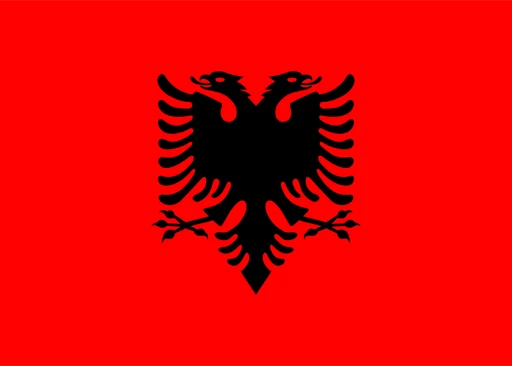
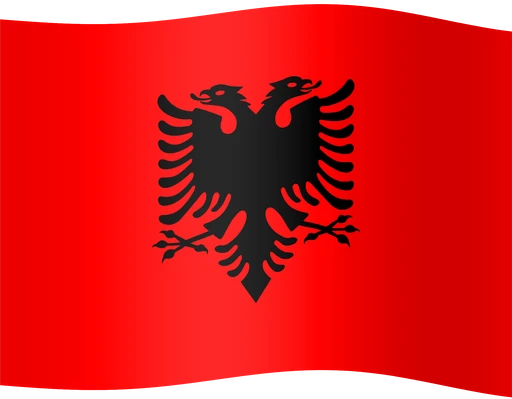
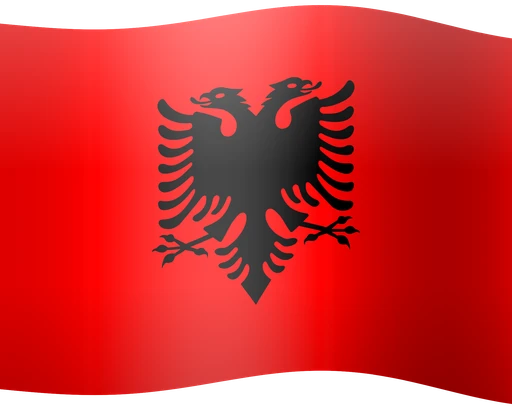
The flag of Albania, known as the 'Flamuri Kombëtar', is a red field with a black double-headed eagle at its center. Red stands for bravery, strength, and valor. The black double-headed eagle is the emblem of the Albanian state and represents freedom and the heroism of the Albanian people.
Albania's flag is a black double-headed eagle centered on a deep red field, and it is one of Europe's oldest national symbols. Its roots go back to the 15th-century resistance of Gjergj Kastrioti Skanderbeg against the Ottoman Empire. Unlike most modern flags, which came out of committee design or revolutionary tricolors, Albania's banner is a heraldic charge that has survived centuries of foreign rule, communist dictatorship, and post-Cold War reinvention. The double-headed eagle was once a symbol of Byzantine imperial authority. Albanian nationalism turned it into something else: a marker of sovereignty for a people who spent most of their history governed by others.
Skanderbeg's eagle: from Byzantine heraldry to national rebellion
The double-headed eagle didn't begin its life as an Albanian symbol. Its origins trace to Byzantine and broader Eastern Mediterranean heraldry, where it represented the dual sovereignty of empire over East and West. You'll find it stamped on coins, carved into church facades, and woven into imperial textiles across a millennium of Eastern Roman rule. But when Gjergj Kastrioti Skanderbeg (1405-1468) raised a black double-headed eagle on a red field as his personal and military standard, he pulled the symbol out of the imperial context and welded it to something new: national resistance.
Skanderbeg, an Albanian nobleman who'd been taken as a child hostage by the Ottomans and trained in their military, turned against his captors in 1443 and launched a 25-year guerrilla campaign that kept Ottoman expansion at bay in the western Balkans. His family coat of arms, the Kastrioti eagle, became the rallying banner for Albanian fighters. Over time, it stopped being a dynastic emblem and became synonymous with Albanian identity itself.
After Skanderbeg's death and the eventual Ottoman conquest of Albania in 1479, the eagle didn't vanish. It survived through oral tradition, folk art, church decoration, and the memory of diaspora communities scattered across southern Italy and Greece. For over four centuries, it persisted as a quiet act of cultural defiance.
Other nations use the double-headed eagle too, of course. Russia, Serbia, and the old Holy Roman Empire all claimed versions. But those traditions are bound up with imperial power and Orthodox ecclesiastical authority. Albania's eagle is different. It's an eagle of rebellion, not empire. That distinction matters enormously to Albanians, and it's what gives the symbol its particular emotional charge.
Independence and the flag's modern birth: 1912
On November 28, 1912, in the coastal city of Vlorë, Ismail Qemali declared Albanian independence from the crumbling Ottoman Empire and raised a flag bearing the double-headed eagle. The callback to Skanderbeg was deliberate and unmistakable. In a moment when the Balkan Wars were redrawing the map and Greek, Serbian, and Montenegrin forces were carving up Albanian-speaking territory, the flag was a blunt assertion: we exist, we are distinct, and we have been here for centuries.
Early versions of the independence-era flag weren't fully standardized. Some included a white star above the eagle, and proportions varied from one flagmaker to the next. But the core elements, black eagle on red, were fixed from the start. International recognition followed with the 1913 Treaty of London, which established the Principality of Albania. The eagle flag became the new state's official banner, and a symbol that had lived in folklore for 400 years was suddenly flying over government buildings.
A flag remade five times: monarchs, fascists, and communists
Few national flags have been altered as frequently as Albania's, and each change tells you exactly who was in charge.
The Principality of Albania (1914-1925) and the subsequent Republic under Ahmet Zogu added the Helmet of Skanderbeg above the eagle, reinforcing the medieval connection and lending the new state historical gravitas. When Zogu crowned himself King Zog I in 1928, the flag gained a royal crown atop the helmet, a bid for dynastic legitimacy from a man who'd started his career as a minor clan leader.
Then came the Italians. During the fascist occupation (1939-1943), Mussolini's regime imposed the lictor fasces on the Albanian flag, merging the eagle with Italian fascist iconography. It was deeply unpopular and lasted only as long as the occupation itself.
Communist Albania under Enver Hoxha (1946-1992) added a gold-bordered red star above the eagle. It was a standard communist modification, the kind you'd see across the Eastern Bloc. But Albania's flag remained more distinctive than most of its socialist peers precisely because the eagle was kept. Where other communist states adopted bland tricolors with stars, Albania's medieval raptor endured beneath the ideological ornament.
The star came off on April 7, 1992, after the collapse of the Hoxha regime. The restored design, a black eagle on red with no additional charges, is the flag that flies today, stripped back to its essential elements and freed from the accumulated symbols of every regime that tried to claim it.
Blood red and midnight black: the design decoded
The current flag's proportions are 5:7. The red is a specific deep crimson (Pantone 1797C or equivalent), and the eagle is solid black. Two colors and one charge, with nothing else on the field.
Traditionally, the red field is interpreted as representing bravery, strength, and the blood shed for Albanian freedom, though this symbolism solidified during the nationalist period of the 19th and early 20th centuries rather than being some ancient fixed meaning. The eagle's specific silhouette is precisely defined: talons open, wings spread, both heads facing outward. Symbolically, the two heads are read as vigilance over East and West, or the unity of the Albanian people across divided territories.
The flag is also unusual linguistically. Albanians call their country "Shqipëria," which translates to "Land of the Eagles," and they call themselves "Shqiptarë," meaning "Children of the Eagles" or "People of the Eagles." Almost no other flag matches its country's name that literally. The French don't call themselves "people of the tricolor." Albanians are, in their own language, the eagle's people.
Vexillologists consistently rank it among the most graphically effective national flags in the world. The two-color palette and bold central charge make it legible at any distance, in any wind.
The eagle beyond borders: pan-Albanian symbolism and cultural life
For ethnic Albanians in Kosovo, North Macedonia, Montenegro, and across the global diaspora, this flag functions as something bigger than a state symbol. It's an ethnic and cultural marker that transcends borders.
Kosovo's relationship with the Albanian flag is particularly layered. When Kosovo declared independence in 2008, it adopted its own distinct flag, a blue field with a gold map silhouette and six white stars. But in practice, the Albanian double-headed eagle remains ubiquitous in Kosovar public life, flown alongside the national flag at celebrations, painted on walls, and worn as patches and jewelry.
You've probably seen the eagle hand gesture without knowing what it was. Hands crossed at the wrists, thumbs interlocked, fingers spread to mimic the double-headed eagle. Swiss-Albanian footballers Granit Xhaka and Xherdan Shaqiri made it famous (and controversial) during the 2018 World Cup, flashing it after scoring against Serbia. The gesture sparked international debate, but for Albanians it was simply an expression of identity.
Independence Day and Flag Day fall on the same date, November 28, and celebrations are massive both in Albania and across the diaspora. The flag flies over government buildings, military installations, and embassies year-round, and Albanian law includes specific rules governing its display and prohibiting its desecration.
Similar flags and heraldic cousins
Montenegro's flag also features a double-headed eagle, but it's gold on red and loaded with additional heraldic elements: a shield, a lion, a crown. Serbia's coat of arms carries a white double-headed eagle with a dynastic shield. Russia's imperial eagle, revived after the Soviet collapse, is gold and elaborate, dripping with Orthodox and imperial symbolism. All of these share the same Byzantine ancestry.
Variant Albanian eagles appear on sub-regional and historical flags too, like the flag of the short-lived Republic of Chameria. But the state flag's version is the definitive one.
What sets Albania's flag apart from its heraldic cousins is restraint. There are no crowns, shields, secondary charges, or third colors, just a black eagle on blood red. Among double-headed eagle flags it is the most austere, and that austerity is exactly what makes it the most visually arresting.
References
[1] Constitution of the Republic of Albania, Article 14, official flag specifications.
[2] Elsie, Robert. Historical Dictionary of Albania. Scarecrow Press, 2010.
[3] Noli, Fan S. George Castrioti Scanderbeg (1405-1468). International Universities Press, 1947.
[4] Smith, Whitney. Flags Through the Ages and Across the World. McGraw-Hill, 1975.
[5] Vickers, Miranda. The Albanians: A Modern History. I.B. Tauris, 1999.
[6] Flags of the World (FOTW), Albania page. Maintained by the International Federation of Vexillological Associations (FIAV). https://www.fotw.info/flags/al.html
[7] Frashëri, Kristo. The History of Albania: A Brief Survey. Tirana, 1964.
[8] Flag Institute (UK), Albania flag entry and specifications. https://www.flaginstitute.org/wp/flags/albania/
Common questions
- What does the double-headed eagle on the Albanian flag mean?
- The double-headed eagle stands for Albania's unity, vigilance, valor, and sovereignty. It draws from Byzantine symbols and was made famous by Skanderbeg, who fought against Ottoman rule.
- Why is the background of the Albanian flag red?
- The red background honors the sacrifices of those who fought for Albania's freedom. It's a tribute to their bravery and the history of struggle for independence.
- Has the design of the Albanian flag changed over time?
- Yes, the flag has changed. During the communist era, a gold star was added above the eagle. This was removed in 1991, returning to the red field and black eagle design.
- Why does Albania have a double-headed eagle on its flag?
- It goes back to Gjergj Kastrioti Skanderbeg, the 15th-century Albanian hero who used the double-headed eagle as his personal and military standard during 25 years of resistance against the Ottomans. The symbol has Byzantine roots, but Skanderbeg made it purely Albanian, a mark of rebellion and identity. It was brought back when Albania declared independence in 1912.
- What does 'Shqipëria' mean, and what's the connection to the flag?
- Shqipëria, Albania's name in Albanian, literally means 'Land of the Eagles.' Albanians call themselves Shqiptarë, or 'Children of the Eagles.' So the double-headed eagle on the flag isn't just a symbol. It's a literal reflection of what Albanians call themselves. The people and the flag are linguistically the same thing. Almost no other country can say that.
- Why is the Albanian flag red and black?
- The red background traditionally represents bravery, strength, and blood shed for Albanian freedom, ideas that really took hold during the 19th-century nationalist movement. The black eagle dates to Skanderbeg's 15th-century coat of arms. It's one of the most visually striking national flags out there, and that stark two-color combo is a big reason why.
- What's the double-headed eagle hand gesture Albanian footballers make?
- You cross your hands at the wrists, interlock your thumbs, and spread your fingers to mimic the eagle's two heads and wings. Granit Xhaka and Xherdan Shaqiri, both Swiss-Albanian, made it famous (and controversial) when they flashed it after scoring against Serbia at the 2018 World Cup. For Albanians, it's simply a way of expressing cultural and ethnic pride.
- Why has Albania's flag changed so many times?
- Every regime that took power tweaked the flag. The monarchy slapped Skanderbeg's helmet on it, then later a crown. Italian fascists added the lictor fasces during their WWII occupation. The communists stuck a red star above the eagle. When communism collapsed in 1992, all that stuff got stripped away, leaving the clean black eagle on red. It's the simplest version the flag has ever had.
Featured in these articles
- The Map That Became a Flag: Why Kosovo and Cyprus Broke Vexillology's Most Sacred Rule
- The Dragon, the Lion, and the Eagle: Why Mythical Beasts Still Guard the World's Flags
- The Parrot, the Sisserou, and the Rose: How Dominica Put a Rare Bird on Its Flag, and What It Cost
- The Two-Headed Eagle: How a Byzantine Symbol Survived Empires, Revolutions, and Republics
Download this flag
Free in 12 styles, from 32px icons up to 2000px, as SVG, PNG, WebP and JPG.