The Flag of Mexico
United Mexican States
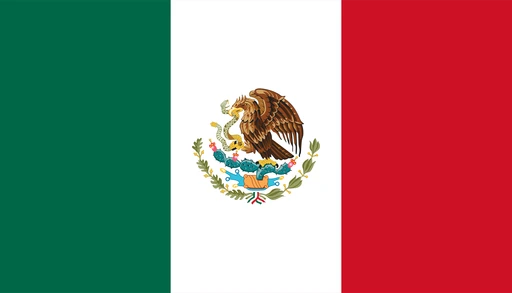
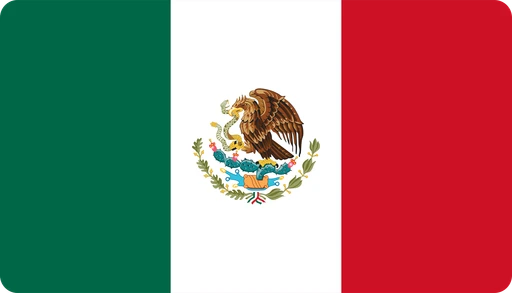
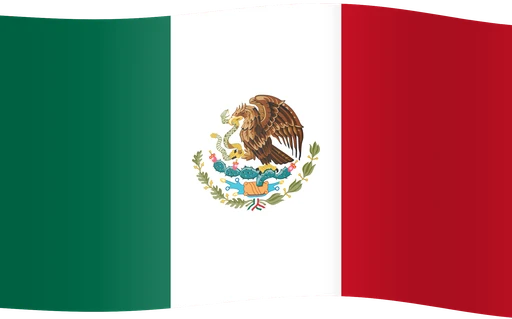
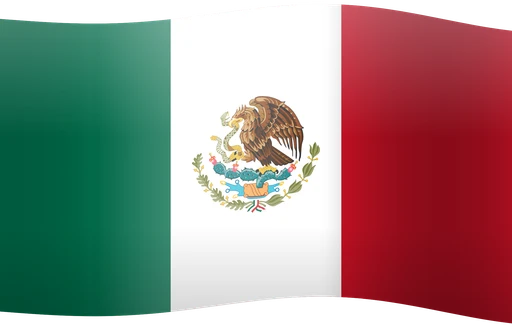
The flag of Mexico is a vertical tricolor of green, white, and red with the national coat of arms (an eagle holding a serpent in its beak and talon, perched on a prickly pear cactus) in the center of the white stripe. Green stands for hope and victory, white for purity and faith, and red for the blood of the national heroes.
At the center of Mexico's flag sits one of the most complex coats of arms in use anywhere: an eagle perched on a cactus, devouring a serpent, an image from the Aztec prophecy that guided the founding of Tenochtitlán, the city beneath modern Mexico City. The flag has been redesigned more than a dozen times since independence, and the three vertical bands of green, white, and red have meant radically different things to different generations of Mexicans.
The Aztec prophecy at the center
Look closely at the coat of arms and you're looking at a scene from roughly 1325 CE. An eagle, understood in Aztec cosmology as an avatar of the sun deity, stands atop a prickly pear cactus growing from a rock in a lake. A serpent writhes in its beak and talons. According to legend, the god Huitzilopochtli commanded the wandering Mexica people to found their city at the exact spot where they witnessed this vision. They did, and Tenochtitlán rose from the waters of Lake Texcoco. Centuries later, the Spanish built Mexico City on those same ruins, but the founding image endured.
Very few flags of former colonies reference an indigenous founding myth this prominently. The eagle is not a European heraldic borrowing. It is pre-Columbian in origin.
The serpent's symbolism is often misread through a European lens, where snakes tend to represent evil. In pre-Columbian tradition, the serpent was a figure of considerable power, not villainy. Scholars interpret the full image as the triumph of the sun (the eagle) over the forces of darkness, a cosmic rather than moral battle. Oak and laurel branches encircle the emblem in its modern form, added in later iterations to represent the strength of the Mexican nation and victory, respectively.
One detail worth knowing: the artistic rendering of the eagle has shifted dramatically over the centuries. Early versions depicted a stylized, almost heraldic bird. The current "naturalistic" eagle, more zoologically accurate and shown in profile, was standardized in 1968 by designer Francisco Eppens Helguera. Every eagle before it looked noticeably different.
A flag redrawn again and again
Mexico's first revolutionary banner wasn't a tricolor at all. When Padre Miguel Hidalgo launched the War of Independence in 1810, he raised a banner bearing the image of the Virgin of Guadalupe. It was a religious rallying cry, not a national flag in the modern sense.
The tricolor emerged later, in 1821, when the Army of the Three Guarantees (Ejército Trigarante) adopted it under Agustín de Iturbide. The three colors originally stood for three political promises outlined in the Plan de Iguala: green for independence, white for the purity of the Catholic faith, red for the unity of Mexicans and Spaniards. Early versions arranged the stripes diagonally, not vertically. The vertical format we recognize today was adopted under the First Mexican Republic in 1823.
From there, the flag changed with nearly every political upheaval. The First Empire under Iturbide, the Republic, the Reform War, and the Second Empire under Maximilian I all left their marks. Maximilian's version (1864-1867) stands out: four separate coats of arms in the corners and an eagle heavily influenced by Habsburg heraldry, his Austrian inheritance imposed on the Mexican flag. When the Republic was restored, the Habsburg eagle was discarded.
The 1917 Constitution, born from the Mexican Revolution, prompted further standardization, though the definitive legal standard didn't arrive until 1984, when the Law on the National Arms, Flag, and Anthem (Ley sobre el Escudo, la Bandera y el Himno Nacionales) codified every detail. The sequence of redesigns tracks Mexico's political history closely: empire, republic, civil war, foreign intervention, revolution.
Colors whose meaning shifted
The colors of the Mexican flag haven't changed since 1821, but what they officially represent has.
Under Iturbide's original scheme, green meant independence from Spain, white meant the purity of the Roman Catholic faith, and red meant the unity between European-born Spaniards and Mexicans. These meanings were tightly bound to the political compromise of the Plan de Iguala. As Mexico evolved into a secular republic and the Church's political influence waned, those definitions quietly fell away.
Today the official symbolism reads differently: green for hope and the fertility of the land, white for unity, red for the blood of the nation's heroes. It is a secular, nationalist reframing, and it happened without any change to the flag's visual design, which is rare.
Mexican law specifies the flag's proportions at 4:7, with each of the three vertical bands occupying equal width. The exact shades of green and red are defined under government standards, though in practice, slight variations do appear across manufacturers and contexts.
Rules, rituals, and everyday use
Mexico takes its flag seriously, and the law reflects it. The 1984 Law on the National Arms, Flag, and Anthem establishes detailed protocols for how the flag is displayed, handled, and reproduced. Desecration is a punishable offense.
Every Monday morning, schools across the country hold a formal ceremony called Honores a la Bandera. Students stand at attention, sing the national anthem, and salute as the flag is raised. For millions of Mexican children, this weekly ritual is among their earliest civic memories. February 24 is Flag Day (Día de la Bandera), a national holiday established in 1937 by President Lázaro Cárdenas, marked by ceremonies in public squares nationwide.
There's an important legal distinction most people outside Mexico don't know about. The "plain" tricolor, without the coat of arms, is used by private citizens. The version bearing the coat of arms is reserved for official government use. A giant flag of this kind flies over the Zócalo in Mexico City, maintained and ceremonially changed by the military. You'll also find the flag on military uniforms, federal police vehicles, government documents, and diplomatic premises around the world.
The Italian connection
It comes up constantly: Mexico's flag looks a lot like Italy's. Both are vertical green-white-red tricolors with similar proportions. The key differences are the coat of arms on Mexico's white band and a slightly darker shade of green. This resemblance has caused genuine confusion in international settings, which is precisely why the coat of arms is so critical for identification at sea and in diplomacy.
The similarity isn't coincidental. Both flags trace their ideological ancestry to the French tricolor and the wave of republican symbolism that spread during the Napoleonic era. They are related rather than copied from each other.
Beyond Italy, the flags of several former Spanish colonies, including El Salvador and Nicaragua, share similar color palettes and coat-of-arms traditions. There's a recognizable post-colonial visual language across Latin America, and Mexico's flag sits squarely within it.
Within Mexico itself, 31 state flags have distinct designs, and several incorporate local indigenous symbols in the same way the national flag fuses pre-Columbian imagery with European heraldic convention. Across the border, the Mexican coat of arms has influenced the flags and seals of Mexican-American cultural organizations throughout the U.S. Southwest.
References
[1] Ley sobre el Escudo, la Bandera y el Himno Nacionales (1984). Official Mexican federal law, Cámara de Diputados legal database. www.diputados.gob.mx
[2] Secretaría de Gobernación (SEGOB), Mexico. Official government publications on national symbols and Flag Day.
[3] Smith, Whitney. Flags Through the Ages and Across the World. McGraw-Hill, 1975.
[4] Florescano, Enrique. The Myth of Quetzalcóatl. Johns Hopkins University Press, 1999.
[5] Prescott, William H. History of the Conquest of Mexico. 1843.
[6] Flag Institute (UK). Peer-reviewed vexillological data on Mexico's flag specifications and history. www.flaginstitute.org
[7] Museo Nacional de Historia, Castillo de Chapultepec, Mexico City. Holdings include original Ejército Trigarante banners and historic national flags.
[8] Zárate Toscano, Verónica. Los nobles ante la muerte en México: Actitudes, ceremonias y memoria (1750-1850). Political history of symbols during Mexico's independence era.
Common questions
- What do the eagle and snake on the Mexican flag mean?
- The eagle and snake come from an Aztec legend. They mark the place where the Aztecs were told to build their city, Tenochtitlan: wherever they saw an eagle eating a snake on a cactus. It is one of the few national emblems drawn from an indigenous founding story.
- Why does the Mexican flag resemble the Italian flag?
- Although both flags have a tricolor design, their meanings and symbols are distinct. Mexico's colors represent hope, purity, and the blood of heroes, plus it has a unique coat of arms. The similarity is purely coincidental.
Featured in these articles
- The Eagle Stood Alone: How Mexico's Flag Rewrote Its Own Founding Myth
- The Dragon, the Lion, and the Eagle: Why Mythical Beasts Still Guard the World's Flags
- The Tree That Holds Up a Nation: Lebanon's Cedar and the Surprisingly Rare Tradition of Putting Plants on Flags
- The Dragon on the Flag: How Bhutan and Wales Keep Mythical Beasts Alive in Modern Nation-Branding
Download this flag
Free in 12 styles, from 32px icons up to 2000px, as SVG, PNG, WebP and JPG.