The Flag of Wales
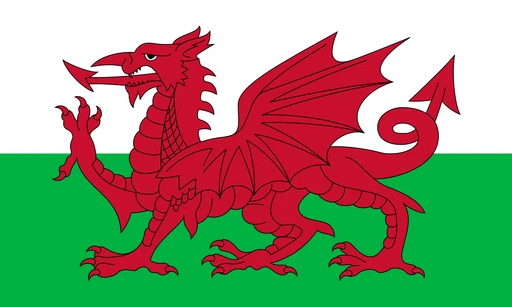
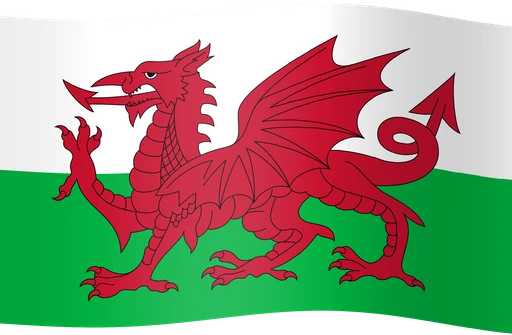
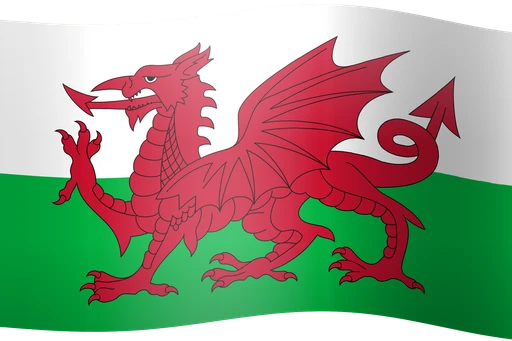
The flag of Wales, known as Y Ddraig Goch (The Red Dragon), features a red dragon passant (walking with one foreleg raised) on a field of green and white horizontal stripes. There is no standardised aspect ratio, though the flag is usually seen in 3:5 or 2:3. The green and white stripes are of equal width and come from the House of Tudor, the Welsh dynasty that held the English throne from 1485 to 1603. The red dragon is far older, and runs through Welsh mythology and history as a figure of strength and national pride.
The flag of Wales, Y Ddraig Goch, or "The Red Dragon," is one of the oldest national flags still in use. Where most countries settled on stripes, crosses, or stars, Wales went with a dragon. Yet for all its antiquity, stretching back at least to the Roman era and woven into Arthurian legend, the Welsh flag was not officially recognized until 1959, and Wales remains the only constituent country of the United Kingdom whose symbols are absent from the Union Jack.
The oldest dragon in Europe
The red dragon as a Welsh symbol likely predates English nationhood itself. Roman-era Britons carried the draco standard, a windsock-like dragon banner originally adopted from Roman cavalry auxiliaries. When Rome withdrew from Britain in the early fifth century, the symbol stayed on among the Celtic Britons who remained, and stopped being a purely military emblem.
The earliest written account linking the dragon to Wales appears in the Historia Brittonum (c. 829 CE), attributed to the monk Nennius. In it, the British king Vortigern tries to build a fortress, but the walls keep collapsing. Beneath the foundation, two dragons are discovered locked in combat: one red, one white. A young prophet (later identified with Merlin) declares that the red dragon represents the Britons and the white the Saxons, and that the red will eventually triumph. Geoffrey of Monmouth expanded this legend in his Historia Regum Britanniae (c. 1136), embedding the dragon even deeper into the mythic fabric of Britain. The Mabinogion, the great medieval Welsh prose collection, echoes the same motif in the tale of Lludd and Llefelys, where the two battling dragons are trapped and buried at Dinas Emrys in Snowdonia. That site is still there. You can visit it.
Centuries later, the dragon marched onto a real battlefield. Henry VII, of Welsh Tudor descent, carried a red dragon banner at the Battle of Bosworth Field in 1485. His victory over Richard III and subsequent accession to the English throne cemented the dragon as a marker of Welsh identity and royal legitimacy. Henry understood the power of the symbol: it connected him to ancient British prophecy and rallied Welsh support to his cause.
Despite the Tudor connection, the red dragon was never taken into the royal arms of England the way the English lion or the Scottish unicorn were. It helped win the crown and then got left out of the family portrait, and that exclusion set a pattern.
The long road to official status
When the first Union Flag was created in 1606, combining the crosses of St. George and St. Andrew, Wales was already legally absorbed into England under the Laws in Wales Acts of 1535 and 1542. It had no separate heraldic identity to contribute. By the time St. Patrick's saltire was added in 1801 to represent Ireland, Wales's absence was glaring, and it has been a sore point ever since.
Throughout the 19th and early 20th centuries, the red dragon appeared on various royal badges associated with Wales but lacked any formal standing as a national flag. It was a symbol everyone recognized and no one had bothered to make official. In 1953, following sustained campaigning by Welsh civic leaders and cultural organizations, a version featuring the red dragon on a green-and-white field was adopted as the royal badge for Wales. Progress, yes, but still not technically a flag.
That changed on February 23, 1959, when Queen Elizabeth II officially recognized Y Ddraig Goch, the red dragon passant on a green and white bicolour, as the national flag of Wales. One of the world's oldest national symbols had finally received formal status, which makes it, paradoxically, one of the most recently "official" flags on the planet.
Campaigns to work Welsh symbolism into the Union Jack have surfaced periodically since, but none has succeeded.
A dragon passant on green and white
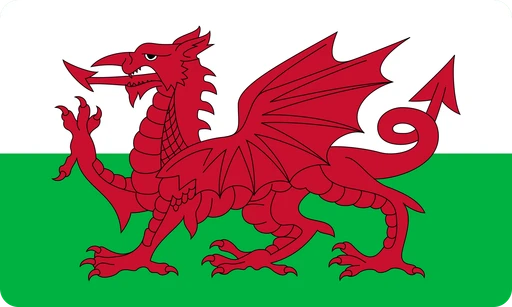
The design is simple in concept and awkward in execution. A red dragon strides across a horizontal bicolour, white above and green below. It faces the hoist side, claws raised, tongue extended, tail curling upward.
The green and white background comes from the livery colours of the House of Tudor, specifically Henry VII's heraldic colours. The field isn't abstract symbolism; it's a direct link to a Welsh dynasty that once ruled all of England. The red of the dragon has long been associated with courage and with the warrior spirit of the Britons, though those meanings were probably assigned after the fact to a symbol whose origins are more totemic than heraldic.
One curious detail: there's no single codified shade of red or green. Unlike many national flags, the Welsh flag doesn't have precisely specified Pantone or RGB values enshrined in legislation, which means reproductions vary. The Welsh Government's visual identity guidelines suggest specific colours for official use, but walk through any Welsh town and you'll see dragons in every shade from scarlet to crimson.
The dragon's posture, passant (walking with one foreleg raised), gives the flag its almost combative character. Very few national or subnational flags carry such a complex, non-geometric central figure; Bhutan's thunder dragon is the closest parallel. Most flag designers will tell you a child should be able to draw a flag from memory, which is not going to happen here.
Usage, protocol and variants
Y Ddraig Goch flies over Welsh Government buildings, the Senedd (Welsh Parliament) in Cardiff Bay, and at public events across the country. It's everywhere on Saint David's Day, March 1, and practically mandatory at rugby internationals, where the Principality Stadium becomes a sea of red and green.
There are no statutory precedence rules equivalent to the U.S. Flag Code, but Welsh Government guidance recommends flying it alongside the Union Jack on designated flag-flying days. The flag's public presence has grown since devolution in 1999 and the establishment of the National Assembly for Wales, now the Senedd Cymru, which uses the dragon throughout its branding and official materials.
Several variant forms exist. The Royal Badge of Wales places the dragon on a green mount within a scroll reading Y Ddraig Goch Ddyry Cychwyn, meaning "The Red Dragon Gives Impetus." A historic version featured a Tudor crown above the badge. Then there's Saint David's Cross (Croes Dewi Sant), a gold cross on a black field, sometimes flown as an alternative or complementary Welsh flag, particularly by those who prefer a simpler, cross-based design consistent with the flags of England, Scotland, and Ireland.
Welsh sporting teams lean on dragon imagery almost without exception. The Welsh Rugby Union's three-feathered emblem coexists with it as a parallel national sporting symbol, but when fans paint their faces, it's the dragon they reach for.
Wales and the Union Jack
The absence of Welsh representation from the Union Jack is one of the most frequently discussed oddities in British vexillology, and a point of national pride and frustration in roughly equal measure.
In 2007, MP Ian Lucas formally raised the issue in Parliament, calling for the Union Jack to be redesigned to include the Welsh dragon. The proposal drew public interest and press coverage but no legislative action. Designers and vexillologists have since floated various solutions, including quartering the dragon, adding a green stripe, and incorporating St. David's Cross. None has gained traction.
Being left out may have done the flag a favour. England, Scotland, and Northern Ireland all see their symbols fragmented and overlaid in the Union Jack, while Wales has a flag that belongs entirely to itself.
The dragon in everyday Welsh life
The red dragon is not confined to government buildings and official occasions. It appears on pub signs, tattoos, corporate logos, and bumper stickers across Wales, stitched into ordinary life in a way few national symbols manage.
Welsh diaspora communities fly it too, from Y Wladfa in Patagonia to the old Welsh settlements of Pennsylvania. In the 21st century it has become bound up with campaigns for the Welsh language and for greater political autonomy, tying present-day arguments to myths over a thousand years old.
The flag consistently ranks among the world's best-loved in popular polls and vexillological discussions. Roughly 1,500 years after the red dragon first appeared on a battlefield, it is still flying.
References
[1] Welsh Government, Flying Flags in Wales: Guidance (official Welsh Government publication on flag protocol and usage). gov.wales
[2] Historia Brittonum, attributed to Nennius (c. 829 CE), primary source for the Vortigern dragon legend.
[3] Geoffrey of Monmouth, Historia Regum Britanniae (c. 1136), key medieval source expanding the red dragon mythology.
[4] The Mabinogion, translated by Sioned Davies (Oxford University Press, 2007), authoritative modern translation of medieval Welsh tales including the tale of Lludd and Llefelys.
[5] Flag Institute (UK), "Wales. Y Ddraig Goch," online reference entry. flaginstitute.org
[6] Davies, John, A History of Wales (Penguin, revised edition 2007), comprehensive scholarly history providing context for Welsh national symbols.
[7] Senedd Cymru / Welsh Parliament, official records and visual identity guidelines. senedd.wales
[8] Smith, Whitney, Flags Through the Ages and Across the World (McGraw-Hill, 1975), standard vexillological reference work.
[9] Hansard, House of Commons Debates, 27 November 2007, record of Ian Lucas MP raising the Union Jack redesign question in Parliament. hansard.parliament.uk
Common questions
- Why is there a dragon on the Welsh flag?
- It goes way back to Roman-era Britain, when soldiers carried dragon-shaped windsock banners called 'draco' standards. After Rome pulled out, the Celtic Britons kept the symbol as their own. Then medieval legends ran with it, especially the story of Merlin and two battling dragons, red for the Britons, white for the Saxons. Henry VII flew a red dragon banner at Bosworth Field in 1485, which didn't hurt either.
- Why isn't Wales on the Union Jack?
- By the time the first Union Flag was created in 1606, Wales had already been legally absorbed into England under the Laws in Wales Acts of 1535 to 1542. It didn't have a separate heraldic identity to contribute. When Ireland's saltire got added in 1801, Wales's absence was already baked in. People have campaigned to change that over the years, but it's never happened.
- When did the Welsh flag become official?
- The red dragon is one of the oldest national symbols in Europe, but the flag didn't become official until February 23, 1959. That's when Queen Elizabeth II formally designated Y Ddraig Goch as Wales's national flag. A royal badge version had been adopted back in 1953, but full flag status took another six years.
- What does 'Y Ddraig Goch' mean?
- It's Welsh for 'The Red Dragon.' It refers to both the dragon symbol and the flag itself. The phrase shows up in medieval Welsh texts and it's still the standard Welsh-language name for the national flag today.
- What do the green and white colors on the Welsh flag represent?
- The green and white halves of the background come from the livery colors of the House of Tudor, specifically Henry VII, who was Welsh. So it's not abstract symbolism. It's a direct link to the Welsh dynasty that won the English crown at Bosworth Field in 1485.
Featured in these articles
Download this flag
Free in 12 styles, from 32px icons up to 2000px, as SVG, PNG, WebP and JPG.