The Flag of Malta
Republic of Malta
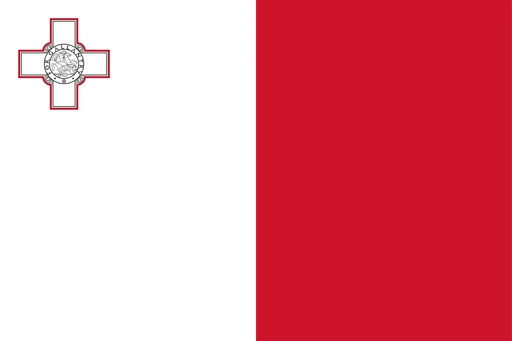
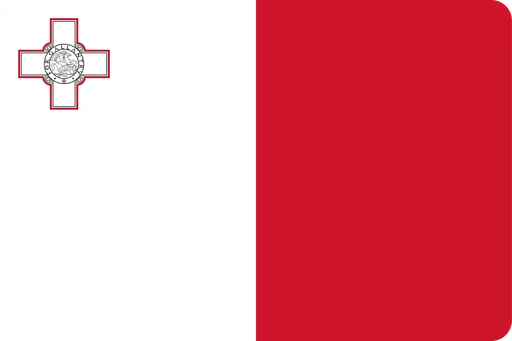
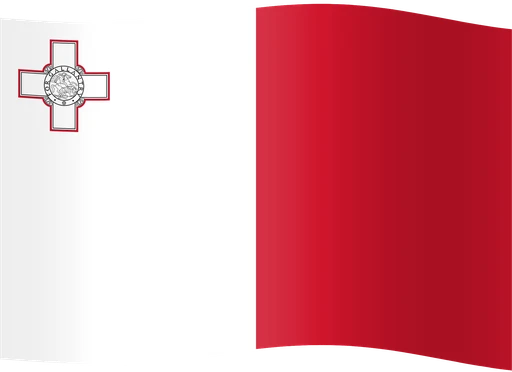
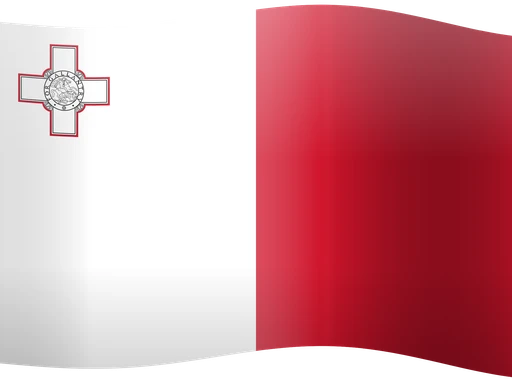
The flag of Malta consists of two vertical halves: white on the hoist side and red on the fly side. It also features a representation of the George Cross, edged in red, in the canton (upper hoist quarter) of the white stripe. The George Cross is a symbol of bravery and is one of the highest awards for gallantry in the United Kingdom and former British colonies. The proportions of the flag are traditionally 2:3.
The flag of Malta is one of only two national flags in the world to carry a military decoration. It is divided into two vertical stripes, white on the hoist and red on the fly, with a representation of the George Cross in the upper hoist corner. King George VI awarded that cross to the entire island in 1942, for its defiance during one of the most intense aerial bombardments in history.
The George Cross and the siege
In April 1942, King George VI did something no British monarch had done before or has done since: he awarded the George Cross, Britain's highest civilian honor for bravery, to an entire island. Not to a soldier. Not to a unit. To every man, woman, and child on Malta.
The reason was staggering. Between 1940 and 1942, Malta endured more than 3,000 air raids from Axis bombers. By some estimates, it became the most bombed place on Earth during the Second World War. The island sat squarely between Axis supply lines and Allied positions in North Africa, making it a target of relentless strategic importance. Its people lived in caves, rationed food to near-starvation levels, and refused to break.
Putting the cross on the flag turned that award into permanent national memory, and it set Malta apart from nearly every other sovereign state. Only one other national flag, the Philippines in its wartime configuration, has controversially displayed a medal. Malta's use is constitutionally enshrined and internationally recognized.
Look closely at the George Cross on the flag and you'll notice it's rendered with a blue-grey fimbriation, a thin border that distinguishes the stylized replica from the actual medal's full-color design. That subtlety matters: the flag represents the honor, not the physical object.
When Malta gained independence from Britain in 1964, the decision to keep the George Cross wasn't automatic. It was a sovereign choice made by a newly free nation, a deliberate embrace of the wartime honor as a cornerstone of what it means to be Maltese.
Red and white, older than the flag
The bicolor of white on the hoist and red on the fly has roots reaching far deeper than the twentieth century. These colors trace back to the Knights of St. John, the Knights Hospitaller, who ruled Malta from 1530 to 1798. Their famous eight-pointed Maltese Cross featured a white cross on a red field, and the flag's colors are essentially an inversion and simplification of that heraldic tradition.
One popular legend pushes the origin even further back. Count Roger I of Sicily supposedly gave part of his red-and-white checkered banner to the Maltese in 1090 as a token of Christian solidarity after helping expel Arab rulers. It's a great story. Historians, however, treat it as largely mythological, a founding legend that says more about Maltese self-image than about eleventh-century events.
What's undeniable is the colors' persistence. Under French rule from 1798 to 1800, and then British rule from 1800 to 1964, various colonial ensigns and administrative flags kept incorporating red and white. Empires came and went. The colors stayed.
The specific shade of red is worth noting: it's a vivid, relatively warm red defined in official specifications, setting it apart from the scarlet or crimson used by neighboring Mediterranean nations. And the arrangement itself is unusual. Most bicolor flags place the darker color on the hoist side, closest to the flagpole. Malta does the opposite, putting white on the hoist and red on the fly. On a flagpole, this creates a distinctive visual impression that's immediately recognizable.
Knights, colonizers, and independence
Before the Knights of St. John ever set foot on Malta, the islands fell under the Kingdom of Sicily, and their heraldry reflected Aragonese and Norman influences. Then came the Knights in 1530, and for 268 years their cross-bearing standards flew over the archipelago, longer than many modern nations have existed. Their visual imprint on Maltese culture is still everywhere, including on the flag.
Napoleon seized Malta in 1798, and the brief French period introduced tricolor influences. But the Maltese rose against French rule within two years, and the interlude left little lasting mark on the island's symbols.
British colonial rule lasted far longer, from 1800 to 1964. During this era, Malta used a colonial blue ensign with a distinctive badge, a version that evolved multiple times as administrative arrangements shifted. Through all of it, the red-and-white pairing endured in unofficial and semi-official contexts. During World War II, Maltese forces and partisans carried a red-and-white flag informally, well before it had any legal standing.
The formal moment came on September 21, 1964, when Malta's independence flag was officially adopted. For the first time, the white-red bicolor with the George Cross was codified in law. The current specifications were further clarified in the Flag and Emblem of Malta Act, which governs protocol, proportions, and usage to this day, ensuring that the flag's design is protected by statute, not just tradition.
Protocol and use
The Flag and Emblem of Malta Act, Cap. 273 of the Laws of Malta, sets out precise legal rules governing everything from the flag's dimensions to the exact representation of the George Cross. Nothing about this flag is left to improvisation.
Proportions are set at a ratio of 2:3, standard for many European and Commonwealth-influenced nations. A civil ensign and a naval ensign exist as official variants. The naval ensign follows a red ensign format adapted for Malta's armed forces, a nod to the island's long maritime heritage.
The flag flies on all government buildings, embassies, and official vessels. Specific national days mandate public display, turning Valletta and the rest of the island into a sea of white and red. Since joining the European Union in 2004, Malta also frequently displays the EU flag alongside the national flag at official venues, a practice governed by EU protocol.
Misuse or desecration of the flag is addressed under Maltese law, and for a nation whose flag carries a literal war medal, that sensitivity runs deeper than the statute suggests. The original George Cross medal itself is kept at the Palace of the Grand Masters in Valletta, separate from but permanently linked to its representation on the flag.
The Maltese Cross and the lookalike flags
The eight-pointed Maltese Cross, with its distinctive forked tips, is one of the most widely recognized heraldic symbols on the planet. You'll find it on the badges of ambulance services, fire departments, and military orders across dozens of countries. It's so ubiquitous that people often encounter it without realizing they're looking at a symbol born in Malta's history.
The national flag itself, being a simple bicolor, sometimes gets confused with similar designs. Poland's flag uses the same two colors but arranged horizontally, white over red. Monaco's flag flips that to red over white, also horizontal. Malta's vertical arrangement and the George Cross set it clearly apart, but at a distance, the resemblance can catch people off guard.
Georgia's flag and the historical flags of various crusading orders share white-and-red cross imagery, part of a broader Mediterranean and Christian heraldic tradition to which Malta firmly belongs. Then there's the Order of Malta, the modern continuation of the Knights of St. John, which is a sovereign entity recognized by over 100 states. It flies its own red flag bearing a white Maltese Cross, legally and diplomatically distinct from the Republic of Malta's national flag.
Gozo, Malta's sister island, has its own regional symbols but flies the national flag rather than a separate banner. Vexillologists often cite Malta's as one of the most historically layered of the simple-looking flags.
The flag in Maltese culture
The flag, and particularly the George Cross, is a touchstone of Maltese national pride. The wartime suffering it commemorates is taught in schools and marked on national holidays, especially Victory Day on September 8. The George Cross Award ceremony of April 15, 1942 is commemorated annually, and the original letter from King George VI is displayed in Valletta.
Maltese diaspora communities worldwide use the flag as a powerful connector to home. Significant populations in Australia, Canada, the UK, and the United States fly it at festivals, churches, and cultural gatherings, keeping the red and white visible far from the Mediterranean.
Back on the islands, the flag appears in art, ceramics, lace, and handicraft traditions, often combined with the eight-pointed Maltese Cross in decorative contexts.
During EU accession debates and Malta's 2003 membership referendum, the national flag became a central symbol in both pro- and anti-EU campaigns. Each side claimed it, which is a reasonable indication that it remains an active political symbol rather than a museum piece.
Sports teams representing Malta internationally carry the red and white with some intensity, particularly in football, where supporters drape themselves in the flag at matches across Europe.
References
[1] Flag and Emblem of Malta Act (Cap. 273), Laws of Malta. Official legal text governing flag specifications and usage. (https://legislation.mt)
[2] Bradford, Ernle. Siege: Malta 1940-1943. London: Hamish Hamilton, 1985. Definitive English-language account of the WWII siege underpinning the George Cross award.
[3] Frendo, Henry. Malta's Quest for Independence. Malta: Valletta Publishing, 1989. Scholarly account of the political transition surrounding the 1964 flag adoption.
[4] Smith, Whitney. Flags Through the Ages and Across the World. New York: McGraw-Hill, 1975. Comprehensive vexillological reference placing the Maltese flag in global context.
[5] Flags of the World (FOTW), Malta entry. Vexillological analysis of design specifications, variants, and history. (https://www.crwflags.com/fotw/flags/mt.html)
[6] The George Cross Award Letter (April 15, 1942), displayed at the Palace of the Grand Masters, Valletta, Malta. Primary source document.
[7] Attard, Lawrence E. The Great Exodus. Malta: PEG Ltd., 1989. Historical account of Maltese emigration and national identity.
[8] Heritage Malta. Official cultural agency with resources on the George Cross medal and Maltese wartime history. (https://heritagemalta.org)
[9] The Sovereign Military Order of Malta. Official site distinguishing the Order's heraldry from the Republic of Malta's national symbols. (https://www.orderofmalta.int)
[10] National Archives of Malta. Primary source repository for historical flag records and colonial-era documentation. (https://nationalarchives.gov.mt)
Common questions
- Why is the George Cross on the Maltese flag?
- The George Cross appears on the Maltese flag because King George VI awarded it to Malta in April 1942. This was in recognition of the island's bravery during World War II, symbolizing the courage and challenges the Maltese people faced under heavy bombing.
- What do the Maltese flag colors mean?
- The white color on the Maltese flag stands for peace and purity, while the red represents courage and bravery. These colors also honor the traditions of the Knights of St. John, who used similar colors historically.
- Why does the Malta flag have a cross on it?
- That's the George Cross, Britain's highest civilian honor. King George VI awarded it to all of Malta in 1942 for surviving over 3,000 Axis air raids during World War II. When Malta gained independence in 1964, they put it right on the flag to remember that incredible wartime resilience.
- Is the cross on the Malta flag a Maltese Cross?
- Nope, it's the George Cross, a British medal for bravery. The eight-pointed Maltese Cross (the one linked to the Knights of St. John) doesn't appear on the flag, though it's everywhere else in Maltese culture and on official emblems.
- How is the Malta flag different from the Poland and Monaco flags?
- All three use the same red and white colors, but the layout's completely different. Poland's got white on top and red on bottom, horizontal. Monaco does the opposite, red on top. Malta's vertical instead, white on the left and red on the right, plus it's the only one with the George Cross in the upper left corner.
Featured in these articles
- The Dragon on the Flag: How Bhutan and Wales Keep Mythical Beasts Alive in Modern Nation-Branding
- The George Cross on Malta's Flag: How a British War Medal Became a Nation's Permanent Symbol of Sovereignty
- The Dragon on the Flag of Bhutan and Wales: Two Ancient Creatures, Two Completely Different Meanings
Download this flag
Free in 12 styles, from 32px icons up to 2000px, as SVG, PNG, WebP and JPG.