The Flag of China
People's Republic of China
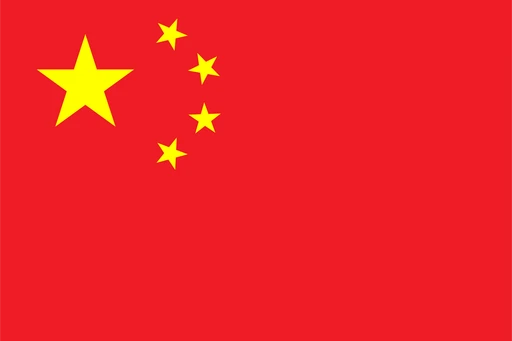
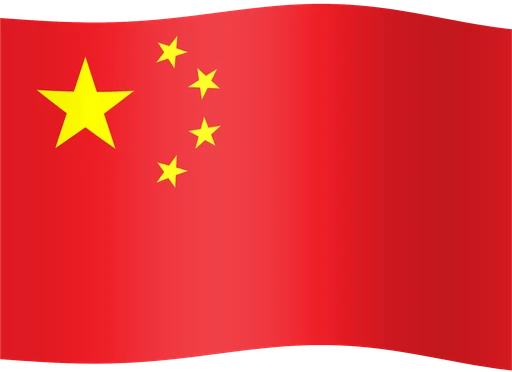
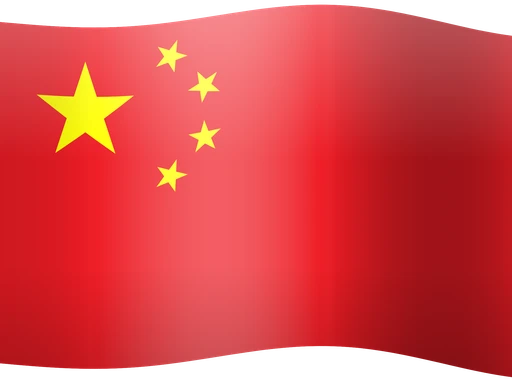
The national flag of the People's Republic of China, known as the Five-star Red Flag, is a red field with five golden stars in the top left corner. One large star sits with four smaller ones in a semicircular arc beside it, each small star tilted so a point aims at the large one. Red is the color of the revolution, and the stars stand for the unity of the Chinese people under the leadership of the Communist Party of China.
The Five-starred Red Flag (五星红旗, Wǔxīng Hóngqí) of the People's Republic of China came not from a committee of party elites but from a sketch by an obscure Shanghai economist named Zeng Liansong, who had no formal design training. It was picked from nearly 3,000 entries in a nationwide competition held in the summer of 1949, and it was first raised over Tiananmen Square on October 1, 1949, the day Mao Zedong proclaimed the founding of the People's Republic. The meaning officially assigned to those five golden stars shifted even before the flag was first hoisted.
Three thousand sketches and one sleepless night: the 1949 design competition
In June 1949, the Chinese People's Political Consultative Conference (CPPCC) Preparatory Committee published a public call for national flag designs in major newspapers across the liberated areas. The response was enormous: 2,992 submissions poured in from citizens, soldiers, overseas Chinese, and party officials. Even Mao Zedong reportedly submitted ideas, favoring a design with a single large star and a horizontal yellow bar running across the red field.
Zeng Liansong, an economist living in Shanghai, had no background in art or design. But he couldn't shake a communist proverb from his mind: "longing for the stars, longing for the moon." Over several sleepless nights in July 1949, he worked out a composition of five golden stars on a red field, one large and four small, arranged so the smaller stars arced around the larger one. His original sketch included a hammer and sickle inside the large star, a direct echo of the Soviet flag.
That hammer and sickle didn't survive deliberations. The committee removed it, partly to distinguish the new PRC flag from the USSR's, and partly because this was meant to be a national flag rather than a party one. The final design was approved on September 27, 1949, four days before it flew at the founding ceremony.
Red field, golden stars: what the flag actually means
The red background represents the communist revolution, colored, as the official explanation goes, by the blood of martyrs who died in the struggle for liberation. It's a symbolic convention shared with socialist flags worldwide, from Vietnam to the Soviet Union, but in China the association runs especially deep given the scale of the civil war and anti-Japanese resistance that preceded the PRC's founding.
The large star represents the Communist Party of China and its leading role in the state. The four smaller stars, at the time of adoption, were explicitly tied to Mao Zedong's "New Democracy" theory: each one stood for one of four social classes united under the CCP. The working class, the peasantry, the urban petty bourgeoisie, and the national bourgeoisie. This was a very specific, very Marxist reading, and it was the officially stated meaning in 1949.
The detail people most often get wrong is the angle of the small stars. Each has one point aimed directly at the center of the large star, which is specified in the flag's construction sheet and stands for the unity of the Chinese people under Party leadership. The golden-yellow color is sometimes read as evoking the Yellow River civilization and the "golden brilliant future," though that reading is informal.
The four-class explanation has quietly faded from everyday use. Today the four small stars are described more loosely as "the Chinese people" or the unity of various nationalities and groups. The design hasn't changed, only what people say it means.
The geometry of revolution: precise construction and proportions
The flag's official proportions are 2:3, and the design is laid out on a notional grid of 15 × 10 units. The large star sits centered at 5 units from the hoist and 5 units from the top, with a circumscribed circle of radius 3 units. Each small star has a circumscribed circle of radius 1 unit. The four small stars are positioned in a semicircular arc to the upper right of the large star, each rotated so one vertex points toward the large star's center.
Getting that rotation right is trickier than it sounds. Unofficial reproductions frequently botch it, placing the small stars upright instead of tilted, which changes the entire visual relationship.
The specific shades of red and yellow are defined in the Chinese national standard GB 12982-2004, with precise colorimetric values. Manufacturing standards are strict: improperly produced flags can trigger regulatory action, and every flag must be made domestically at a designated production facility. This isn't a design you're free to print on a whim.
Protocol, law, and the politics of display
The Flag Law of the People's Republic of China (中华人民共和国国旗法), first enacted in 1990 and revised in 2020, governs the flag's use, display, and protection in extensive detail. Desecration is a criminal offense carrying penalties of up to three years' imprisonment. Burning, defacing, trampling, or publicly disrespecting the flag all qualify.
Every morning at Tiananmen Square, a dedicated unit of the People's Liberation Army performs an elaborate flag-raising ceremony. It's one of Beijing's biggest tourist attractions, drawing thousands of spectators daily and enormous crowds on National Day, October 1. Specific rules govern half-staff occasions: deaths of national leaders, major disasters, and national mourning days.
The 2020 revision of the Flag Law added provisions on digital and online misuse of the flag image, which in practice means policing memes, social media posts, and digital art alongside physical flags. In Hong Kong and Macau, the PRC national flag flies alongside the regional flags, a protocol that has taken on sharply political overtones amid the pro-democracy movements there.
Rivals, alternatives, and the flag that almost was
Several competing designs in the 1949 competition featured a single large star with a horizontal yellow stripe across the center of the red field. Mao initially preferred this approach, but critics pointed out that the bar seemed to split the country in two, evoking national division at the exact moment unity was the message. The stripe was dropped.
Across the Taiwan Strait, the Republic of China continues to fly the "Blue Sky with a White Sun and a Wholly Red Earth" flag, adopted in 1928. Two flags, two governments, one claimed nation. The dispute surfaces at every international sporting event, diplomatic gathering, and UN session where representation is contested.
The PRC flag replaced both the Five Races Under One Union flag (五色旗) of the early Republic (1912-1928) and the ROC's Nationalist flag, each of which told a very different story about Chinese statehood. Visually the five-star red flag is a relative of other socialist state flags, notably Vietnam's single gold star on red, but its constellation of stars is distinct. That motif has since carried into other Chinese institutional flags and emblems.
From Tiananmen to the Moon: the flag in Chinese culture and beyond
In December 2020, the Chang'e 5 mission planted a Chinese flag on the lunar surface, making China the second nation to place its flag on the Moon. The lunar flag was engineered to withstand extreme temperatures and intense UV radiation.
Back on Earth, the flag reaches well past government buildings. Students across China take part in weekly flag-raising ceremonies at school, and "patriotic education" curricula treat the flag's history as a core topic. It appears at Olympic ceremonies, UN proceedings, and diplomatic events, and it also turns up in protest movements and geopolitical flashpoints where China's role is contested.
Zeng Liansong, who sketched the winning design over those sleepless July nights, received no financial reward. He lived modestly in Shanghai until his death in 1999, and his story is now taught in Chinese schools as an example of an ordinary citizen shaping national history. In Chinese cinema, particularly films about the founding of the PRC, the flag-raising at Tiananmen is staged as the climax, reshot by one generation of filmmakers after another.
References
[1] Flag Law of the People's Republic of China (中华人民共和国国旗法), National People's Congress, 1990 (revised 2020). Full text available via the NPC official website.
[2] GB 12982-2004: National Flag (中华人民共和国国旗), Standardization Administration of China. Official manufacturing and colorimetric standard for the PRC national flag.
[3] Records of the Chinese People's Political Consultative Conference (CPPCC) First Plenary Session, September 1949. Primary source on the flag selection deliberations.
[4] Smith, Whitney. Flags Through the Ages and Across the World. McGraw-Hill, 1975. Authoritative vexillological reference with comparative context.
[5] Barmé, Geremie R. In the Red: On Contemporary Chinese Culture. Columbia University Press, 1999. Scholarly treatment of PRC national symbols and their cultural significance.
[6] Zeng Liansong's personal account of the flag design process, as republished in People's Daily retrospective articles and cited in CPPCC historical archives.
[7] Xinhua News Agency reporting on the Chang'e 5 lunar flag placement, December 2020.
[8] Flags of the World (FOTW), crwflags.com. Peer-reviewed vexillological database entry for the PRC flag.
Common questions
- What do the stars on the Chinese flag stand for?
- The big star signifies the leadership of the Communist Party. The four smaller stars represent the unity of the working class, peasantry, urban petty bourgeoisie, and national bourgeoisie under the party.
- Why is the Chinese flag red?
- Red represents the communist revolution and the people of China. It's also a symbol of joy and good fortune in Chinese culture.
- Who created the Chinese flag?
- Zeng Liansong designed the flag. His design was picked from over 3,000 entries in a 1949 competition to reflect the People's Republic of China's new values.
- What do the five stars on the Chinese flag represent?
- The big star is the Communist Party of China. The four smaller ones originally stood for four social classes united under the CCP: workers, peasants, the urban petty bourgeoisie, and the national bourgeoisie. These days, though, the meaning has loosened up. Most people just say the four small stars represent the unity of the Chinese people.
- Why is the Chinese flag red with yellow stars?
- The red background is about the communist revolution and the blood of those who died fighting for liberation. The golden-yellow stars symbolize a bright future. Some people connect the yellow to China's Yellow River civilization, but that's more of a folk interpretation than anything official.
- Who designed the Chinese flag?
- A Shanghai economist named Zeng Liansong. He had no formal design training. In 1949, China held a nationwide competition that pulled in nearly 3,000 entries, and his won. His original sketch actually had a hammer and sickle inside the large star, but the committee removed it. They wanted the flag to feel like a national symbol, not just a party one, and to look distinct from the Soviet flag.
- Why do the small stars on the Chinese flag point toward the big star?
- Each small star is tilted so that one of its points aims right at the center of the large star. It's meant to show the unity of the Chinese people under the Communist Party's leadership. This angle is spelled out in the flag's official construction sheet, and it's a detail that unofficial versions often get wrong by placing the small stars upright.
- Has China ever planted its flag on the Moon?
- Yes! In December 2020, the Chang'e 5 mission placed a Chinese flag on the lunar surface. That made China the second country to put its national flag on the Moon. The flag was specially engineered to handle extreme temperatures and intense UV radiation.
Featured in these articles
- Red, Gold, and the Flag That Belongs to Everyone: How Communist Vietnam and Royal Spain Ended Up Wearing the Same Colors
- The Dragon That Had to Be Tamed: Why Bhutan's Druk Is the Most Precisely Controlled Symbol in Flag History
- The Sun That Rises Differently: How Japan's Rising Sun Flag Became the World's Most Contested Military Symbol
- The Bauhinia That Blooms for No One: Hong Kong's Post-Handover Flag and the Politics of Botanical Design
Download this flag
Free in 12 styles, from 32px icons up to 2000px, as SVG, PNG, WebP and JPG.