Hand someone a blank rectangle and ask them to design a flag, and nine times out of ten they will reach for horizontal or vertical stripes. That is the default, inherited from centuries of European heraldry and military banners, and of the 193 UN member states the overwhelming majority use some arrangement of horizontal or vertical bands.
A small handful went the other way and drew a line corner to corner.
The choice looks like pure geometry, but it carries a lot of narrative weight, because a diagonal implies motion and tension in a way that horizontal calm and vertical stability never do. Guyana, Tanzania, and Saint Kitts and Nevis all made that choice, and in each case the slash across the cloth is doing argumentative work about breaking from a colonial past and welding divided territories and peoples into something new.
Why diagonals read differently
Flags have a grammar most of us never think about, and layout communicates before color or symbol registers at all.
Horizontal stripes suggest stratification and stability. France, Germany, the Netherlands: layered, settled, at rest.
Vertical stripes suggest equal pillars side by side. Italy, Ireland, Nigeria: partners in a row, balanced and orderly.
Diagonals imply movement, and a division being actively crossed. A cut that separates and connects at the same time.
Whitney Smith, who founded the Flag Research Center and coined the word "vexillology," wrote extensively about flag semiotics, and his work established that geometry is a flag's first message, processed before any conscious reading of color or emblem. The diagonal is also the rarest primary layout among national flags, which makes reaching for it a self-conscious decision rather than an inherited one.
That matters because the colonial template flags, the British Blue and Red Ensigns, the French tricolores, were all horizontal or vertical. A newly independent nation that chose a diagonal was performing a visual break from the colonizer's design language on top of the political one.
The three cases below, Guyana in 1966, Tanzania in 1964, and Saint Kitts and Nevis in 1983, are all postcolonial, all diagonal, and all telling a story of transformation rather than settled order.
Guyana's Golden Arrowhead
Guyana's flag is one of the most dynamic national designs anywhere. A green field carries a red triangle at the hoist, overlaid by a black-bordered golden triangle, the arrowhead, pointing toward the fly. The whole composition is built on a diagonal axis that drags the eye forward.
Whitney Smith designed it himself, which makes this one of the very few cases where a leading flag scholar directly shaped a national banner. He was not theorizing about diagonal energy in the abstract. He built it into the cloth.
The symbolism runs layer by layer. Green for agriculture and the forests covering much of the interior, white for the rivers, gold for mineral wealth, black for endurance through hardship, red for the drive of nation-building. The arrowhead does more than divide the field. It aims it.
Guyana gained independence from Britain on May 26, 1966, and the flag was part of a deliberate effort by Premier Forbes Burnham and the independence movement to present the country as a nation in motion rather than a static postcolonial state.
Compare it with neighboring Suriname's horizontal stripes, or with the broader Caribbean pattern of horizontal tricolors.
Guyana's stands out in the region precisely because it refuses the conventional layout. It looks like it is going somewhere, which was the whole rhetorical point.
There is a political layer underneath. Guyana's population includes Indo-Guyanese, Afro-Guyanese, and Indigenous peoples, and the tensions between those groups have shaped the country's post-independence history. The arrow was meant to cut across those divisions and point everyone the same way. Whether it worked politically is arguable. The argument itself is right there on the flag.
Tanzania's slash: two nations in one cloth
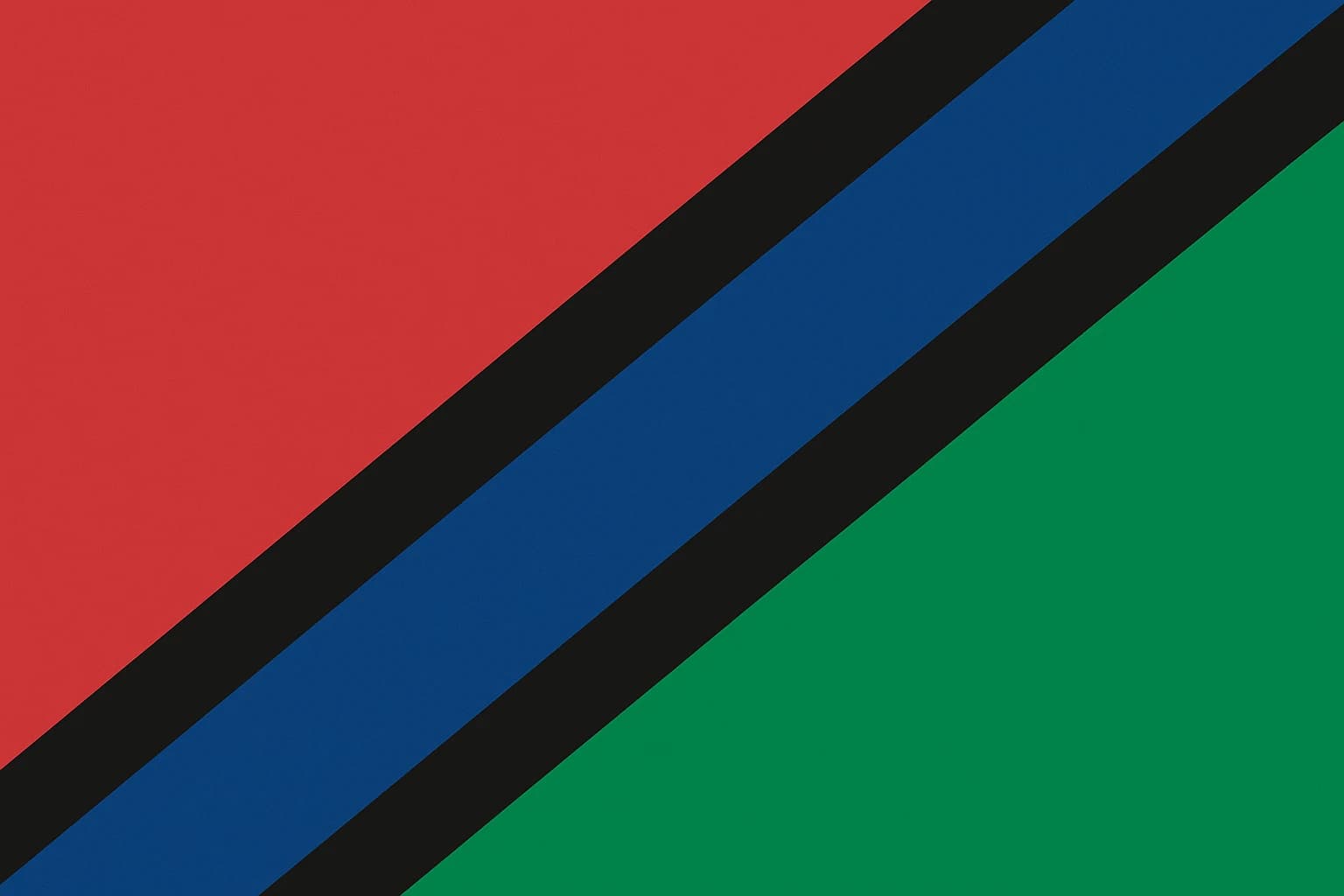
Tanzania's flag reads clearly once you know the history. A diagonal black band edged in yellow runs from the lower hoist to the upper fly, with green filling the upper-left triangle and blue the lower-right.
It was adopted on June 30, 1964, six months after Tanganyika and Zanzibar merged into the United Republic of Tanzania, and it is a literal merger of two older flags. Tanganyika's used green, black, and green horizontal stripes with yellow borders. Zanzibar's post-revolution flag used blue, black, and green horizontal bands. The diagonal combined both identities without putting either on top.
Green represents the land and agriculture, blue the Indian Ocean and Zanzibar's island identity, black the Swahili people who form the demographic core of both territories, and yellow the mineral wealth. The line itself carries the most meaning, since it is the seam along which two rectangles of identity join.
Julius Nyerere's vision of ujamaa, or familyhood, and of pan-African unity informed the design. It was needed. The merger was contentious: Zanzibar had gone through a violent revolution in January 1964, and many Zanzibaris were uneasy about absorption into a larger mainland state. A flag that communicated partnership rather than conquest had to give neither territory the top or bottom position, and the diagonal does exactly that, leaving green and blue in corners of equal weight.
The alternative is instructive. When Egypt and Syria formed the United Arab Republic from 1958 to 1961, they stacked horizontal stripes, which communicated hierarchy, or at best sequence. Tanzania's solution was more honest about what joining two distinct political entities actually involves.
Saint Kitts and Nevis: a black band between struggle and abundance
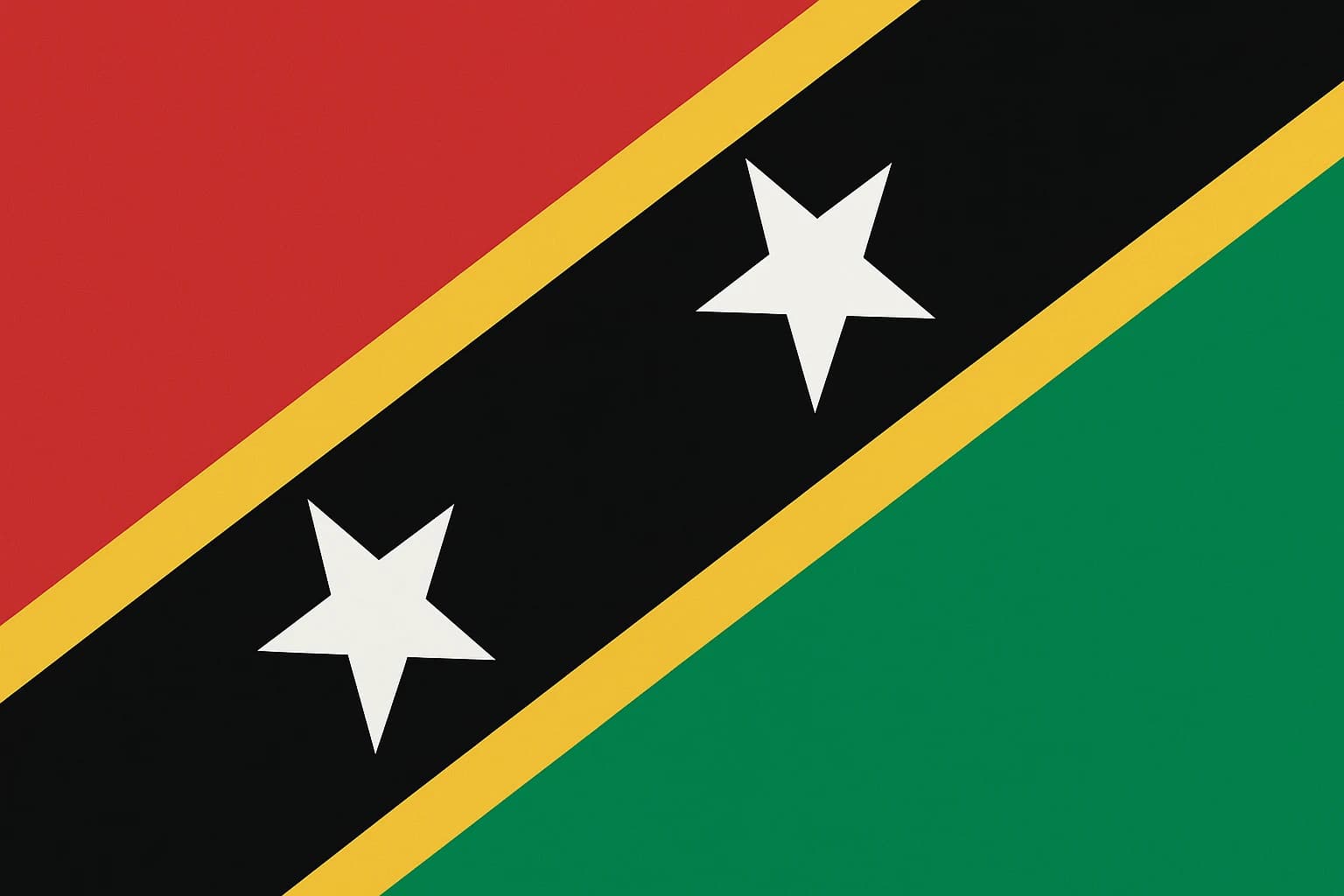
Saint Kitts and Nevis adopted its flag on September 19, 1983, at independence from Britain, making it the newest nation in the Americas at the time.
Two white stars sit on a diagonal black band edged in yellow, separating a green upper-left triangle from a red lower-right one. The band cuts through the entire field and refuses to behave like an accent.
Green represents the fertile land, red the struggle against slavery and colonialism, black the African heritage of the majority population, and yellow the year-round Caribbean sunshine. The two white stars stand for hope and liberty, one per island. The black band places African identity at the center of the design, mediating between the painful past and the natural abundance on either side of it.
The design came out of a national competition won by a student, Edris Lewis, which matched the participatory mood of the independence moment. Where safer entries would have used horizontal bands, Lewis drew a line through the whole rectangle.
Saint Kitts and Nevis was among the last Caribbean nations to gain independence, and the flag was built to assert a fully formed identity rather than one tentatively emerging from a colonial shadow.
The two stars also speak to the federation's internal duality. Nevis has kept its own island assembly and has periodically flirted with secession; a 1998 referendum fell just short of the two-thirds majority needed to break away. The stars sit on a shared band, holding the federation together visually while politics pull at it.
Set that against other Caribbean flags. Barbados, Jamaica, Trinidad and Tobago mostly use vertical or horizontal schemes or a single geometric device.
The full diagonal slash is unusual in that company, and it reads as a more assertive postcolonial voice.
The diagonal as postcolonial rhetoric
Three continents, three decades, three colonial histories, one geometric tool. That is not coincidence.
Nearly all diagonal national flags belong to postcolonial nations. The Republic of the Congo, Namibia, and the Solomon Islands all fit the pattern.
Horizontal and vertical layouts carry the weight of European heraldic tradition. The diagonal offered a way around it.
It also creates visual tension. The eye follows a diagonal and looks for resolution, where horizontal lines settle and vertical lines stand. For nations that were themselves in motion, newly independent or freshly merged, that was the honest geometric choice.
Graphic design theory eventually caught up: diagonals convey energy, disruption, and urgency, and these flag designers were working with that principle decades before it became a design-school staple. Vexillological analysis still tends to focus on colors and emblems, on eagles and stars and crescents, and to treat layout as secondary. In these three cases the layout is the emblem.
What became of the three
Guyana's Golden Arrowhead has become a diaspora symbol, carried by Guyanese communities from Brooklyn to Toronto. With the oil boom driven by the Stabroek Block discoveries putting the country in the global spotlight, that forward-pointing arrow reads as almost prophetic, since a flag designed to say "we are going somewhere" now belongs to one of the fastest-growing economies on earth.
Tanzania's remains one of the most recognizable flags in Africa, and design circles still cite it as an elegant answer to the problem of depicting a political union. The seam holds.
The Saint Kitts and Nevis flag keeps doing its quiet work. The Nevis question is unresolved, but the two stars on their shared black band assert the federation from every flagpole on both islands, decade after decade.
No major nation has adopted a new diagonal flag design this century. The era of bold geometric experimentation appears to have closed, which makes these mid to late 20th century designs artifacts of a specific moment in postcolonial thinking about what a flag was for.