The Flag of Germany
Federal Republic of Germany
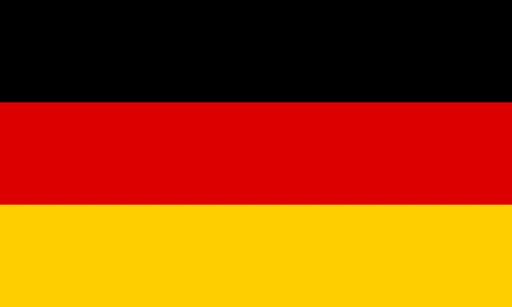
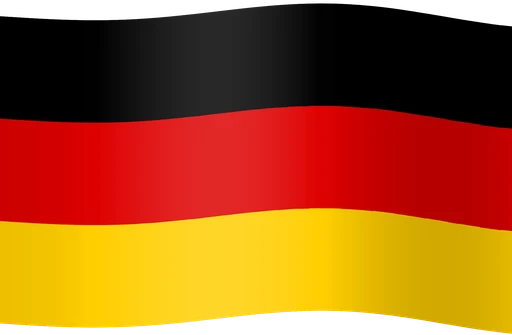
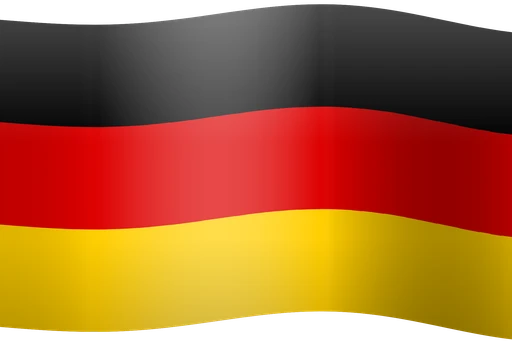
The flag of Germany has three horizontal bands of equal width: black at the top, red in the middle, and gold at the bottom. The tricolor is associated with German unity and freedom.
The flag of Germany, three horizontal bands of black, red, and gold, carries nearly two centuries of democratic struggle and national aspiration. The colors were not handed down by a ruling dynasty. They came from below, taken up by student revolutionaries and liberal nationalists who wanted a unified, free Germany long before one existed. They were banned, replaced, and fought over, and the version flying today was chosen as a deliberate rebuke to the darkest chapters of German history.
Born in revolution
The story begins in 1813, with a volunteer fighting force called the Lützow Free Corps. These men took up arms against Napoleon's occupation of German lands, and because they came from all walks of life and could not afford matching uniforms, their coats were dyed the cheapest color available: black. Red facings and gold-colored buttons completed the look. It was practical rather than symbolic, but the combination stuck, and after the wars the colors became shorthand for German resistance and unity.
Student fraternities known as the Burschenschaften took it up next. In the early decades of the 19th century these young radicals adopted black, red, and gold as a rallying cry for a liberal, constitutional, unified German state, something that existed nowhere on any map. The Hambach Festival of 1832 brought the tricolor into the open air: roughly 30,000 people gathered in the Bavarian Palatinate to demand constitutional government and national unification, waving the black-red-gold banner in one of the first mass political demonstrations in German history.
Then came 1848. Revolutions swept across Europe, and in Frankfurt a newly convened parliament adopted black-red-gold as the colors of a proposed unified Germany, the first time they appeared on something intended as a national flag. The revolution failed and the parliament dissolved, leaving the flag with no state to fly over. What it represented was not what Germany was but what it might become.
Rival banners and suppressed colors, 1871 to 1949
When Otto von Bismarck unified Germany in 1871, he did it on Prussian terms, and the flag reflected that. The new German Empire flew black, white, and red, the colors of Prussia and the North German Confederation. The liberal tricolor was deliberately sidelined. Bismarck's Germany was authoritarian, militaristic, and monarchical, and black-red-gold carried too much of the democratic revolution with it.
The Weimar Republic changed that. After the Kaiser abdicated in 1918 and democracy arrived, the new republic restored black-red-gold in 1919, reconnecting itself with the unfinished project of 1848. The choice ignited a bitter culture war. Nationalists and monarchists despised it, mocking the Weimar tricolor as the "schwarz-rot-senf" flag, "black-red-mustard," a jab at the gold as something cheap and ordinary. The imperial black-white-red remained popular among right-wing factions, and street brawls over which flag to fly were not uncommon.
When the Nazis came to power in 1933, the democratic colors were erased. Black-white-red returned alongside the swastika, and by 1935 the swastika flag was the sole national flag. Black-red-gold was not simply replaced; it was actively suppressed.
After the Second World War, the choice facing a shattered Germany was intensely symbolic. The Allied powers permitted the restoration of black-red-gold, and when West Germany adopted it in 1949 the decision was anything but casual. The new republic chose these colors precisely because of their anti-authoritarian history, which makes the German tricolor one of the few national flags explicitly selected as a repudiation of its predecessor.
One flag, two Germanys
After 1949, both West Germany and East Germany flew identical black-red-gold tricolors. At international events like the Olympics, the two delegations marched behind the same flag, which was awkward and politically charged.
East Germany resolved the problem in 1959 by adding its own coat of arms to the tricolor: a hammer and compass encircled by a wreath of rye, symbols of the workers, intellectuals, and farmers building a socialist state. West Germany refused to add any emblem, and the plain tricolor became a political statement in itself. The same three colors now told two completely different stories, one of Western liberal democracy and one of Soviet-aligned socialism.
After reunification on October 3, 1990, the plain West German tricolor was adopted as the flag of the unified nation and the GDR's emblem-bearing version disappeared. The choice was more than aesthetic: it declared the Federal Republic the legitimate successor state.
One wrinkle worth knowing: the Federal Eagle, the Bundesadler, does appear on Germany's official state flag and coat of arms, but not on the civil flag. The distinction matters in protocol and reflects a careful balance between state authority and civic identity.
What black, red, and gold actually mean
There is no single official government interpretation of the colors, and the absence is itself revealing. The meaning has been debated and contested over generations rather than decreed from above.
The most resonant formulation comes from the 1848 era: "Aus der Schwärze der Knechtschaft durch blutrote Kämpfe zum goldenen Licht der Freiheit," or "From the blackness of servitude, through blood-red battles, to the golden light of freedom." It is almost certainly retrospective rather than original, but it captured something real about how Germans read the sequence of colors as a narrative arc.
The Lützow Corps origin offers a more literal reading: the physical colors of the uniform, black cloth, red trim, gold buttons.
One distinction matters more than it might appear: the third stripe is officially "gold," not yellow. The golden hue links the flag to the imperial eagle of the Holy Roman Empire and to centuries of golden symbolism in European heraldry, connecting sovereignty, enlightenment, and aspiration. Vexillologists note that the flag earned its meaning through popular struggle rather than royal decree. Comparisons to the French Tricolor are instructive: both flags were born in revolution, both were suppressed and restored.
Protocol, variants, and the flag in practice
The civil flag, the Bundesflagge, is the plain tricolor, and any citizen can fly it. The state flag, or Dienstflagge, carries the Federal Eagle and is reserved for government buildings and official use. Unauthorized use of the state flag can result in a fine. Naval and maritime variants exist too, with the Bundesadler centered on the tricolor in slightly different configurations.
Official proportions are specified as 3:5 for the civil flag. Flag days are designated by the federal government, and flying the flag is encouraged but never legally compelled for citizens. That is a conscious choice. Given the history of forced flag display under the Nazi regime, compulsion would carry an unbearable echo.
Germany's relationship with flag-waving is culturally complex. For decades after the war, public displays of the national flag were relatively rare and sometimes viewed with suspicion. That shifted during the 2006 FIFA World Cup, hosted in Germany, when millions of fans draped themselves in black-red-gold. The sight prompted wide cultural commentary about whether Germany was finally comfortable with itself. The "Sommermärchen" (summer fairy tale) moment did not resolve the tension, but it loosened it considerably.
The flag's identity is enshrined in Article 22 of the German Basic Law: "Die Bundesflagge ist schwarz-rot-gold."
Belgium, Austria, and the family of tricolors
Belgium's flag, black, yellow, and red in vertical stripes, shares the same palette, and the kinship is not coincidental. Belgium's revolution of 1830 drew on the same well of European liberal nationalism that fed the German tricolor. The two flags are siblings, born of the same revolutionary moment and arranged differently.
Austria's flag, red-white-red, is one of the world's oldest national banner designs, tracing its legend back to the Siege of Acre in 1191. The contrast with Germany's choice shows how differently two neighboring nations built identities through symbols: one looking to medieval crusading heritage, the other to 19th-century democratic aspiration.
Behind both the German tricolor and the Austrian eagle sits a common ancestor: the flag of the Holy Roman Empire, a black eagle on a golden field. That combination echoes forward through centuries of Central European heraldry. Black-red-gold also influenced nationalist movements across the region in the 19th century, appearing in various forms on the flags of former German states and political movements. The colors traveled further than Europe: the flag of Tanzania's ruling party carries a similar palette, a trace of how far revolutionary color symbolism spread from 19th-century European nationalism.
References
[1] German Basic Law (Grundgesetz), Article 22. Official constitutional text, available via the Bundestag website. (https://www.bundestag.de)
[2] Federal Government of Germany: "The Federal Flag." Official explainer on national symbols. (https://www.bundesregierung.de)
[3] Whitney Smith, Flags Through the Ages and Across the World (McGraw-Hill, 1975). Foundational vexillology reference covering the history of flag design worldwide.
[4] Peter Wende, A History of Germany (Palgrave Macmillan, 2005). Comprehensive historical context for Weimar-era and post-war flag politics.
[5] Frank Lorenz Müller, The Revolution of 1848-1849 in the German States. Scholarly account of the Frankfurt Parliament and the adoption of the first national tricolor.
[6] FOTW (Flags of the World). Peer-reviewed vexillological database with detailed German flag specifications and variants. (https://www.fotw.info)
[7] Flaggenerlass (Flag Decree) of the Federal Republic of Germany. Official government regulations on flag usage, proportions, and designated flag days.
[8] Harold Marcuse, Legacies of Dachau (Cambridge University Press, 2001). Context for understanding post-war symbolic choices in German public life.
[9] Der Spiegel and Die Zeit archive coverage of the 2006 World Cup and its impact on German national identity and flag culture.
Common questions
- What do the colors black, red, and gold represent on the German flag?
- There's no official meaning, but the most popular explanation comes from the 1848 revolution: "From the blackness of servitude, through blood-red battles, to the golden light of freedom." The colors actually came from the Lützow Free Corps in 1813 (black coats, red trim, gold buttons), and later democratic revolutionaries adopted them as symbols of a free, united Germany.
- Why is the German flag gold instead of yellow?
- It's officially gold, not yellow, and the distinction matters. Gold connects the flag to the imperial eagle of the Holy Roman Empire and to European heraldry, suggesting sovereignty and enlightenment. During the Weimar Republic, critics mocked the flag by calling it "black-red-mustard" to ridicule those golden tones.
- Why did the Nazis ban black, red, and gold?
- Because these colors were tied to democracy and the Weimar Republic, which the Nazis hated. After 1933, the regime suppressed the tricolor and brought back the imperial black-white-red flag alongside the swastika. When West Germany was founded in 1949, black-red-gold was deliberately restored as a rejection of the Nazi era and a nod back to the democratic tradition of 1848.
Featured in these articles
- The Flag That Had to Please Everyone: How the European Union's Circle of Stars Became the Most Negotiated Image in History
- The Diagonal That Refuses to Be Ignored: What Trinidad, Tanzania, and Namibia's Bold Stripes Are Really Saying
- The Sun That Rises Differently: How Japan's Rising Sun Flag Became the World's Most Contested Military Symbol
- The Diagonal That Changed Everything: How Saint Kitts and Nevis Turned a Simple Black Stripe Into a Masterclass in Flag Geometry
Download this flag
Free in 12 styles, from 32px icons up to 2000px, as SVG, PNG, WebP and JPG.