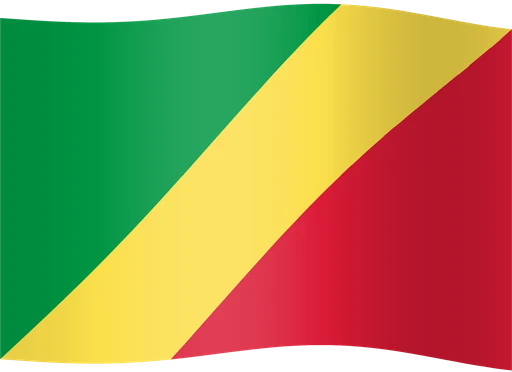
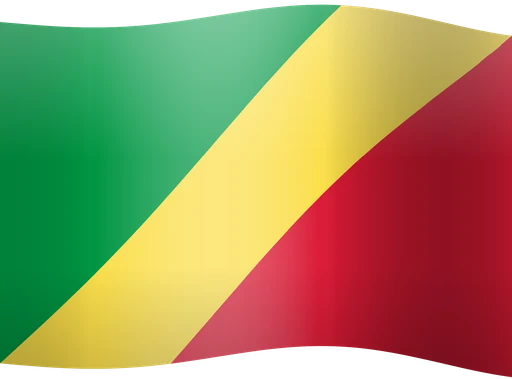
The Flag of The Republic of the Congo
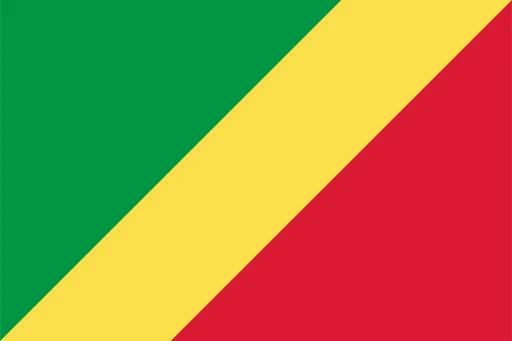
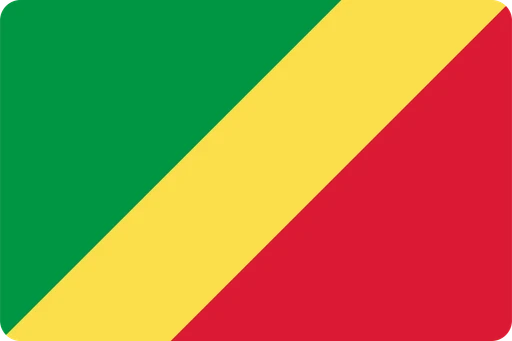
The flag of the Republic of the Congo consists of a diagonally divided field with a yellow band running from the lower hoist side to the upper fly side, dividing the flag into two triangles. The triangle on the hoist side is green, and the triangle on the fly side is red. The colors are pan-African, and in Congolese use they point to the country's natural resources and its struggle for independence.
The flag of the Republic of the Congo is one of the few national flags divided diagonally: a green and red bicolor split by a yellow band running from the lower hoist to the upper fly. It was adopted at independence in 1959, dropped in 1970 for a Soviet-inspired red banner during the country's Marxist-Leninist period, and put back in 1991 when the one-party state gave way to multiparty democracy. The Pan-African colors are shared with much of the continent. The geometry is not.
A flag lost and found: 1959, 1970, 1991
On September 15, 1959, a full year before the Republic of the Congo achieved complete independence from France on August 15, 1960, the country adopted its distinctive diagonal tricolor. At that point, it was still the autonomous Republic of the Congo within the French Community, but it already wanted a flag that looked nothing like what came before. The diagonal design was a deliberate break from the vertical and horizontal tricolor tradition inherited from the French colonial framework. It was meant to set the new nation apart from its neighbors, many of whom were simultaneously designing their own flags from the same limited palette of Pan-African colors.
That flag flew for just over a decade. In 1970, following Marien Ngouabi's Marxist coup and the establishment of the People's Republic of the Congo, the diagonal tricolor was scrapped. In its place came a red field bearing a crossed hammer and hoe, a gold star, and a green wreath, all deliberately echoing Soviet and Eastern Bloc iconography. This wasn't subtle. The new flag made the country's ideological alignment visible from any flagpole, and it flew for over two decades as the dominant emblem of the one-party state under the Congolese Party of Labour (PCT).
Then came 1991. During the National Sovereign Conference that dismantled the one-party system, one of the very first symbolic acts was the restoration of the original 1959 flag. It happened on June 10, 1991, and the gesture carried enormous weight: the country was physically unfurling its pre-Marxist identity, reclaiming a visual heritage that an entire generation had never lived under. That date is sometimes cited alongside the original 1959 adoption as a dual founding moment for the flag, and reasonably so. Few national flags have been abolished and then brought back to life with such clear political intent.
The diagonal that defies convention
Almost nobody uses diagonal flag designs. The Republic of the Congo shares the trait with only a handful of other nations, including Tanzania, Namibia, and Trinidad and Tobago, though each deploys the diagonal differently. On the Congolese flag, a yellow stripe runs from the lower-left (hoist) corner to the upper-right (fly) corner, dividing the field into a green upper-left triangle and a red lower-right triangle. The proportions are officially 2:3, and the yellow band occupies roughly one-third of the flag's width measured perpendicular to the diagonal.
There's a practical vexillological advantage to this layout. When a flag hangs limp on a windless day, horizontal tricolors can look like nothing more than colored stripes. A diagonal creates visual dynamism whether the flag is flying, hanging, or draped over a balcony. During the decolonization era, when dozens of new African nations were adopting flags almost simultaneously, this kind of instant recognizability mattered. The Congolese flag doesn't need wind to look interesting.
Pan-African roots, Congolese meanings
Green, yellow, and red. You'll find these colors on flags across the continent, drawn from the Pan-African tradition that links dozens of nations to the broader movement of African independence and solidarity. But the specific meanings attached to each color shift from country to country, and the Republic of the Congo has its own interpretations.
Green points to the country's agriculture and its vast equatorial forests. This isn't decorative symbolism: the Congo Basin rainforest is the second-largest tropical forest on Earth, and it dominates the national landscape. Yellow is glossed as friendship and nobility, and as the country's natural wealth: the petroleum, timber, and minerals that have shaped the post-independence economy. Red honors those who fought for independence from colonial rule.
The diagonal itself carries meaning beyond aesthetics. It's been read as symbolizing forward movement, a path cutting dynamically across the field rather than sitting passively in horizontal bands. There's an interesting tension, though, between official government explanations and popular interpretations. Some Congolese sources de-emphasize the standard Pan-African glosses entirely, focusing instead on hope and progress. The flag resonates locally in ways that go beyond continental symbolism, and that's part of what keeps it alive in everyday life.
Two Congos, two flags
If you've ever mixed up the Republic of the Congo (Congo-Brazzaville) with the Democratic Republic of the Congo (Congo-Kinshasa), you're not alone. These two nations, separated by the Congo River, share a name, a geographic heritage, and even a diagonal motif on their flags. The DRC's flag features a sky-blue field with a diagonal red stripe bordered in yellow and a yellow star in the upper-left corner. In practice, the two designs look quite different, but the coincidence of diagonal geometry is notable.
Both nations drew from the same Congo River basin cultural heritage and French/Belgian colonial frameworks, making their flag choices part of a broader effort to establish separate identities after independence. In international contexts, at the United Nations, the African Union, or Africa Cup of Nations tournaments, the two flags are frequently displayed near each other alphabetically, so telling them apart at a glance has practical value.
The flag in Congolese life and protocol
Article 5 of the 2015 Constitution of the Republic of the Congo enshrines the diagonal tricolor as a national emblem, placing it alongside the national anthem "La Congolaise" and the national motto. It flies at government buildings, military installations, and diplomatic missions, with its display governed by protocol laws common across Francophone African states.
Two dates bring the flag out in force: Independence Day on August 15 and the anniversary of the 1991 National Conference. Both occasions see prominent displays and patriotic ceremonies in Brazzaville and across the country. You'll also spot it at Africa Cup of Nations tournaments, where the national football team's kits carry the green, yellow, and red, and Congolese fans in the stands turn the diagonal tricolor into a sea of color.
In the Congolese diaspora, particularly in France where a significant expatriate community lives, the flag functions as a marker of cultural identity. At community gatherings, concerts, and cultural festivals in Paris and other French cities, it's the green-yellow-red diagonal that signals home, not a map or a coat of arms. Not bad for a design that spent two decades out of official use.
References
[1] Constitution of the Republic of the Congo (2015), Article 5. Official definition of national symbols including the flag, anthem, and motto.
[2] Whitney Smith, Flags Through the Ages and Across the World (1975). Comprehensive vexillological reference covering the original 1959 adoption and design rationale.
[3] Flags of the World (FOTW), "Republic of the Congo." The world's largest online vexillology resource, with detailed historical notes on the 1970-1991 Marxist-era flag and the 1991 restoration. https://www.crwflags.com/fotw/flags/cg.html
[4] Rémy Bazenguissa-Ganga, Les voies du politique au Congo (1997). Scholarly analysis of the 1991 National Sovereign Conference and the symbolic politics of flag restoration.
[5] Flag Institute (UK), World Flag Database. Technical specifications, proportions, and historical flag variants for the Republic of the Congo. https://www.flaginstitute.org/wp/
Common questions
- What is the difference between the flags of the Republic of the Congo and the DRC?
- They are two different countries with different flags. The Republic of the Congo (Brazzaville) uses a diagonal yellow band separating green and red triangles. The Democratic Republic of the Congo (Kinshasa) uses a sky blue field with a yellow star and a red diagonal stripe fimbriated in yellow.
- Why was the Republic of the Congo's flag changed and then restored?
- The original 1959 flag was replaced in 1970 when the country became a People's Republic and adopted a red field with the national emblem. It was reinstated on 10 June 1991 after the Marxist-Leninist government collapsed, as a deliberate return to the symbols of independence.
- What do the colours on the Republic of the Congo's flag mean?
- They are the pan-African colours. In Congolese use, green points to the country's forests and natural resources, yellow to its friendship and nobility, and red to the blood shed in the struggle for independence. The diagonal arrangement is unusual and distinguishes it from other pan-African tricolours.
- When did the Republic of the Congo adopt its flag?
- On 15 September 1959, shortly before independence from France on 15 August 1960. It was in use for eleven years, replaced for twenty-one, and restored in 1991, so the current flag has a longer gap in its service than most.
Featured in these articles
- The Diagonal That Refuses to Be Ignored: What Trinidad, Tanzania, and Namibia's Bold Stripes Are Really Saying
- Diagonal Lines and Divided Futures: How Guyana, Tanzania, and Saint Kitts and Nevis Used Slashes to Tell Stories of Struggle
- The Diagonal Divide: Why Some Flags Cut Themselves in Half at an Angle, and Why It Matters
- Diagonal Lines and What They Mean: The Bold Geometry of Trinidad, Namibia, and Tanzania
Download this flag
Free in 12 styles, from 32px icons up to 2000px, as SVG, PNG, WebP and JPG.