The Parrot, the Sisserou, and the Rose: How Dominica Put a Rare Bird on Its Flag, and What It Cost
Julio Song · · 9 min read
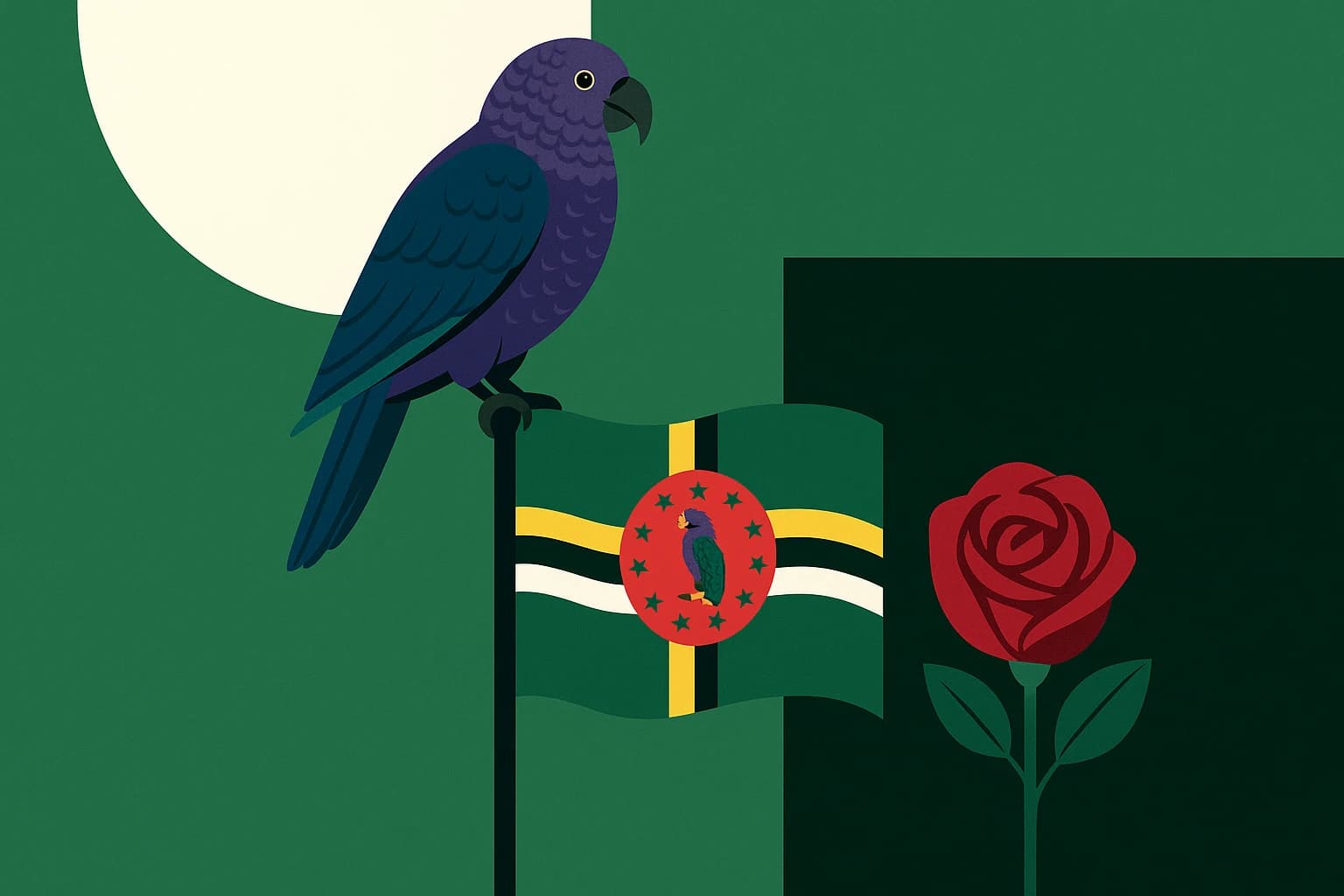
One national flag shows a living animal drawn in near-photorealistic detail, centered on a field of green, ringed by ten stars, crossed by three colors, and finished in a shade of purple that appears on no other flag on Earth. It belongs to a Caribbean island of fewer than 75,000 people. The animal at its center, the Sisserou parrot (Amazona imperialis), is critically endangered, lives nowhere else, and could plausibly go extinct within the lifetime of children alive now. Dominica has staked its national identity on a species that is disappearing.
A flag unlike any other
Start with what you see. A deep green field. A cross of yellow, black, and white dividing it into four quadrants. At the center a red disc, and inside it a parrot rendered with real ornithological specificity: green body plumage, a violet-purple head, dark wing feathers. Ten green five-pointed stars ring the disc, one for each of Dominica's parishes.
The strangeness goes past composition. Purple was so expensive to produce as a dye that it was effectively barred from flag design for centuries. Tyrian purple, extracted from the mucus of Murex sea snails, took thousands of mollusks per ounce, and it was the color of Roman emperors and Byzantine royalty for that reason. By the time synthetic aniline dyes made purple cheap in the 19th century, flag tradition had already settled around the reds, blues, whites, greens, and yellows of the pre-industrial palette. Purple never got into the vocabulary.
Dominica's is still the only sovereign national flag where purple is a prominent, named part of the design. Nicaragua's coat of arms contains a tiny rainbow with a purple band in it, but that is a technicality by comparison.
Animals on flags usually arrive stylized. Mexico's eagle is heraldic; Albania's double-headed eagle is a silhouette. Dominica's Sisserou is a recognizable species, the kind of drawing a birdwatcher could identify. None of that was accidental, which raises the question of who decided to put this particular bird here, and what it has cost since.
The 1978 independence process
Dominica moved from British associated statehood to full independence on November 3, 1978, under Prime Minister Patrick John, part of a wave of Caribbean sovereignty moments that had been building for over a decade after Trinidad and Tobago in 1962, Barbados in 1966, and Grenada in 1974.
The design came out of a government competition and committee process led by Alwyn Bully, a Dominican playwright, artist, and cultural figure. Bully was not a vexillologist. He was a storyteller, and it shows in the result.
He wanted a flag that could only belong to Dominica, one a child anywhere could look at and know was not generic. The Sisserou answered that in a single stroke, because no other nation had the bird and no other nation could claim it.
The rest carries deliberate meaning too. Ten stars for the ten parishes. The tricolor cross for the Christian Trinity and for Dominica's three principal rivers. The green field for the island's forest cover, so thick and persistent that Dominica is said to be the one Caribbean island Columbus would still recognize. The official motto, "Après Bondie, C'est La Ter" ("After God, the Earth"), ties the whole thing to the land.
Which way should the parrot face?
In 1981, and again in 1988, the orientation of the Sisserou, whether it faces the hoist toward the flagpole or the fly away from it, became a real point of national political contention.
Heraldic tradition holds that animals on flags and coats of arms face the hoist, symbolizing advance rather than retreat. The original 1978 design had the bird facing the fly, and critics argued that the national bird looked like it was fleeing.
The 1981 change came under Prime Minister Eugenia Charles, Dominica's first female prime minister and one of the Caribbean's most consequential political leaders. The parrot was reversed. A later revision changed it again, leaving a period of genuine confusion about which version was official.
The heat had little to do with aesthetics. In post-independence Caribbean politics the flag was a live symbol rather than a settled artifact, so arguments about its design were arguments about who controlled the story of the nation. The same pattern shows up elsewhere: South Africa's 1994 redesign was a negotiation about post-apartheid identity, Zimbabwe's independence flag carried the visual DNA of liberation-era politics, and New Zealand's 2015 to 2016 referendum exposed fractures over colonial legacy and Pacific identity.
The bird itself
Amazona imperialis, the Imperial Amazon, known locally as the Sisserou, is the largest parrot in the Amazona genus. It lives only in the upper montane forests of Dominica, above roughly 600 meters, and its entire global population sits on that one island.
Estimates suggest fewer than 250 to 350 individuals survive in the wild. The number fell sharply after Hurricane Maria made landfall directly over Dominica in September 2017 as a Category 5 storm, destroying vast tracts of the old-growth forest and the tall canopy trees the Sisserou needs for nesting and feeding.
Several factors compound the fragility. The birds need mature forest at high elevation on one particular island. They lay one or two eggs per clutch and take a long time to mature. They were poached for the pet trade throughout the 20th century. And Atlantic hurricanes, the storms that shaped Dominica's dramatic geography in the first place, are intensifying.
Conservation infrastructure has grown up around the flag's symbolism. The Dominica Forestry Division runs a Sisserou monitoring program, and Morne Trois Pitons National Park, a UNESCO World Heritage Site since 1997, protects core habitat. Tying national pride to the bird's survival has turned out to be a workable form of conservation branding.
There is an uncomfortable gap in it, though. A species this rare is also the most reproduced image in Dominican life, on passports, government buildings, currency, and official correspondence. The Sisserou is everywhere in print and almost nowhere in the forest.
What happens when your national icon is dying?
Dominica has made a wager other nations have not. Its identity is inseparable from a species whose extinction is a realistic near-term possibility.
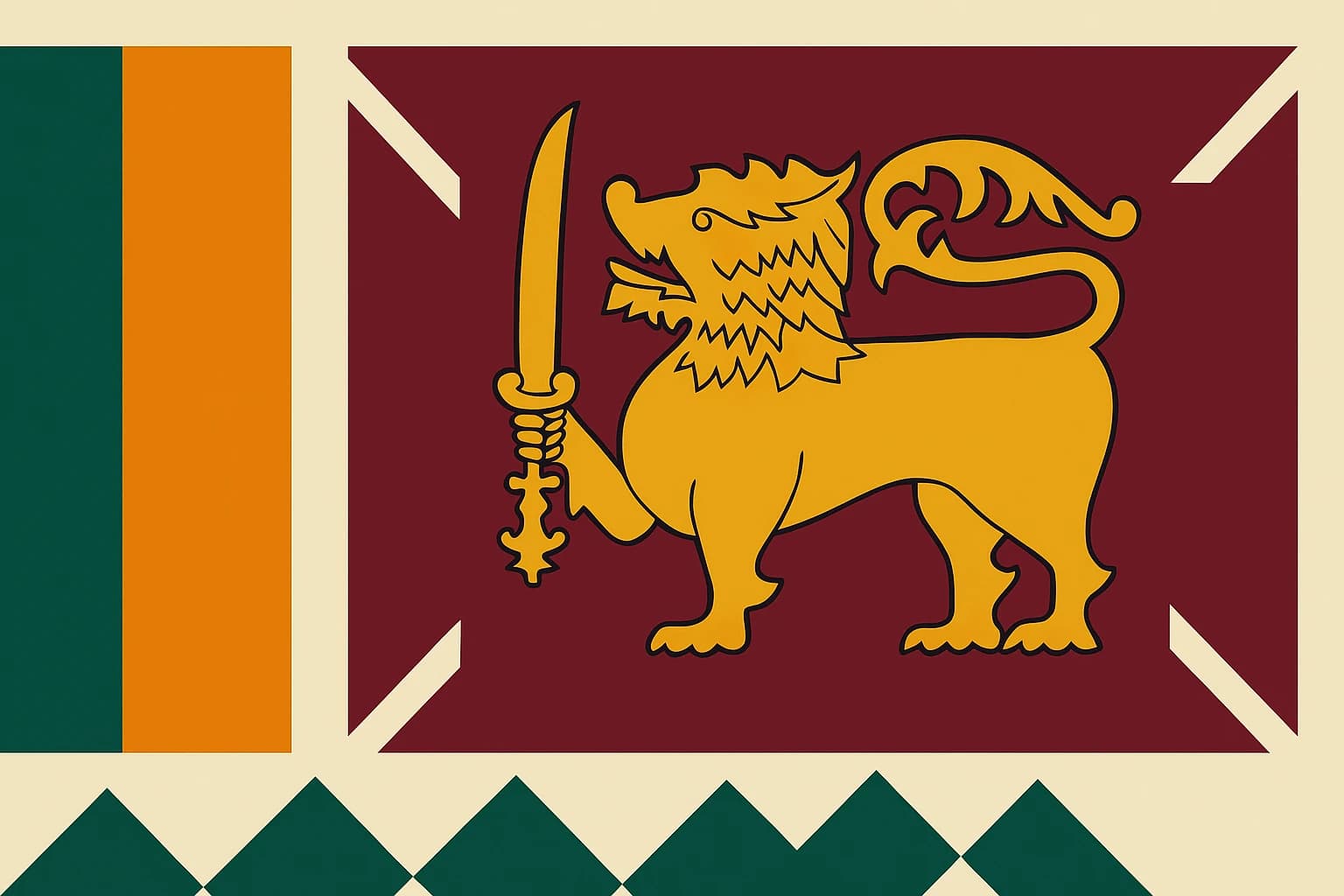
The comparisons are instructive. The bald eagle went onto the U.S. Great Seal in 1782, when the species was abundant; it was itself endangered by the mid-20th century, pushed toward collapse by DDT and habitat loss, before a recovery program brought it back. Scotland's unicorn is extinction-proof by definition. Sri Lanka's lion is a heraldic symbol rather than a population count.
Hurricane Maria functioned as a stress test. When the storm killed an unknown but significant number of parrots and flattened the forest they need, the government's conservation response doubled as a defense of what the flag means, and international coverage almost always led with the flag angle.
There is a good case that the flag has been a net positive for the species. It gives citizens a stake in survival, it makes the Sisserou globally recognizable in ways that help fundraising and diplomatic support, and Dominican schoolchildren grow up knowing the bird on their flag lives in the forests up the hill.
The harder question does not go away. Climate scientists modeling Atlantic hurricane intensity give extinction a non-trivial probability by 2075. If it happens, what does a country do with a flag depicting something that no longer exists? Memorial, reproach, or standing instruction to bring it back.
The politics of an impossible color
The purple deserves its own accounting. Tyrian purple took roughly 12,000 Murex snails to produce 1.5 grams of dye. The process meant cracking shells, extracting a small gland, exposing the secretion to sunlight, and putting up with a stench so bad that ancient dye works were pushed to the edges of cities. The result was expensive enough to be legislated: in Rome, only the emperor could wear a fully purple toga.
Synthetic dyes in the 1850s and 1860s made purple cheap overnight, but by then the world's flags had largely been designed and the visual vocabulary of sovereignty was set. Red, white, blue, green, yellow, black.
Dominica broke the pattern because of a bird. The Sisserou's violet-purple head is the only reason purple is on that flag, and Alwyn Bully chose ornithological accuracy over vexillological convention to get it there.
Early reproductions, especially in the 1980s and 1990s, often rendered the head as blue or a generic violet, because printers and flag manufacturers defaulted to their standard palettes. The flag's most distinctive element was routinely flattened by industrial inertia, and getting the purple right took insistence, specification, and repeated correction. Cheap reproductions still miss it. The Flag Institute in the UK has documented the distinction, which leaves Dominica holding a singular place in world vexillology because of a color choice made out of fidelity to a living creature.
Bully's legacy
In 1978 the dominant model for a new nation's flag was the pan-African tricolor or the socialist star and stripe. Abstraction was the safe choice; specificity was the risk, and Bully took it.
What the flag argues is that a national identity can be grounded in biological fact: a particular forest, at a particular elevation, on a particular island. That geographical particularity is why the design has become a real soft-power asset, ranked consistently among the world's most striking flags and making Dominica recognizable far beyond what an island its size would otherwise manage.
It also commits the country to a relationship with something that can die, which makes it a stranger and more honest object than most national symbols. Whether the bet looks reckless or visionary in fifty years depends entirely on whether the Sisserou is still nesting above 600 meters when someone checks.
Julio Song
Writer
Julio is a staff writer at FlagDB. He studied Mathematics at the University of Madrid and has a passion for vexillology.
More from Julio Song →Related articles
Black Is Not Nothing: The Radical Political Statement Hidden in Jamaica's Flag
The Horizontal Stripe That Started a Revolution: How Haiti's Flag Was Born from a Torn Tricolor