The Dragon, the Lion, and the Eagle: Why Mythical Beasts Still Guard the World's Flags
Julio Song · · 9 min read
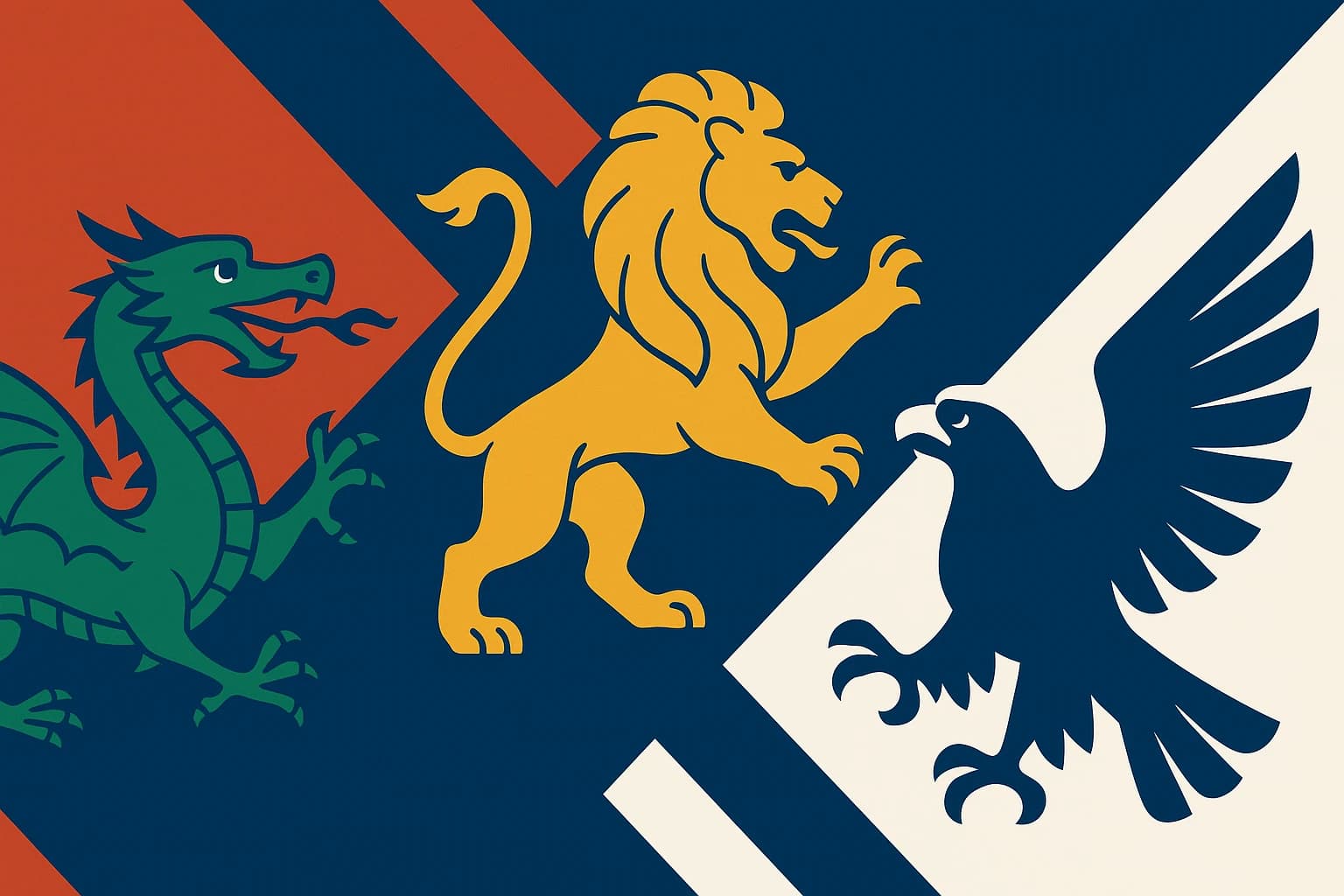
In 2026, nations photograph their own borders from orbit. They render coastlines in photorealistic 3D. They simulate entire economies on supercomputers. And yet Wales still plants a fire-breathing dragon on its flag. Albania flies a creature with two heads that has never existed. Sri Lanka lets a sword-wielding lion stand watch over its republic.
Why? When a nation has every real symbol available to it, its genuine wildlife, its living people, its photographable landscape, why does it so often reach for a beast that never walked the earth?
Mythical and heraldic creatures on flags are not design failures or quaint holdovers from a less rational age. Each one encodes a claim about ancient sovereignty and cultural continuity that no photograph, geometric shape, or real animal carries with the same weight. The Welsh dragon, the Albanian eagle, and the Sri Lankan lion each make that claim differently.
A crowded mythology
Most people would guess that a handful of flags feature legendary creatures. In fact more than 10% of the world's sovereign and territorial flags carry a creature that is mythological, heraldic (stylized well beyond any real animal), or explicitly legendary.
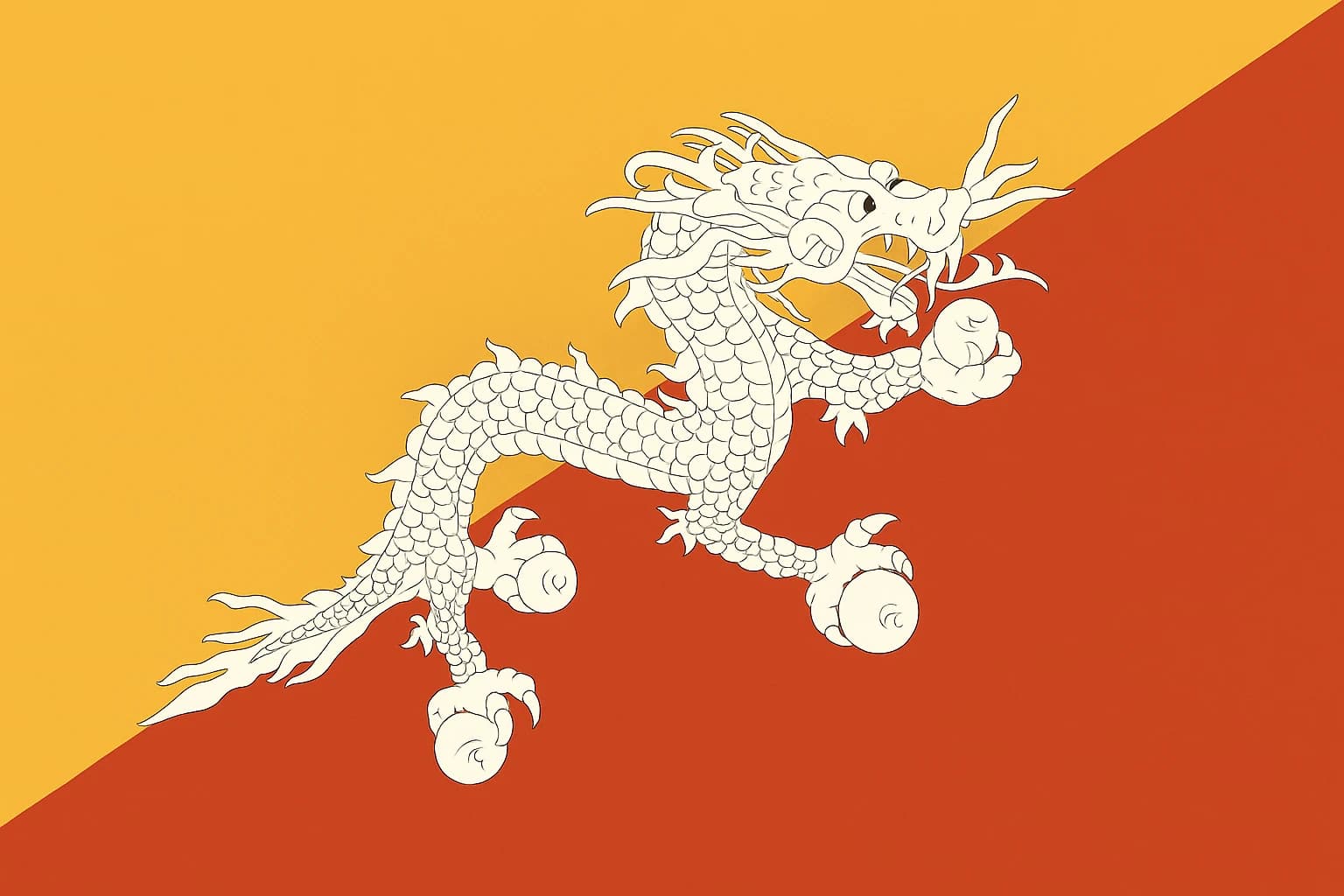
The Bhutanese druk, a thunder dragon, coils across a field of orange and yellow.
Mexico's eagle perched on a cactus devouring a serpent comes straight from Aztec prophecy.
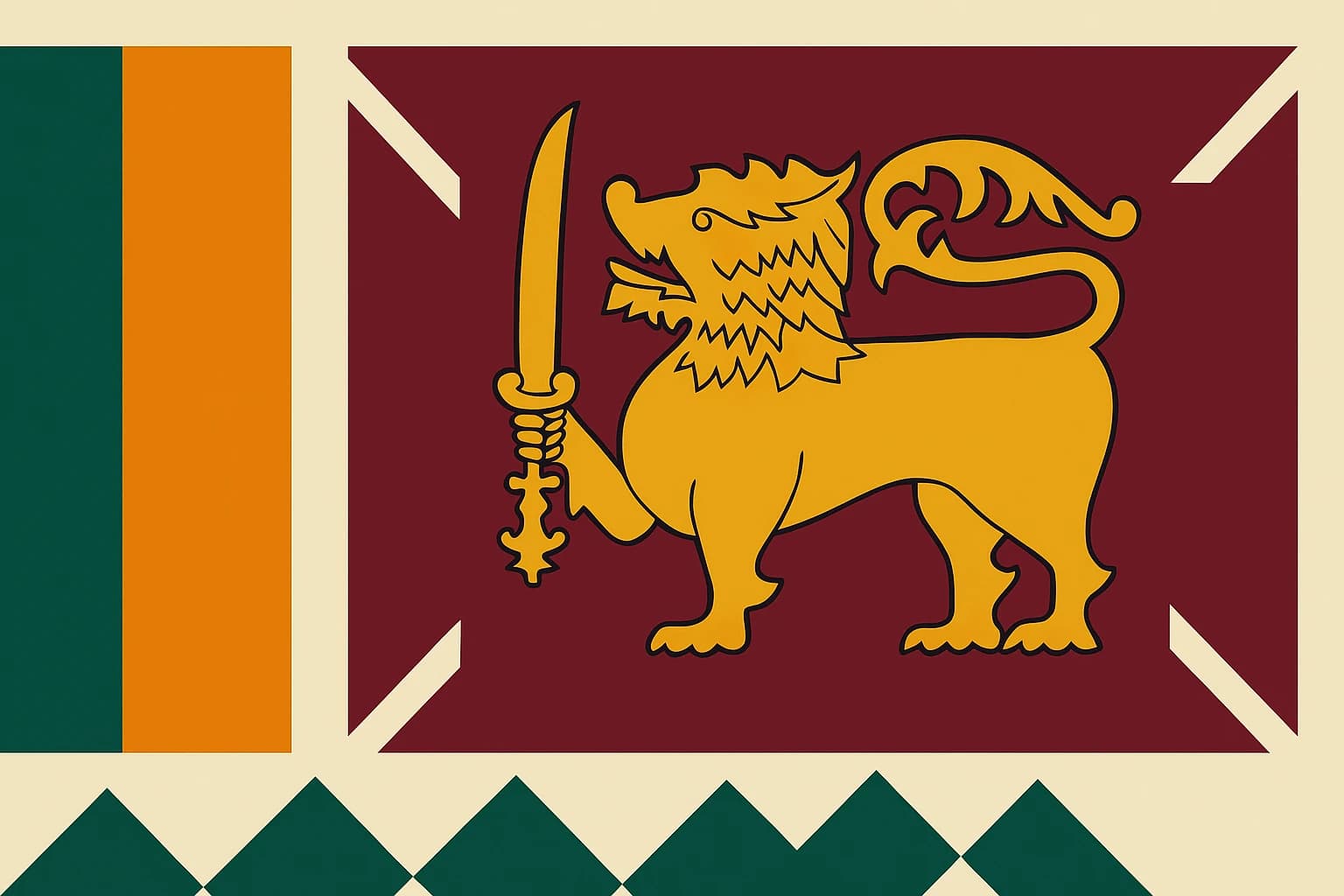
The double-headed eagle recurs across Albania, Montenegro, and historical Serbia. Sri Lanka's lion holds a sword. None of these depict creatures a wildlife photographer could capture on a good day in the field.
There's a distinction worth drawing. Some flags use real animals symbolically: Canada's maple leaf is a plant, New Zealand's kiwi is a bird you can photograph. The flags here feature creatures that are visibly impossible, and the impossibility is the point. Choosing a myth says this nation's story exceeds what the natural world alone can illustrate.
Why it keeps happening, even in flags designed or redesigned recently, starts with where these creatures came from.
Born in battle, not in books
The origin of heraldic beasts is practical and un-romantic. On a medieval battlefield, knights were armored head to toe. An army needed a symbol visible at distance, instantly memorable, and impossible to confuse with the enemy's banner. A real deer or a real dog blurred into ambiguity at 200 meters. A lion rampant or a two-headed eagle? Unmistakable.
Over centuries, the heraldic bestiary became a language of power. The lion signified martial courage and royal dominance across European and Middle Eastern traditions simultaneously, giving it a cross-cultural authority no locally real animal could achieve. The eagle, especially when doubled, signified the Byzantine Empire's claim over both East and West. That's a political argument encoded in anatomy.
Flags inherited this language directly from coats of arms. The Welsh dragon descends from the personal standard of Welsh kings, itself borrowed from Roman draco military standards carried into Britain. The creature on Wales's flag in 2026 has an unbroken symbolic lineage stretching back to at least the 9th century, and arguably to Roman legions.
These creatures were never meant to be zoologically accurate. They were meant to be politically legible, which reframes the whole "why a myth?" question.
Origin is only half the story, though. The harder question is why these creatures survived the age of nationalism, modernism, and secular rationalism, when almost every other medieval symbol was being stripped away.
The red dragon that survived conquest
The Welsh dragon, Y Ddraig Goch, appears in Geoffrey of Monmouth's Historia Regum Britanniae around 1138. In that text, the red dragon battles a white dragon representing the Saxons. From its literary birth, the creature was a symbol of resistance to English domination.
Then the politics turned. Henry VII, a Welshman ascending to the English throne in 1485, carried the red dragon at the Battle of Bosworth Field and incorporated it into the royal arms. A conqueror co-opted the conquered people's symbol, which gave the dragon new official prestige at exactly the moment Wales was being absorbed into England.
The modern turning point came in 1959, when the current Welsh flag was formally gazetted. Wales was not independent then. It had no Parliament, no devolved government, and no international standing, so the dragon was the only sovereignty Wales could publicly assert.
By 2026 the Senedd, the Welsh Parliament, is in its 27th year and independence debates continue to simmer. The dragon reads differently now, less a cultural protest symbol than the potential flag of a future state.
The dragon survived because nothing real could replace it without conceding the argument. A red kite or a puffin would say "we are a region with nice wildlife." The dragon says "we are a people with a story older than the nation that absorbed us."
Albania's double-headed eagle
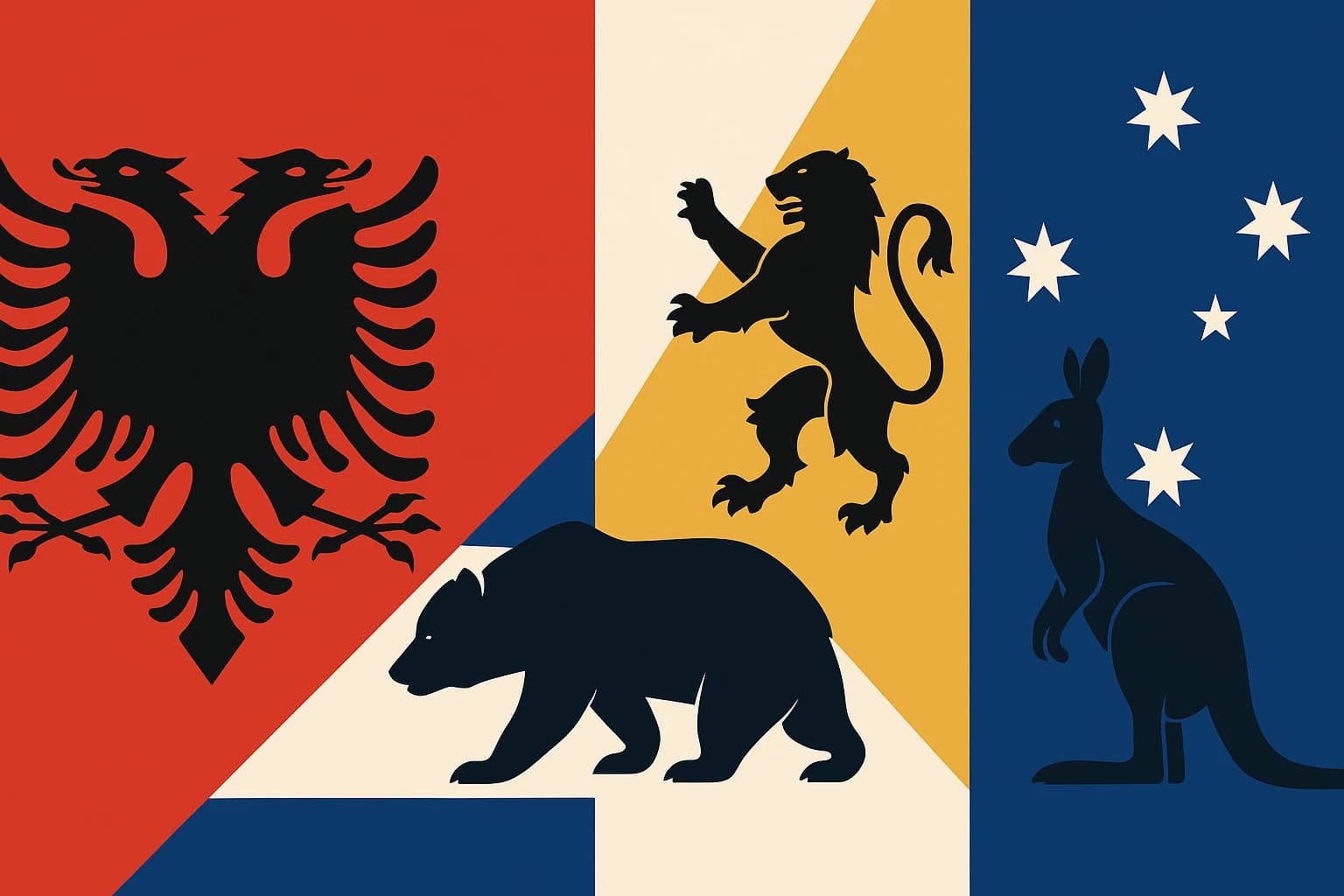
Albania's flag matters partly because the Albanian diaspora is one of the most dispersed in Europe. Major communities live in Kosovo, North Macedonia, Montenegro, Greece, Italy, and cities across the Americas, and the black double-headed eagle on red is recognized and claimed by all of them.
The creature's Albanian history traces back to Gjergj Kastrioti, known as Skanderbeg, the medieval lord who used the double-headed eagle as his personal seal during his 15th-century resistance against Ottoman expansion. Albania's current flag is, in essence, Skanderbeg's battle standard. Like the Welsh dragon, this is a symbol forged in resistance.
The double head's original Byzantine meaning, dominion over East and West, made Albania's adoption of it a political argument in itself. A small Balkan nation was claiming the visual grammar of empire, asserting that it too had a civilizational story, not merely a tribal one.
The 20th century tested it. The communist government of Enver Hoxha (1944 to 1985) kept the eagle but added a red star above it. When communism fell, Albanians removed the star and restored the original eagle. The creature outlasted the ideology that tried to co-opt it.
Being mythological rather than geographically specific is what makes the eagle work for a scattered people. It belongs equally to Albanians in Tirana, Pristina, and the Bronx, because it has no address.
Sri Lanka's lion
Lions have not been native to Sri Lanka for thousands of years. The Sinhala lion on the flag is not a symbol of existing wildlife but of legendary ancestry, specifically the founding myth in which the Sinhalese people descend from the union of a princess and a lion.
The lion's heraldic journey runs through the Kandyan Kingdom's royal standard, through the flag retained (controversially) when Ceylon gained independence in 1948, and through the modifications of 1972 when the republic was declared. The sword in the lion's paw, the Bo tree leaves at the corners, and the orange and green stripes representing minority communities were all added through explicit political negotiations. This flag is a treaty as much as a symbol.
The controversy is worth stating plainly. The Tamil and Muslim communities represented by those stripes have at various points disputed whether the lion, a specifically Sinhala ethnic symbol, should represent a pluralist nation. A mythical creature can be a unifying story and an exclusionary one at the same time, depending on whose myth it is.
The lion persists anyway. No alternative has been proposed that carries equal narrative weight for the Sinhalese majority, and replacing the lion would mean replacing the founding story.
What a real animal cannot do
Real animals are constrained by their appearance, their habitat, and their existing associations. A lion on a flag means something different in Sri Lanka (ancestry, royalty, myth) than in England (martial power) or Kenya (wildlife conservation). The Sinhala lion's sword-holding, upright posture marks it as heraldic rather than zoological.
There's also a practical vexillological principle at work: legibility at distance. A good flag needs a symbol that reads clearly when the fabric is rippling at 100 meters. Mythical creatures, always rendered in their most stylized form, meet that standard better than realistic images of real animals. Flags with photorealistic scenes or text go illegible at distance. The bold abstracted form of a heraldic beast is a design solution.
Geometry can't supply the other half. A triangle, a stripe, or a star represents a value but cannot tell a story with a protagonist. The dragon, the eagle, and the lion are characters with histories, enemies, victories, and prophecies attached.
The North American Vexillological Association's "Good Flag, Bad Flag" principles emphasize meaningful symbolism as a core criterion, and heraldic creatures satisfy it despite looking archaic.
Myth as political technology
The mythical creature gets chosen not despite the availability of real alternatives but because of what those alternatives cannot do. The dragon asserts continuity. The eagle projects civilizational identity across a diaspora. The lion encodes a founding story.
Call the mechanism temporal compression. A mythical creature collapses thousands of years into a single image. When Wales flies the dragon it references Roman legions, medieval kings, Tudor politics, 19th-century cultural revival, and 21st-century devolution at once. No real animal has that range.
Nations that fly mythical creatures are claiming, implicitly, that their identity cannot be explained by geography or economics or recorded history alone. That is either a real insight or a useful fiction, and the two may amount to the same thing.
The practice is not dying out. Newer national symbols and regional flags continue to use heraldic and legendary creatures, which suggests the appetite for mythological identity markers grows rather than shrinks as the world gets more data-saturated.
The better question may be the inverse one. What does it mean when a nation chooses not to? Flags of pure geometry or pure realism may be conceding that they have no myth strong enough to carry their identity.
The manifesto that breathes fire
Satellites render every border in precise digital coordinates, and Wales still flies a dragon, Albania a two-headed eagle, Sri Lanka an impossible lion.
That isn't sentimentality or inertia. A flag is not a map, it's a manifesto, and a manifesto that says "we descend from a dragon, our enemies never broke us, and our story began before your history books did" cannot be replaced by a photograph of a red kite, however beautiful the bird.
These animals have stayed on flags because the claims they make are hard to make any other way.
Julio Song
Writer
Julio is a staff writer at FlagDB. He studied Mathematics at the University of Madrid and has a passion for vexillology.
More from Julio Song →