The Flag of Armenia
Republic of Armenia
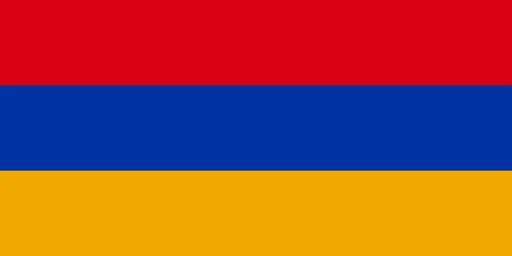
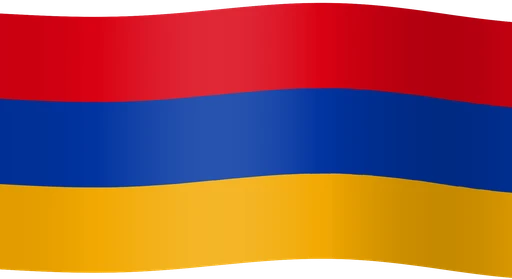
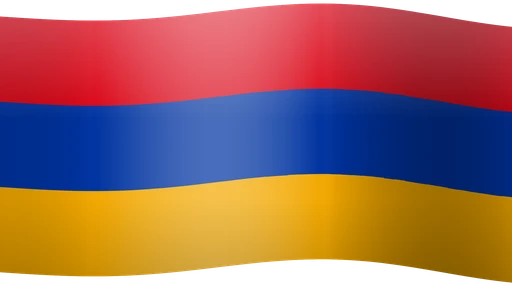
Armenia's flag has three horizontal stripes of equal width: red on top, blue in the middle, orange at the bottom. Red is read as the spirit of the Armenian people, blue as their peaceful sky, and orange as the fertile land. The aspect ratio is 1:2.
Armenia's tricolor of red, blue, and orange is one of the oldest national symbols in the South Caucasus, and it took a long detour to permanence. First raised during the brief First Republic of Armenia (1918-1920), it was suppressed for seven decades under Soviet rule and restored in 1990 as the country moved toward independence. Its colors reach back centuries, tied to the rainbow God showed Noah on Mount Ararat, to the vestments of Armenian clergy, and to blood shed across a difficult national history. Today it flies over Yerevan and across a global diaspora.
The rainbow on Ararat
Ask an Armenian where the flag's colors come from and you may hear about Noah. Tradition holds that when the floodwaters receded and the ark came to rest on Mount Ararat, the rainbow in the sky held the colors that would one day define the nation. Ararat still dominates Yerevan's skyline even though it sits across the border in modern Turkey, and the mountain's hold on Armenian identity is inseparable from the colors attached to it.
Long before anyone thought about a modern national flag, Armenian heraldic and church traditions used red, blue, and shades of orange and gold. The Rubenid and Lusignan dynasties of Cilician Armenia, which flourished between the 11th and 14th centuries, flew red and blue banners bearing various royal charges. These were not national flags in the modern sense, but the color tradition they established lasted.
The idea of a distinctly Armenian tricolor belongs to the 19th century. Father Ghevond Alishan, a Mekhitarist monk and scholar based in Venice, is credited with first proposing a modern flag for the Armenian nation. His initial design borrowed from European models: green, white, and red. He later shifted to red, green, and blue, and his ideas circulated among the Armenian intelligentsia and the revolutionary movements gaining ground across the Ottoman and Russian empires. The Armenian national awakening of the late 1800s gave the conversation urgency, and intellectuals, political parties, and clerics all had opinions about what the flag should look like.
The First Republic and the 1918 flag
When the First Republic of Armenia declared independence on May 28, 1918, the circumstances were about as bad as they could be. The Russian Empire had collapsed, the Armenian Genocide was still unfolding, and the new state was surrounded by hostile forces. It also needed a flag.
Stepan Malkhasyants, a linguist and member of the Armenian National Council, is widely credited with the final selection: red on top, blue in the middle, apricot-orange on the bottom. Red and blue connected to centuries of Armenian heraldic tradition. The bottom stripe was the real decision. Rather than defaulting to green, white, or yellow like most European tricolors, Malkhasyants and his colleagues chose tsiran, the color of the apricot. The apricot is Armenia's national fruit, and its warm golden-orange gave the flag an identity no other country could claim.
The First Republic lasted barely two and a half years. By late 1920 Soviet forces had absorbed Armenia, first into the Transcaucasian SFSR and later into the Armenian SSR, and the tricolor was banned outright. Displaying it could mean arrest.
But flags are hard to kill. Throughout the Soviet period the tricolor survived in diaspora communities, flying at Armenian churches, cultural centers, and annual commemorations of the Genocide. For millions of Armenians outside the homeland, the 1918 flag was the only flag that counted.
Soviet suppression and diaspora memory
Under Soviet rule, Armenia was assigned a succession of red banners with the hammer and sickle, sometimes with Armenian script or a stylized Mount Ararat. The 1952 Armenian SSR flag added a horizontal blue stripe, a quiet concession to national identity within Soviet constraints, and about as much as the Kremlin would allow.
Displaying the tricolor inside Soviet Armenia was illegal. Underground nationalist circles kept it alive anyway, and it surfaced during rare moments of defiance, most notably the 1965 demonstrations in Yerevan marking the 50th anniversary of the Armenian Genocide, when thousands took to the streets in one of the first mass protests in the Soviet Union.
In the diaspora, particularly in Lebanon, Syria, France, Argentina, and the United States, the tricolor was the national symbol without qualification. The Armenian Revolutionary Federation (Dashnaktsutyun) and other community organizations kept it present at every gathering, march, and classroom. For decades the Armenian flag was better known outside Armenia than inside it.
That changed in 1988. When Armenians in Yerevan began raising the tricolor during the Karabakh movement, demanding unification with Nagorno-Karabakh, the gesture was national affirmation and anti-Soviet defiance at once. People wept in the streets at the sight of it.
Restoration in 1990
On August 24, 1990, more than a year before Armenia declared full independence on September 21, 1991, the Supreme Soviet of the Armenian SSR formally re-adopted the tricolor. A flag that had been illegal for seventy years was official again.
The 1990 law, revised in 2006, specifies proportions of 1:2 and assigns each color a formal meaning. Red represents the Armenian Highland, the long struggle for survival, the maintenance of the Christian faith, and independence. Blue stands for the will of the Armenian people to live beneath peaceful skies. Orange is the creative talent and industriousness of the nation.
The exact shade of that bottom stripe has been argued about ever since. Should it be the warmer, softer apricot of the 1918 original, or a brighter orange? The 2006 law codified specific values and settled on a shade some traditionalists consider too bright and too far from the original tsiran.
The plain tricolor is the civil flag. Government and military variants add the Armenian coat of arms, which shows Mount Ararat, the emblems of four ancient Armenian kingdoms, and a lion and eagle as supporters.
Comparisons and confusions
The red-blue-orange combination is unique among national flags, almost entirely because of the apricot-orange stripe. No other country uses it. At a distance or on a small screen the flag is most often mistaken for Colombia's yellow-blue-red or Romania's blue-yellow-red, though the order and shades are quite distinct close up.
The flag of Artsakh (Nagorno-Karabakh) deserves separate mention. Until 2023 this de facto Armenian-populated entity used the Armenian tricolor with a white zigzag chevron on the fly side, standing for the region's separation and its wish for unity with Armenia. Artsakh fell in September 2023, when Azerbaijan recaptured the territory and its entire Armenian population was displaced, and both flags now carry that grief. The Artsakh flag is displayed alongside the Armenian tricolor at memorials and protests worldwide.
Beyond the Republic, the tricolor turns up wherever Armenians have settled: at Armenian schools in Beirut, cultural organizations in Los Angeles, community centers in Buenos Aires.
The flag in Armenian life today
Armenian Flag Day falls on June 15 and was established in 2009. It is marked with ceremonies and public displays. The flag's most emotionally charged appearances, though, come on April 24, the annual commemoration of the Armenian Genocide, when the tricolor is displayed alongside black mourning banners.
In the diaspora the flag works as a generational thread, appearing at protests, cultural festivals, weddings, and on car dashboards from Glendale to Marseille. For communities that may share little beyond heritage, it is the common denominator. A teenager in São Paulo and an elderly woman in Aleppo might not speak the same language, but both would recognize it instantly.
The 2020 Nagorno-Karabakh war and the 2023 fall of Artsakh sharpened all of this. Large displays appeared across Armenia and the diaspora, and the tricolor became inseparable from arguments about sovereignty, survival, and what homeland means.
The modern tricolor also sits at the end of a very long line of royal banners, princely standards, and church emblems associated with Armenian kingdoms and principalities, which gives Armenian vexillology unusual depth to work with.
References
[1] Constitution of the Republic of Armenia, Article 15, and the Law on the National Flag of the Republic of Armenia (2006 revision). Official legal text specifying the flag's design, proportions, and color definitions.
[2] Flags of the World (FOTW), Armenia page. Peer-reviewed vexillological reference maintained by the world's largest online flag encyclopedia. https://www.fotw.info/flags/am.html
[3] Whitney Smith, Flags Through the Ages and Across the World (1975). Foundational vexillological reference with coverage of Caucasian flags.
[4] Razmik Panossian, The Armenians: From Kings and Priests to Merchants and Commissars (Columbia University Press, 2006). Scholarly history covering the development of Armenian national symbols in the modern period.
[5] Ghevond Alishan, Sissouan, ou l'Arméno-Cilicie (1899). Early scholarly source discussing Armenian heraldic traditions and proto-national color symbolism.
[6] Armenian National Archives and the Museum of Armenian History, Yerevan. Primary sources on the 1918 flag adoption and the deliberations of the Armenian National Council.
[7] North American Vexillological Association (NAVA) publications. Comparative analysis and standardized color specifications for world flags.
Common questions
- What do the colors on the Armenian flag mean?
- Red stands for the Armenian Highland, the struggle for survival, Christian faith, and independence. Blue is the wish to live under peaceful skies. Orange, sometimes called apricot, is the creative and hard-working character of the Armenian people.
- Why is the bottom stripe of the Armenian flag orange instead of a more common color?
- The orange stripe is *tsiran*, the color of the apricot, Armenia's national fruit. When the flag was designed in 1918 its authors skipped the greens, whites, and yellows of most European tricolors for something distinctly Armenian. The exact shade, whether a soft apricot or a brighter orange, is still argued over by Armenians and flag scholars.
- What's the connection between the Armenian flag and Mount Ararat?
- Armenian tradition ties the flag's colors to the rainbow God showed Noah after the flood, when the ark landed on Mount Ararat. Ararat now sits across the border in Turkey, but it remains central to Armenian identity and appears on Armenia's coat of arms.
- Why was the Armenian flag banned under the Soviet Union?
- When Soviet forces took over Armenia in 1920, the tricolor was replaced with Soviet-style red banners. Flying it was illegal and could get you arrested. Diaspora communities and underground nationalist groups kept it in use, and in 1990, as Armenia pushed toward independence, it was officially restored.
- What's the difference between the Armenian flag and the Artsakh (Nagorno-Karabakh) flag?
- The Artsakh flag used the same red-blue-orange tricolor with a white zigzag chevron on the right side, representing the region's separation and its wish for unity with Armenia. After Azerbaijan recaptured Artsakh in 2023 the flag became a symbol of mourning, and it is often displayed next to the Armenian tricolor at memorials.
Featured in these articles
Download this flag
Free in 12 styles, from 32px icons up to 2000px, as SVG, PNG, WebP and JPG.