A Bhutanese government official holds a freshly printed flag up to the light, counts the claws on the dragon, and sends the whole batch back to the printer. Four claws instead of five. In almost any other country this would be absurd. A misplaced feather on an eagle or a slightly rotated lion goes unnoticed, and the few who notice do not care.
The Druk, Bhutan's Thunder Dragon, is the reason the cloth exists rather than a mascot applied to it. Most countries treat their flag animals as loose approximations, good-enough sketches of a national spirit, while Bhutan has codified its dragon down to the curve of its snarling mouth and the grip of its talons. The Druk predates the modern Bhutanese state by roughly 800 years. It is a dynastic entity, a spiritual force, and a constitutional obligation, all in white ink on a divided field.
Which raises a question most countries never have to answer: what does it mean to treat a mythological creature as the identity itself rather than a symbol of one?
Before the flag, there was the dragon
In the 13th century, a Tibetan Buddhist lama named Phajo Drugom Zhigpo traveled to what is now Bhutan. According to tradition, he heard thunder rolling across the valleys and interpreted the sound as the roar of a dragon. That interpretation gave a name to his religious lineage, the Drukpa Kagyu school, and eventually to an entire kingdom.
The word "Druk" became inseparable from everything Bhutanese. The country's own name in Dzongkha is Druk Yul, the Land of the Thunder Dragon. The monarch is the Druk Gyalpo, the Dragon King. The national airline is Druk Air. The national anthem references the dragon. The identity runs so deep that it would be easier to list the things in Bhutan that don't reference the Druk.
This matters because most national animal symbols work the other way around. A country exists, it designs a flag, and then someone picks an animal to put on it. The American bald eagle, Mexico's golden eagle devouring a serpent, Albania's double-headed eagle. These creatures were chosen retroactively to decorate an already-existing national project. Bhutan's flag was built around a creature that had been the nation's spiritual anchor for eight centuries before anyone thought about flag specifications.
When the Wangchuck dynasty was established in 1907, unifying Bhutan under a single monarchy, the new kings formalized the Druk as a dynastic seal, and the dragon moved from monastery walls into the machinery of statecraft. The dragon did not become a symbol of Bhutan so much as Bhutan became a country of the dragon. Everything that follows about precision comes out of that inversion.
Anatomy of a royal dragon: every detail is a decree
The specifics are where Bhutan's approach becomes extraordinary.
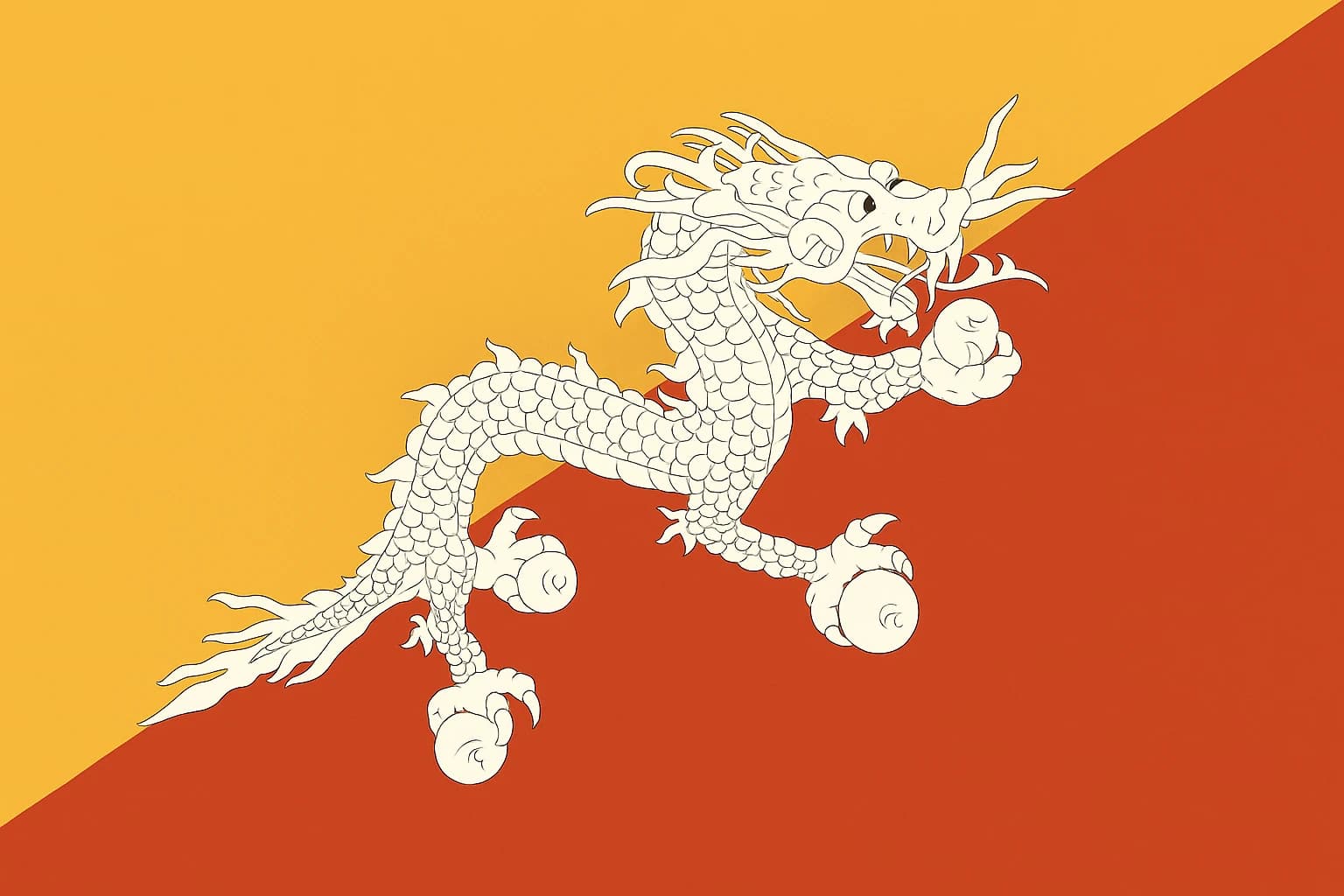
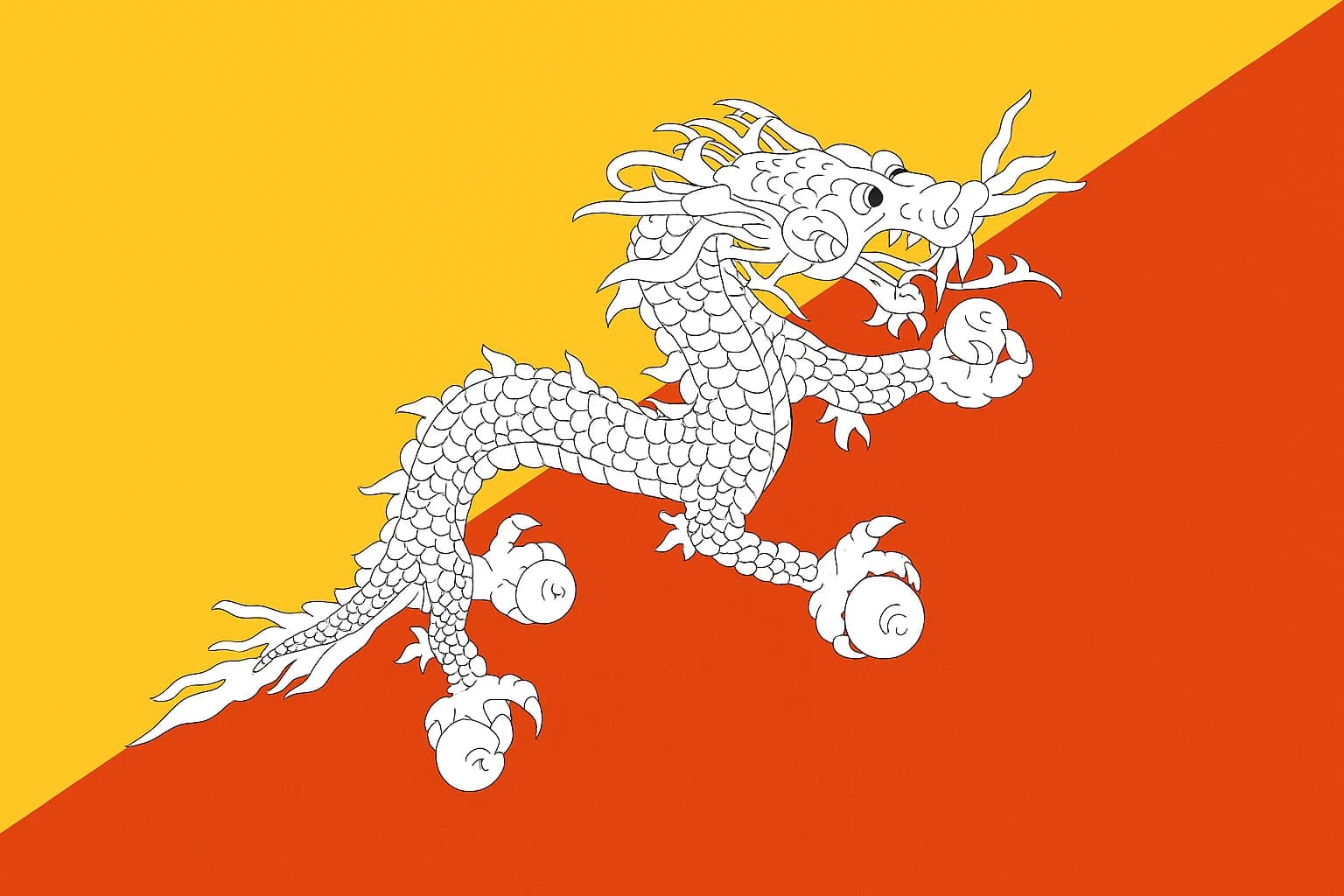
The dragon's body must be white. Not off-white, not cream, not grey. White, representing the purity and loyalty of the Bhutanese people. The dragon faces right, toward the hoist side of the flag. This is a deliberate directional choice: when the flag flies, the dragon faces forward, into the wind and into the future. Official guidelines include rules about how this orientation must be maintained even in mirrored or reversed presentations.
In each of its four claws the dragon clutches norbu, wish-fulfilling jewels standing for wealth and perfection. The number of jewels and the configuration of the claws are standardized, and getting the count wrong means you have printed a mistake rather than Bhutan's flag.
Then there is the detail that separates Bhutan from every other country: the dragon's facial expression is specified. Its mouth is open in a snarl, which is not a roar and certainly not a smile, and it conveys fierce protection of the kingdom. Official guidelines distinguish between an aggressive open mouth and a decorative one. A dragon that looks too friendly is wrong.
The background field is a diagonal divide of orange and yellow. The orange represents the Drukpa Kagyu Buddhist tradition. The yellow represents the secular authority of the Druk Gyalpo. The dragon straddles both halves, bridging the spiritual and the governmental. Even its placement on the flag is a theological statement.
The 1969 standardization and the problem of the facing dragon
For much of the 20th century, the Druk's depiction was not as controlled as it is today. Different workshops produced different dragons. Some faced left, some faced right. Some were green-tinged, others orange. As Bhutan began engaging with international institutions in the 1960s (it joined the United Nations in 1971), these inconsistencies became a diplomatic problem.
Around 1969 the Bhutanese government issued precise standardization guidelines. A dragon facing left rather than right carries a completely different connotation, one suggesting forward movement and assertion, the other retreat, and when the dragon is a dynastic entity rather than a decoration, its direction is a political statement.
The standardization was run by the royal court, not by a design committee or a branding agency, and it was treated as a matter of dynastic correctness rather than aesthetic preference. How the dragon looked was a question for the throne.
An earlier change is worth noting. The flag originally carried an orange or red dragon, changed to white after officials reportedly noticed an uncomfortable visual similarity with China's flag. Even a thunder dragon is not immune to geopolitics.
The timing puts Bhutan in an odd historical bracket. Most countries standardized their flags in the 19th century as European-style nationalism spread. Bhutan did it in the late 20th century, for reasons rooted in centuries-old dynastic logic rather than modern nationalism.
How other nations let their creatures drift
The scale of Bhutan's precision is clearest against how other countries handle their flag animals.
Belize's coat of arms features two men flanking a shield, tools in hand, with a mahogany tree above. The depictions of these figures have varied wildly across official printings, souvenir versions, and government documents. There is no single authoritative anatomical standard for the human figures, and the surrounding foliage shifts with every printer.
Myanmar's flag, redesigned in 2010, once featured a white elephant, an ancient symbol of Burmese royalty. Across iterations of earlier flag designs, the elephant's posture, trunk direction, and decorative caparisons shifted repeatedly, reflecting the country's political turbulence rather than any stable symbolic standard.
Sri Lanka's lion flag offers another instructive case. The lion's curled tail, the way it grips its sword, the proportions of its body: all of these have subtle but documented variations across decades of official printings. These variations have sparked nationalist arguments about which version is "correct."
In each of those cases the animal is a symbol on the flag. Remove Belize's coat of arms and a blue field remains. Simplify Sri Lanka's lion and the flag is still recognizable. In Bhutan the dragon is the flag, and removing it leaves two colored triangles with no identity attached. Altering it does not change how the flag looks so much as dissolve what it means.
Drift in animal symbols is the global norm. Bhutan is the outlier, and the reason why says a good deal about how the country builds its national identity.
Living symbol against decorative motif
In Bhutanese Buddhist tradition, symbols carry spiritual efficacy. The concept of tendrel, sometimes translated as auspicious interdependence, holds that depicting sacred imagery correctly is a matter of ritual function rather than preference. A badly depicted dragon is not aesthetically off, it is spiritually inert, or worse.
Which is why the official counting claws is running a spiritual audit rather than being pedantic.
This connects to Bhutan's broader governing philosophy of Gross National Happiness, introduced formally in the 1970s under the Fourth Druk Gyalpo, Jigme Singye Wangchuck. GNH explicitly rejects the separation of cultural and spiritual identity from state function. The economy serves the culture, not the other way around. Bhutan's flag precision is the vexillological expression of this philosophy: the country maintains its flag holistically, not purely graphically, in the same way it measures national wellbeing holistically rather than in GDP alone.
Compare this to nations that have treated flags as civic utilities subject to popular revision. New Zealand held a flag referendum in 2016, spending $26 million to ask citizens whether they preferred a silver fern over the existing Union Jack-bearing design. They kept the old flag, but the process itself revealed an assumption: that flags are design objects, subject to taste and democratic negotiation.
Bhutan has never held a public debate about its flag's design. The question would be as incoherent as holding a public referendum on whether thunder should sound different. The Druk is not a design decision. Within the Bhutanese worldview, it is a cosmological fact.
The Druk in 2026: precision under pressure
The dragon faces new pressures today. Bhutan's gradual digital opening, a growing tourism sector following the progressive lifting of COVID-era restrictions through 2022-2024, and the sheer volume of unofficial flag merchandise, emoji, and digital assets are introducing inconsistencies at a rate no royal court directive was designed to handle.
Take the Unicode flag emoji for Bhutan: 🇧🇹. On a phone screen the dragon is compressed into an icon a few pixels wide, where the claw count and the specified expression are simply gone and the snarl becomes a smudge. Millions of people see that unofficial version every day, and for many of them it is the only version of Bhutan's flag they will ever encounter.
Bhutan's 2008 transition to a constitutional monarchy added a layer of legal protection. The new constitution formally enshrined the flag's specifications in law, making Bhutan one of the very few nations on Earth where flag design details carry constitutional weight. The dragon's claw count is, in a legal sense, as fundamental as the right to vote.
Constitutional precision does not travel well through internet culture. As Bhutanese youth engage with social media, memes, and online flag redesign communities (r/vexillology has grown enormously in the mid-2020s), the controlled image faces informal pressure no law can reach. Someone will draw a cute cartoon Druk, give it six claws for fun, make it pink, and the versions will spread.
The problem is a concentrated form of one every country now has: how do you keep a symbol sacred in a culture that turns everything into content?
The official counting the claws
The official holding the flag up to the light is the logical endpoint of a civilization that never separated the sacred from the civic, or the mythological from the administrative.
The Druk is the king's spiritual ancestor, the country's name, and the government's mandate, rendered in white on a divided field of saffron and gold. That precision is not the quirk of a small landlocked kingdom. It is a challenge to the modern assumption that national symbols are malleable, democratically negotiable, and ultimately decorative.
With flags being rebranded and emoji flattening centuries of symbolism into 72-pixel squares, Bhutan is the sharpest counterargument available: some symbols were never meant to be redesigned.