Most independence flags are new inventions. Ceylon's was a restoration. When the island became independent in 1948, it did not commission a fresh design; it reached back to the royal standard of the last king of Kandy, which British forces had captured and carried off to England 133 years earlier. The physical banner never came home; it faded quietly in a London military hospital. What came home was the design, rescued by a lawyer with a sketchbook.
The lion before the British
The lion has been the emblem of Sinhalese kingship for as long as records exist; legend traces the people's very name, Sinhala, "of the lion," to a lion ancestor. The banner that matters to this story belonged to Sri Vikrama Rajasinha, ruler of the Kingdom of Kandy, the island's last independent state, holding out in the central highlands long after the coasts had passed through Portuguese and Dutch hands.
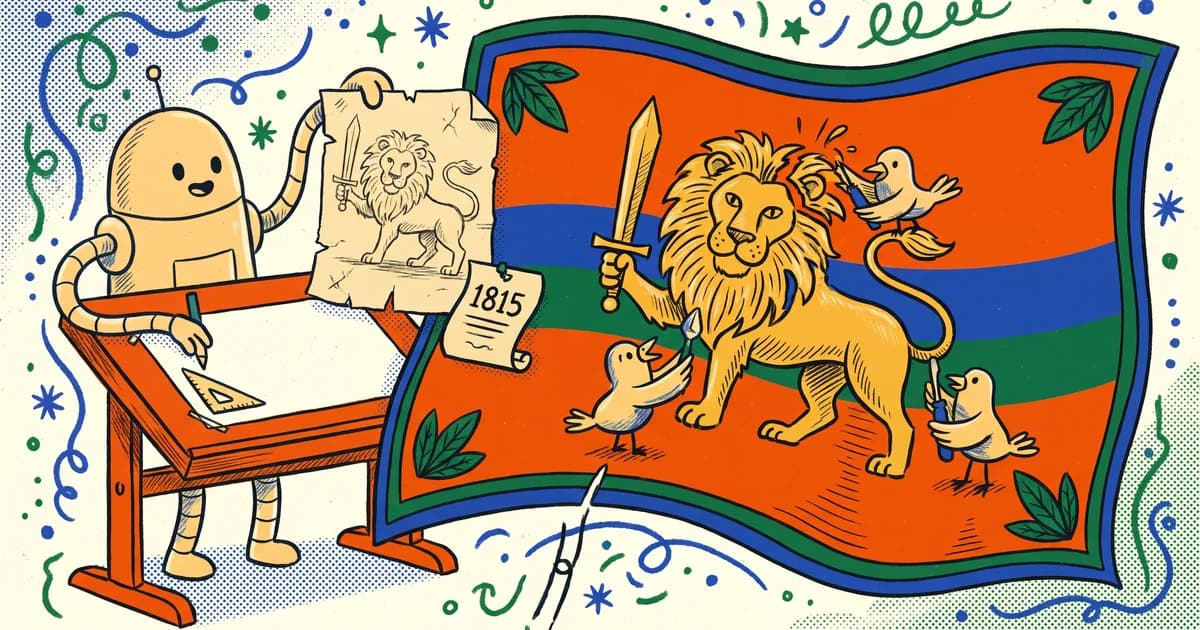
In 1815 the British deposed him, ending over two millennia of Sinhalese monarchy. The Kandyan royal standard, a golden lion holding a sword, on crimson, framed by a yellow border with four pinnacle ornaments in the corners, was taken to Britain as a trophy. For the colonial century that followed, official Ceylon was represented by the Union Jack and, from the 1870s, by ensign badges featuring, a little pointedly, an elephant in front of a dagoba.
1948: the lion comes back
The lion's return began not with a politician but with a researcher. In 1908 the Ceylonese lawyer E.W. Perera tracked the captured Kandyan banners down at the Royal Hospital Chelsea in London, and the design of the faded royal standard was copied and published; a color reproduction printed in a Colombo newspaper in 1915 put the lost flag back into public memory.
As independence approached, A. Sinnalebbe, the Member of Parliament for Batticaloa, moved in January 1948 that the new Dominion of Ceylon adopt the lion flag as its national flag. The motion drew immediate objections, and Prime Minister D.S. Senanayake steered the question to a National Flag Committee rather than forcing a vote. But when independence came on 4 February 1948, the reconstructed lion flag flew anyway, pending a decision, sharing poles with the Union Jack in those first weeks: golden lion passant, sword in its right forepaw, on maroon-crimson, with the yellow border and the four corner ornaments of the Kandyan original. It became the official national flag by act of Parliament on 2 March 1951.
The objections were not hard to understand. The lion flag was the standard of a Sinhalese Buddhist monarchy, and independent Ceylon was not ethnically or religiously uniform. Roughly a quarter of the population was Tamil, largely Hindu, along with a substantial Muslim community, and their absence from the new national symbol was noticed at once.
1951: two stripes for the rest of the nation
The committee's answer, built into the flag formally adopted in 1951, was its most distinctive structural feature: two vertical stripes at the hoist, green and orange, together occupying roughly a quarter of the flag. The orange stripe represents the Tamil community, the green the Muslim community, and their placement is unusual in world vexillology; rather than blending minorities into the general symbolism of shared colors, the flag gives them their own delimited panels, set beside the lion's field rather than inside it.
That design choice has been read both generously and critically ever since: as an honest acknowledgment of a plural society, or as a diagram of communities kept structurally separate. Either way, it makes Sri Lanka's flag one of the few on Earth whose composition explicitly maps ethnicity.
1972: Ceylon becomes Sri Lanka, and the leaves arrive
In 1972 the dominion became a republic and took the name Sri Lanka. The flag was updated to match, in the subtlest of the design's revisions: the four corner ornaments inherited from the Kandyan standard were replaced with four leaves of the bo tree, the sacred fig under which the Buddha attained enlightenment. The change, finalized in its current form in 1978, gave the corners doctrinal content: the four leaves are read as the four Buddhist virtues of loving-kindness, compassion, equanimity, and sympathetic joy.
The lion itself carries a full symbolic inventory in official readings: the lion for the Sinhala people and their courage, the sword for the nation's sovereignty, the maroon field for the Sinhalese, even the eight hairs of the lion's tail enumerated as the Noble Eightfold Path. Few flags have had their anatomy catalogued so thoroughly.
What "the flag of Ceylon" means, then
The name Ceylon points at three different flags depending on the date. Before 1815, it is the Kandyan royal standard, lion and sword on crimson. From 1815 to 1948, it is the Union Jack and, later, colonial ensigns with the elephant badge, the flags of a possession rather than a nation. From 1948 to 1972, it is the restored lion flag of the Dominion of Ceylon, gaining its green and orange stripes in 1951. After 1972 the country is Sri Lanka, and the flag, bo leaves and all, is the one that flies today.
Among post-colonial flags, Ceylon's path is nearly unique. India, Ghana, and most others designed forward, building new symbols for new states. Ceylon designed backward, rebuilding the exact design its colonizer had confiscated, then spending the next thirty years amending it into a symbol a diverse island could share. Whether that project succeeded is still argued about in Sri Lanka today. The lion, for its part, has now flown over the island in three different centuries, with one long British interruption it has never quite let anyone forget.