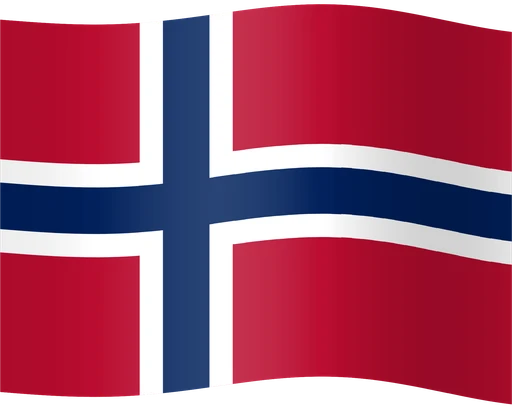
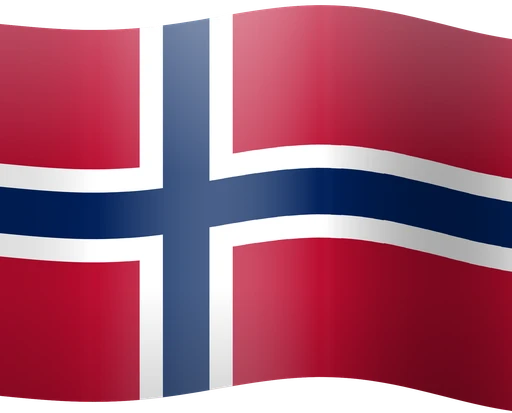
The Flag of Bouvet Island
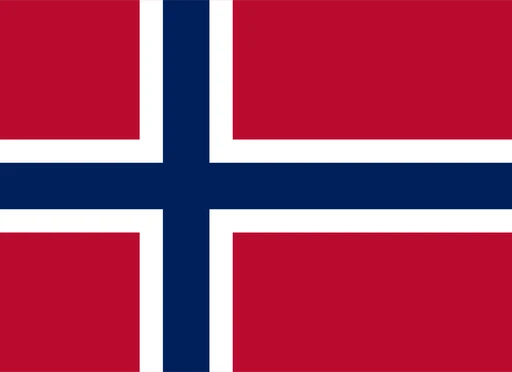
Bouvet Island has no flag of its own. The Norwegian flag stands for it: a red field with a blue cross fringed in white, the cross set toward the hoist. Norway planted that flag on the uninhabited South Atlantic island on 1 December 1927. The red, white and blue are read as the colors of liberty, and the cross is a Christian symbol shared across the Nordic countries.
Bouvet Island is one of the loneliest places on Earth, and it has no flag of its own. The Norwegian flag speaks for it. A red field, a white-fringed blue cross and a claim planted by sailors in 1927 are all the island's symbols need. Nobody lives there to ask for more.
A tiny island with a long search
The island sits in the South Atlantic. It covers 49 square kilometres and about 93 percent of it is glacier. Its highest point is Olavtoppen, at 780 metres.
Jean-Baptiste Charles Bouvet de Lozier sighted it on 1 January 1739 from the French ships Aigle and Marie. He could not land. He also logged its position wrongly, so later expeditions sailed past it and found nothing. In 1808 Captain James Lindsay confirmed it was an island and named it Lindsay Island.
George Norris landed on 10 December 1825 and claimed the island for the British Crown on 16 December. He called it Liverpool Island.
The Norvegia raises a flag
The whaling magnate Lars Christensen financed the First Norvegia Expedition. Led by Harald Horntvedt, it was the first to make an extended stay on Bouvet Island. On 1 December 1927 the crew raised the Norwegian flag and claimed the island for Norway.
A royal decree in January 1928 made the annexation formal. Britain renounced its own claim in November 1929 after diplomatic talks.
The flag came first. A decree, a diplomatic settlement and a statute followed.
Norwegian, but not part of the Kingdom
On 27 February 1930 Norway passed an act making Bouvet Island a dependency. The same act was later extended to Peter I Island and Queen Maud Land. A dependency is Norwegian territory under Norwegian sovereignty, but it is not part of the Kingdom of Norway. Norwegian criminal, private and procedural law apply. All land belongs to the state.
Bouvet Island lies north of 60 degrees south, so it falls outside the Antarctic Treaty System. That sets it apart from Peter I Island and Queen Maud Land, where Norway's claims are on hold. Nobody else claims Bouvet Island.
On 17 December 1971 the island and its territorial waters became a nature reserve. It holds the highest protection class, IUCN category Ia. Seabirds breed there, and so do southern elephant seals and Antarctic fur seals. A survey in 1978 and 1979 estimated 117,000 breeding penguins. Plants are limited to fungi, lichens and mosses.
The flag that stands for it
Because the island is a dependency with no residents, no local flag was ever drawn up. Reference works show the Norwegian flag for Bouvet Island, and this page does the same. No official source found for this page states a separate flag for the island.
The Norwegian flag has a short, tangled history. Until 1814 Norway used the Danish Dannebrog. After the union with Sweden, Norwegian ships sailed under a flag dominated by Swedish design. In autumn 1820 Gabriel Schanche Kielland, a merchant and shipowner from Stavanger, petitioned the Storting for a new commercial flag. The response along the coast was overwhelmingly positive.
Frederik Meltzer, a member of the Storting from Bergen, argued for a cross in red, white and blue. His design drew the most votes on 4 May 1821, and the proposal went to the government on 17 May. King Carl Johan opposed parliament setting the flag and refused to sanction a law. He issued a royal decree making the design the Norwegian commercial flag. Wikipedia dates that royal order to 13 July 1821. The Storting accepted it, arguing the decree confirmed its own decision.
From 1844 the Norwegian flag carried a union mark that joined Norwegian and Swedish colours. Norwegians nicknamed it the herring salad. The Storting passed a Flag Act in 1898 that removed the mark from the national flag, and the plain flag first flew in 1899.
What the colours say
The Storting calls red, white and blue the colours of liberty. They echo the flags of France and the United States. The cross places Norway among the Nordic countries and is generally understood as a Christian symbol. The red and blue also nod to Denmark and Sweden.
Wikipedia gives the proportions as 8:11, which is 16 to 22. It lists web values of #BA0C2F for the red and #00205B for the blue. Producers commonly use Pantone 200 and 281. The government has said its colour recommendation was internal, not a legal definition.
Who is on the island today
Almost no one. Norvegia Station, run by the Norwegian Polar Institute, is a wind-powered research hut with room for six people. It was built in 2012 and holds an automated weather station that sends data by satellite. An earlier container station at Nyrøysa, set up in 1996, was damaged by an earthquake and a winter storm in 2006.
Landing is hard. The coast is steep, the seas are high and Nyrøysa is the only easy landing place. In 1964 a survey party from HMS Protector found an abandoned lifeboat in a lagoon there. Nothing else showed that anyone had been on the island. The boat is believed to have come from a Soviet scientific vessel.
Bouvet Island even has an internet domain, .bv, assigned in 1997. Norid manages it, and it has never been used.
References
[1] "Bouvet Island," Wikipedia. https://en.wikipedia.org/wiki/Bouvet_Island
[2] "The Norwegian flag," The Storting. https://stortinget.no/en/In-English/About-the-Storting/the-norwegian-flag/
[3] "Bilandsloven," Store norske leksikon. https://snl.no/bilandsloven
[4] "Dependencies of Norway," Wikipedia. https://en.wikipedia.org/wiki/Dependencies_of_Norway
[5] "Flag of Norway," Wikipedia. https://en.wikipedia.org/wiki/Flag_of_Norway
[6] Besl. O. nr. 51 (2003-2004), amendment to the act of 27 February 1930 no. 3 on Bouvet Island, Peter I Island and Queen Maud Land, The Storting. https://www.stortinget.no/globalassets/pdf/beslutninger/odelstinget/2003-2004/beso-200304-051.pdf
Common questions
- Does Bouvet Island have its own flag?
- No. Nobody lives on the island and it has no local government to adopt one. It is a Norwegian dependency, and the flag shown for it is the flag of Norway. That is the flag Norwegian explorers raised there on 1 December 1927 when they claimed it.
- Who owns Bouvet Island?
- Norway. It is a dependency under the act of 27 February 1930, so it is Norwegian territory but not part of the Kingdom of Norway. Britain gave up an older claim in 1929, and no other country claims the island. It lies north of 60 degrees south, so the Antarctic Treaty does not cover it.
- When did Norway claim Bouvet Island?
- The First Norvegia Expedition landed on 1 December 1927 and claimed the island for Norway by raising the national flag. A royal decree in January 1928 established the annexation. The act of 27 February 1930 then gave the island its present status as a dependency.
- Who designed the flag flown on Bouvet Island?
- Frederik Meltzer, a member of the Storting from Bergen. His red, white and blue cross won the most votes in parliament in May 1821. The king refused to sign a law on the flag, but a royal decree made it the Norwegian commercial flag, and it later became the national flag.
- What do the colors of the Norwegian flag mean?
- The Storting describes red, white and blue as the colors of liberty, the same ones seen on the revolutionary flags of France and the United States. The cross is generally understood to stand for Christianity. The red and blue are also linked to Denmark and Sweden, Norway's former and present union partners.
Download this flag
Free in 12 styles, from 32px icons up to 2000px, as SVG, PNG, WebP and JPG.