The Flag of Botswana
Republic of Botswana
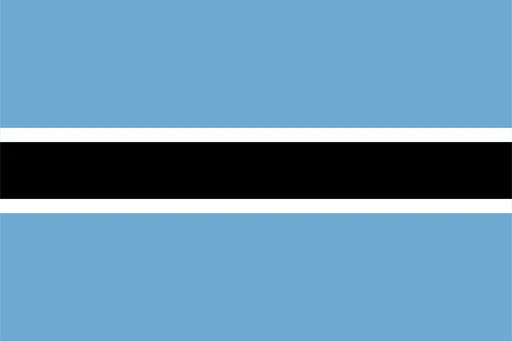
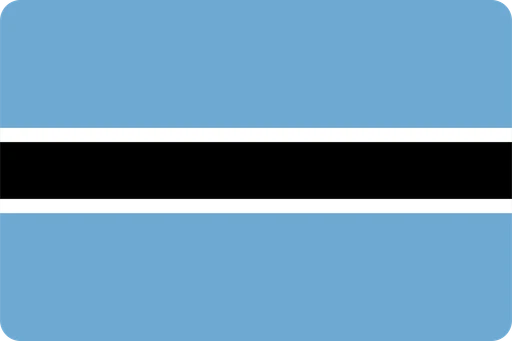
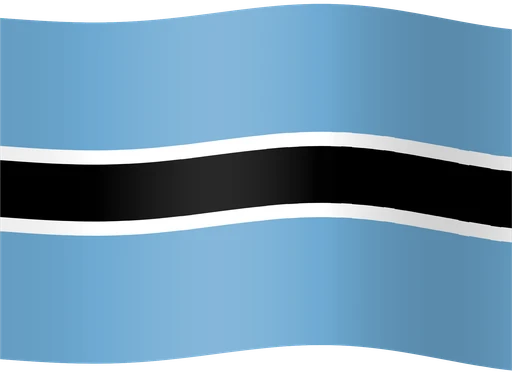
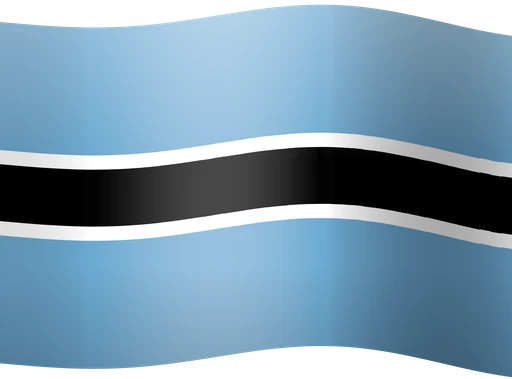
The flag of Botswana is a light blue field with a horizontal black stripe across the center, framed above and below by thin white stripes. The blue stands for water, and specifically for rain, which matters a great deal in a semi-arid country. The black and white bands stand for racial harmony and echo the markings of the zebra, Botswana's national animal.
Botswana's flag is an anomaly among African national flags. Adopted on September 30, 1966, the day the country became independent from Britain, it deliberately rejected the Pan-African palette of red, gold, and green that spread across the continent during decolonization. Botswana chose light blue, black, and white instead: sky, water, and racial harmony rather than continental solidarity or revolutionary struggle. In a region where flags often echoed party politics or liberation movements, Botswana's was built to belong to everyone in the country.
Breaking from the Pan-African palette
When African nations began winning independence in the late 1950s and 1960s, a visual pattern emerged almost immediately. Flag after flag adopted red, gold, and green, colors rooted in the Ethiopian tricolor and popularized by Marcus Garvey's Pan-African movement. They signaled solidarity with a broader African identity, and they often doubled as the colors of whichever political party had led the independence struggle. Ghana set the template in 1957. Guinea, Mali, Senegal, and dozens of others followed.
Botswana did not. When the British Bechuanaland Protectorate became independent on September 30, 1966, the flag raised that morning looked like nothing else on the continent. Light blue, black, and white. No stars, no emblems, no party colors.
Botswana's path to independence had been peaceful. There was no armed liberation war and no guerrilla movement whose colors demanded inclusion. The founders, led by Seretse Khama, envisioned a multiparty democracy from the start and wanted a flag no single faction could claim. Khama's own history gave the message of racial harmony a weight no committee could have designed on paper: his marriage to Ruth Williams, a white Englishwoman, had caused an international scandal in the 1950s and led to his exile by the British government under pressure from apartheid South Africa.
The flag was also a pointed contrast to Botswana's neighbors. South Africa was deep in apartheid. Rhodesia was a white-minority state.
Rain, sky, and the meaning of pula
The dominant color is light blue, sometimes described as cerulean, sometimes compared to UN blue. It covers most of the flag's surface, and its meaning is startlingly literal. In a country where the Kalahari Desert dominates the landscape and rainfall is scarce and unpredictable, water is life. The blue represents rain.
Botswana's national motto is Pula, the Setswana word for rain. It is also the name of the national currency. When Batswana greet each other at public gatherings, Pula! works as a cheer, a blessing, a wish for prosperity. The national anthem includes the line Lefatshe leno la rona, and its refrain calls out: "Let there be rain."
The blue also stands for the open sky over the flat terrain of the Kalahari. But the eye goes to the center of the flag, where a horizontal black stripe runs edge to edge, bordered above and below by thin white fimbriation. That band carries two meanings at once. It represents racial harmony, black and white peoples living together within the blue nation, and it mirrors the markings of the zebra, Botswana's national animal. Political statement and natural emblem in the same stripe.
Design specifications and proportions
The flag's proportions are 2:3, height to width. Construction is straightforward: a light blue field divided by a central horizontal band of black, with thin white stripes (fimbriation) separating the black from the blue above and below. The black stripe takes roughly one-ninth of the flag's height and each white stripe about one-thirty-sixth. The blue sections above and below are equal, so the flag is vertically symmetrical.
There are no emblems, coats of arms, stars, crescents, or charges of any kind. That makes it one of the simplest national flags in Africa, and vexillologists consistently praise it. It follows nearly every principle the North American Vexillological Association recommends: simplicity, meaningful symbolism, no lettering, two to three basic colors, and distinctiveness at a distance. You can recognize it from a hundred meters away, which is more than you can say for many national flags carrying intricate coats of arms.
Its clean geometry invites comparison with the flags of Estonia and Argentina, other triband-style designs that rely on color and proportion rather than ornamentation.
The zebra connection
The zebra (Equus quagga) appears on Botswana's coat of arms, flanking the central shield alongside a second zebra. It does not appear on the flag itself, yet the connection is unmistakable. The black-and-white band at the flag's center echoes the animal's stripes, and most Batswana read the link instinctively.
Zebras make an unusually apt national symbol. You cannot separate a zebra's black stripes from its white ones. They are one animal, one pattern, and the metaphor for national unity writes itself.
The choice also reflects ecological reality. Botswana is home to one of Africa's largest remaining wild zebra populations, and the Makgadikgadi salt pans host one of the continent's great zebra migrations, with tens of thousands of animals crossing each year. The flag and the coat of arms work together: the colors of the zebra on one, the zebra itself on the other.
Usage, protocol, and daily life
The flag flies at government buildings, border posts, and diplomatic missions around the world, following standard national flag protocols. It is never to touch the ground, it is folded with care, and it flies at half-mast during periods of national mourning.
September 30, Botswana Independence Day, brings the most visible display. The flag turns up draped across stages, pinned to lapels, and waved by schoolchildren in parades. You will also spot it on the tail fins of Air Botswana aircraft and on the kits of national sports teams, from football to athletics. The Presidential Standard is a distinct flag, with the national coat of arms centered on a light blue field.
Botswana has never changed its flag, not once in 58 years. In a region where coups, civil wars, and regime changes have prompted countless redesigns, that continuity is exceptional. The flag raised on independence morning in 1966 is the flag flying today.
Botswana's flag among its neighbors
Compare Botswana's flag to its neighbors' and the contrast is sharp. South Africa adopted its multicolored flag in 1994, encoding the transition from apartheid. Zimbabwe's seven-striped banner is layered with liberation symbolism, from the red star to the Zimbabwe Bird. Namibia's sun-and-diagonal design references the long struggle for independence from South African rule.
Botswana's flag encoded none of that. Where its neighbors looked back to honor sacrifice and struggle, Botswana's founders picked peaceful coexistence, democratic governance, and a shared dependence on rain.
Its survival without modification tells its own story. Botswana has never had a coup, a civil war, or a one-party state, so no regime has ever needed to redesign the flag to mark a new era. A flag belonging to no faction may have made that slightly easier. It belongs to the country rather than to any party, movement, or leader.
References
[1] Government of Botswana, Official State Symbols and National Flag Specifications. Available at: gov.bw
[2] Smith, Whitney. Flags Through the Ages and Across the World. McGraw-Hill, 1975.
[3] Znamierowski, Alfred. The World Encyclopedia of Flags. Lorenz Books, 2001.
[4] Parsons, Neil. King Khama, Emperor Joe, and the Great White Queen: Victorian Britain through African Eyes. University of Chicago Press, 1998.
[5] Flag Institute (UK), Botswana Flag Entry and Technical Specifications. Available at: flaginstitute.org
[6] Tlou, Thomas and Campbell, Alec. History of Botswana. Macmillan Botswana, 1984.
[7] Fombad, Charles Manga. "Botswana: An African Model for Democracy and Governance." Journal of African Law, 2005.
[8] North American Vexillological Association (NAVA), Resources on African National Flags. Available at: nava.org
Common questions
- Why doesn't Botswana's flag use the Pan-African colors of red, gold, and green?
- Botswana's founders, led by Seretse Khama, deliberately went a different route. They picked light blue, black, and white because they wanted a flag for all citizens, not one tied to any political party or liberation movement. Botswana's path to independence was peaceful, so there were no guerrilla or party colors to carry forward. The whole design points toward national unity rather than continental solidarity.
- What does the blue on Botswana's flag represent?
- It's all about rain. In a country dominated by the Kalahari Desert, water is everything. Botswana's national motto is "Pula," the Setswana word for rain, and it's also the name of the currency and a cheer meaning prosperity. The blue covers most of the flag, which makes sense when you realize how central rain is to the nation's identity and survival.
- What do the black and white stripes on Botswana's flag mean?
- The central black stripe with thin white stripes on either side has a double meaning. It represents racial harmony, black and white peoples living together in one nation. It also mirrors the markings of the zebra, Botswana's national animal. Zebra stripes are inseparable black and white, which makes them a natural metaphor for unity. It works as both a political statement and a cultural symbol.
- Why is the zebra associated with Botswana's flag?
- No zebra actually appears on the flag, but the black-and-white central band is a deliberate nod to zebra markings. The zebra is Botswana's national animal and shows up on the coat of arms. Its inseparable black and white stripes are a powerful metaphor for national unity. Botswana also hosts one of Africa's great zebra migrations across the Makgadikgadi salt pans, so the symbol is rooted in real ecology too.
Featured in these articles
- The Diagonal That Refuses to Be Ignored: What Trinidad, Tanzania, and Namibia's Bold Stripes Are Really Saying
- Flags and Their Stories: Analyzing the Design of African Nations
- The Design Problem Post-Colonial African Flags Had to Solve
- Algeria, Angola and Botswana: Three African Flags, One Overlapping Palette
Download this flag
Free in 12 styles, from 32px icons up to 2000px, as SVG, PNG, WebP and JPG.