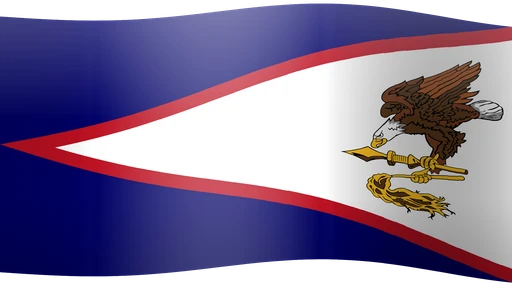
The Flag of American Samoa
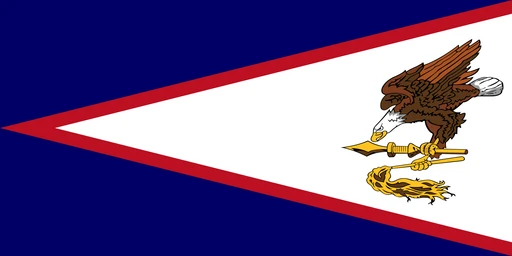
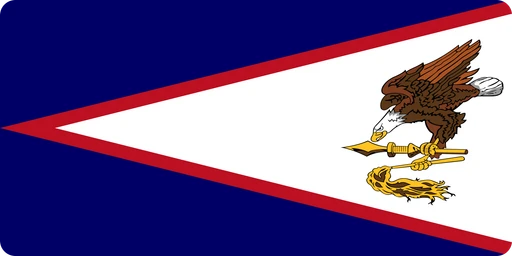
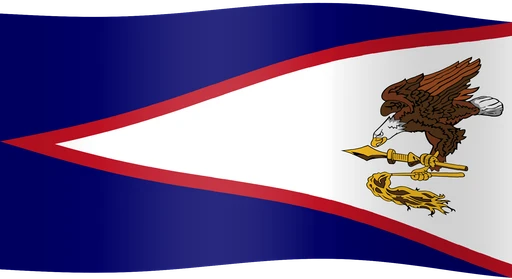
The flag of American Samoa has a dark blue field crossed by a red triangle edged in white, pointing toward the hoist. Inside the triangle a bald eagle holds a war club and a fly-whisk, one American emblem carrying two Samoan ones. The red, white, and blue are the colors of the United States, and they mark American Samoa's ties to it.
American Samoa's flag, adopted on April 27, 1960, is one of the few anywhere to show a bald eagle carrying something other than American emblems. A red triangle edged in white cuts across a dark blue field, and inside it the eagle grips a uatogi (war club) and a fue (fly whisk), the two objects a Samoan chief holds as marks of office.
The eagle and what it carries
The field is dark blue, close to navy. The triangle runs from the fly end all the way to the hoist. Inside it a bald eagle in natural colors, white head, dark brown body, golden beak and talons, flies toward the hoist rather than toward the fly. That direction is unusual. Birds on flags normally face outward; this one moves inward, toward the pole.
The palette is the red, white, and blue of the Stars and Stripes, though blue does its own work here. In Polynesian usage it is the color of the ocean and the sky, the two spaces that define island life. The white border frames the eagle against the red.
The eagle is American, the club and whisk are Samoan, and the flag puts them in the same pair of talons. On the Great Seal of the United States the eagle holds an olive branch and arrows. Here those are swapped for Samoan objects, so what the bird carries forward is Samoan tradition rather than American authority alone.
From naval station to self-governing territory
American Samoa came under U.S. control in pieces. The Treaty of Cession of 1900 covered Tutuila and Aunu'u. The Manu'a group was ceded in 1904. Rose Atoll was annexed in 1925, and Swains Island was incorporated the same year. The Navy administered the territory from 1900 to 1951, and the Department of the Interior after that. Through all of it there was no territorial flag.
That changed alongside the push for local self-government. By the late 1950s American Samoans were pressing for a constitution and an elected legislature. The flag's adoption on April 27, 1960 coincided with the territory's own constitution and the seating of its first elected Fono.
Most U.S. state and territorial flags are a seal dropped onto a blue background. American Samoa's was designed from scratch, and you can identify it from a hundred yards away, which is more than most of the others manage.
The uatogi and the fue
The two objects in the eagle's talons belong to the fa'amatai, the chiefly system that still organizes Samoan governance and daily life.
The uatogi, the war club, is the executive authority of the matai: the power to lead and defend, and the chief's obligation to protect the community. In traditional Samoan society the club was a working weapon, not a ceremonial prop.
The fue, the fly whisk, belongs to the tulafale, the orator chiefs who speak for high chiefs and mediate disputes in council. It stands for language: diplomacy, persuasion, the work of finding consensus. A skilled orator can settle what no warrior can.
Neither object outranks the other, and that is the argument the pair makes: strength together with wisdom, action together with deliberation. Putting them in the eagle's talons in place of the Great Seal's olive branch and arrows was a deliberate choice, and it describes an arrangement that actually exists. The fa'amatai is constitutionally protected in American Samoa, and communal land ownership, chiefly titles, and traditional authority structures are written into law.
Where the flag flies
The flag flies beside the U.S. national flag at government buildings across the territory, with the Stars and Stripes in the position of honor. It appears at the Fono, the Governor's office, public schools, and courthouses, following U.S. flag code adapted for territorial use.
Abroad, it turns up wherever American Samoa competes under its own banner. The territory has its own National Olympic Committee and sends athletes to the Summer and Winter Games. Its football team is best known for a long run of defeats that ended in 2011 with a 2-1 win over Tonga in a FIFA World Cup qualifier, a game later covered in the documentary Next Goal Wins.
On the U.S. mainland the flag belongs to the Samoan-American diaspora, particularly in Hawai'i, California, Washington, and Utah. You will find it at cultural festivals, on car decals, and draped over shoulders at college graduations.
Compared with other U.S. territorial flags
Line up the five major U.S. territorial flags and American Samoa's is the odd one out. Guam puts its seal on a dark blue field with a red border. The U.S. Virgin Islands show an eagle flanked by the letters V and I, holding arrows and an olive branch. Puerto Rico flies a lone-star tricolor influenced by the Cuban flag. The Northern Mariana Islands use a star and latte stone on blue. Only American Samoa and Puerto Rico get much praise from vexillologists.
The North American Vexillological Association's guide Good Flag, Bad Flag sets out five rules for flag design: keep it simple, use meaningful symbolism, limit colors, avoid lettering and seals, and be distinctive. American Samoa's flag meets all five.
Independent Samoa, formerly Western Samoa, flies something quite different: a red field with a blue canton carrying the Southern Cross, a design that came out of its own path through German and then New Zealand administration. The two Samoas share deep cultural roots and very different colonial histories, and the flags show it.
References
[1] American Samoa Government. Revised Constitution of American Samoa. Available at www.americansamoa.gov.
[2] Smith, Whitney. Flags Through the Ages and Across the World. McGraw-Hill, 1975. Comprehensive vexillological reference covering territorial and national flags worldwide.
[3] North American Vexillological Association (NAVA). Good Flag, Bad Flag: How to Design a Great Flag. 2006. Guidelines and evaluations of flag design principles.
[4] Office of the Historian, U.S. Department of State. "Treaties of Cession of American Samoa." Historical documents on territorial acquisition, available via history.state.gov.
[5] Leibowitz, Arnold H. Defining Status: A Comprehensive Analysis of United States Territorial Relations. Martinus Nijhoff Publishers, 1989. Detailed legal history of U.S. territories including American Samoa.
[6] Krämer, Augustin. The Samoa Islands: An Outline of a Monograph with Particular Consideration of German Samoa. Translated edition, University of Hawai'i Press. Historical context on Samoan chiefly symbols and the fa'amatai system.
[7] CIA World Factbook. "American Samoa." Regularly updated reference for basic territorial facts and flag description. Available at www.cia.gov/the-world-factbook.
Common questions
- Why does the American Samoa flag feature a bald eagle?
- The eagle is there for the tie to the United States. In its talons it holds a fly-whisk and a war club, so the image carries American governance and Samoan custom at once.
- What do the symbols in the eagle's talons on the American Samoa flag mean?
- The fly-whisk means wisdom and respect. The war club means authority. Between them they cover Samoan tradition and American governance.
- What is the eagle holding on the American Samoa flag?
- Two chiefly emblems: a *uatogi* (war club) and a *fue* (fly whisk). The club belongs to the executive power of chiefs, the whisk to the oratory and diplomacy of orator chiefs. Holding both is a statement about balanced government, strength with wisdom, which sits at the center of the Samoan *fa'amatai* system.
- Why does the American Samoa flag look so different from other U.S. territorial flags?
- Most U.S. state and territorial flags put a seal on a blue background and stop there. American Samoa's has no text and no seal: a red triangle, a bald eagle, and two Samoan objects. Vexillologists regularly rank it among the best designed U.S. territorial flags.
Featured in these articles
Download this flag
Free in 12 styles, from 32px icons up to 2000px, as SVG, PNG, WebP and JPG.