Blue appears on roughly 40% of the world's national flags. Island and coastal nations, the countries most surrounded by ocean, cluster around blue at an even higher rate, and their blues are often the same shade. Not the turquoise of a Caribbean reef. Not the deep indigo of the open Pacific. Something flatter and more institutional.
If Tuvalu, Micronesia, Aruba, and the Marshall Islands all independently chose blue to represent the water around them, why do so many of their flags look less like the sea outside their windows and more like a United Nations letterhead?
Blue on island flags is not primarily geographic self-expression. It is a political and temporal artifact, the product of a roughly 20-year window from about 1945 to 1965 when newly decolonizing states were absorbing the visual grammar of the postwar international order. These flags were painted with inheritance and ambition, and with the particular anxiety of a small nation trying to look like a real one.
The blue coincidence
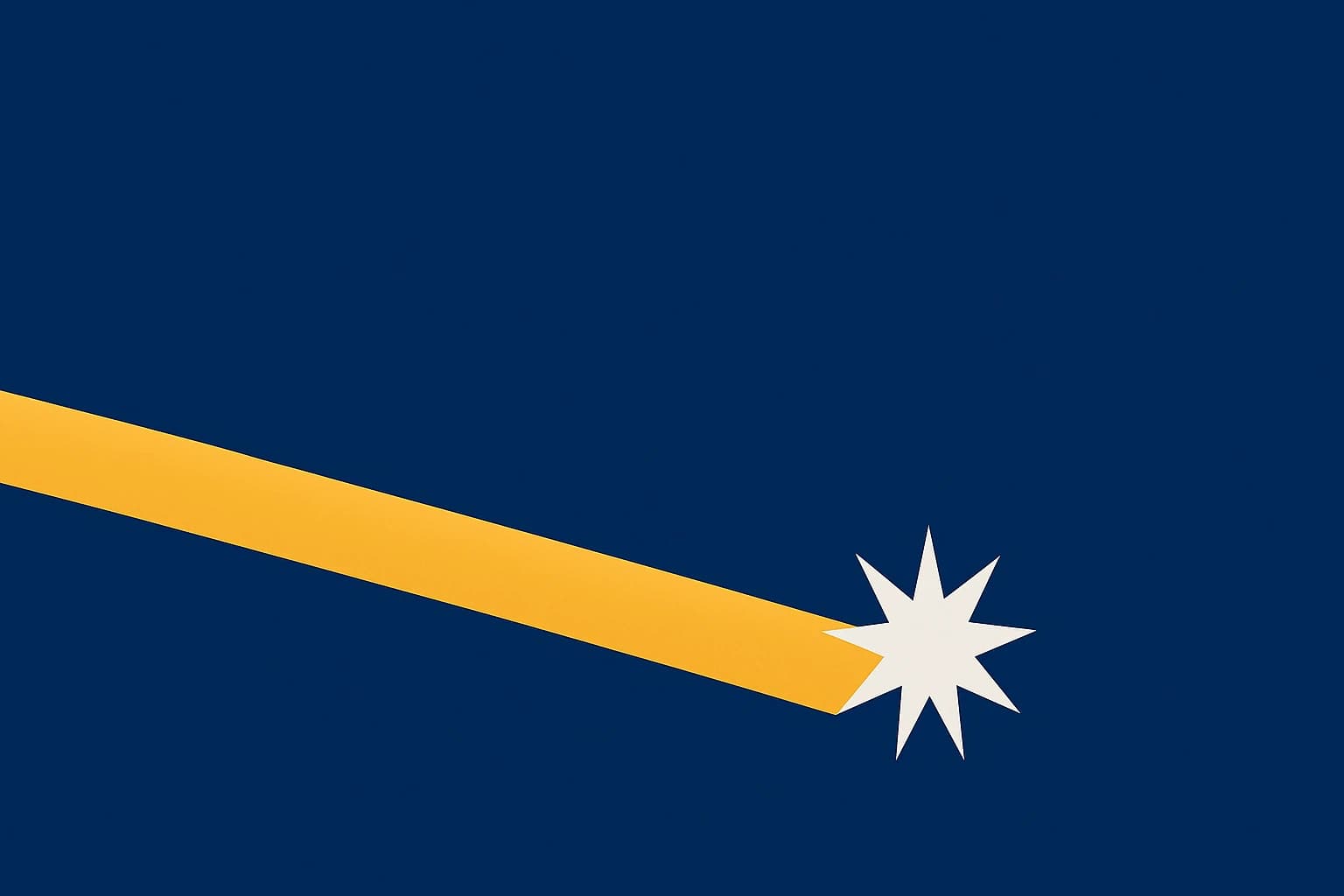
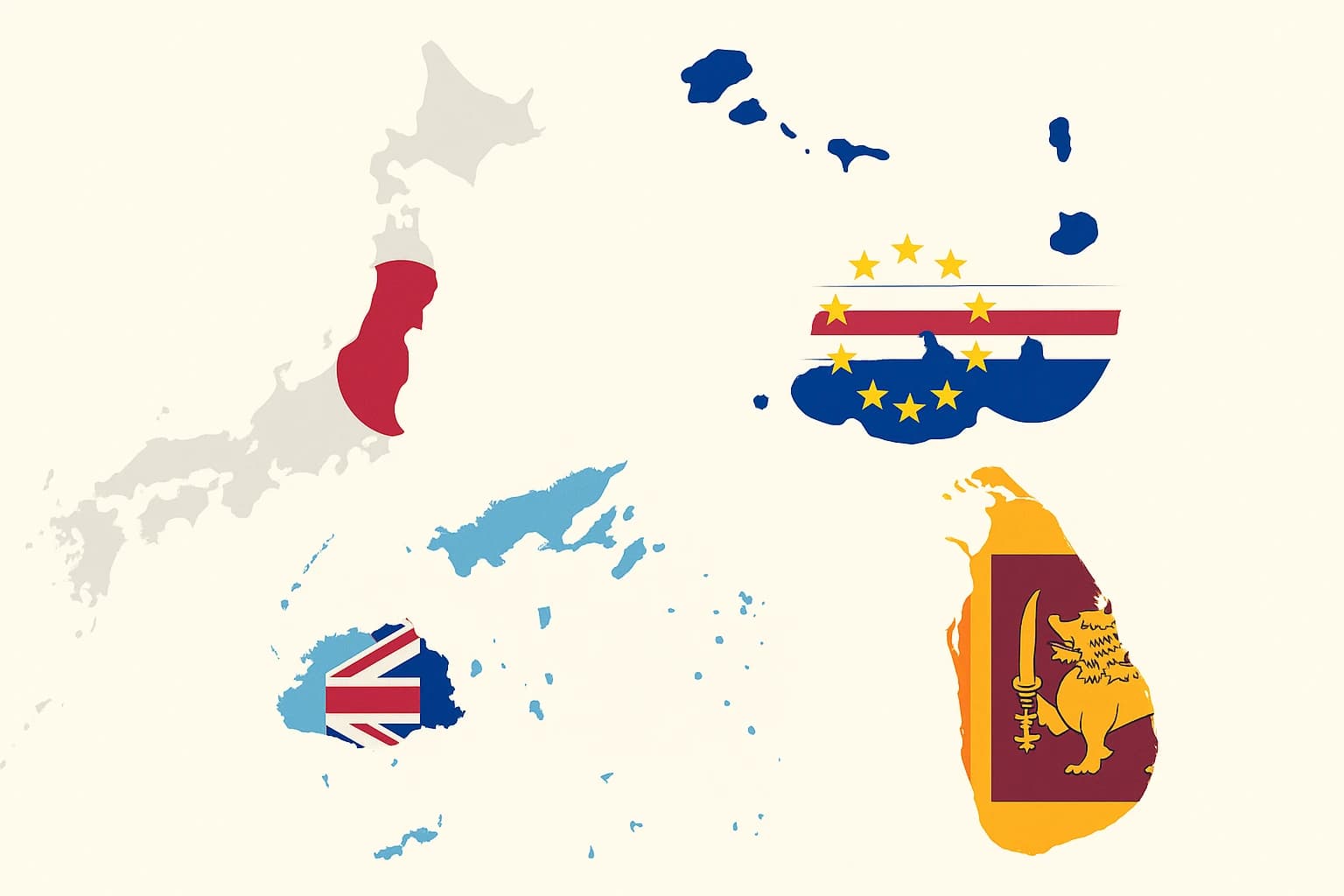
Line up the flags of Pacific and Caribbean island states and something turns up that is uncomfortable for anyone who believes flag design is a free creative act. Tuvalu uses a light blue field. Micronesia's blue is so close to UN blue as to be almost indistinguishable. The Marshall Islands have a blue field. Aruba's blue carries a distinct stripe. Guam flies a blue-bordered design. Nauru uses blue with a yellow stripe.
These nations are scattered across thousands of miles of ocean, and their design committees, in most cases, never spoke to each other. They still landed on strikingly similar colors.
The intuitive explanation is the ocean, and it falls apart on closer inspection. If blue represented the sea, you would expect variation matching the color of local waters, because Caribbean turquoise looks nothing like deep Pacific navy. Instead there is a narrow band of medium blues that look like they came from the same paint can.
Then there is Somalia, a country with a coastline but no islands, whose flag uses a blue that sits squarely in the UN-blue family.
The color's source is not geographic. Three overlapping forces explain it: colonial inheritance, UN aspirational signaling, and the specific moment of mid-century decolonization when what a flag should look like was being invented in real time.
Colonial palettes: the blues that were already there
The first source of island blues is European colonial flags, and the British Blue Ensign is the most consequential of them.
Britain assigned defaced Blue Ensigns to its colonial territories across the Pacific and Caribbean. Fiji, Tuvalu (then the Ellice Islands), the Gilbert Islands, and dozens of other dependencies flew variations of the same blue field with a Union Jack in the canton. By the time independence came, blue was already the ambient color of statehood in these places. It was the color of the authority they had grown up under.
Tuvalu is the telling case. When the country gained independence in 1978, its first instinct was to keep a Blue Ensign variant. It took a national referendum, a flag redesign, and a reversal back to the original design, all compressed into 1995 to 1997, for the country to even have the argument about whether the blue should stay. It stayed.
The Dutch and French equivalents tell the same story from other angles. Aruba's blue traces not to the Caribbean Sea but to the Dutch tricolor and the wider Dutch colonial administrative palette. The unofficial flags of Martinique and Guadeloupe carry similar European chromatic DNA.
For many island nations blue was not chosen. It was inherited and then rationalized as geographic symbolism afterwards. The "it represents the ocean" explanation is often a story told about what was, in practice, path dependency. The blue was already there when they opened their eyes to independence, and they kept it and explained it differently.
The UN blue effect
In 1947 the United Nations adopted a specific medium blue, now identified as Pantone 279, for its flag and branding. The color was chosen to be the "opposite of red," to signal neutrality, peace, and international legitimacy. A chromatic argument against war.
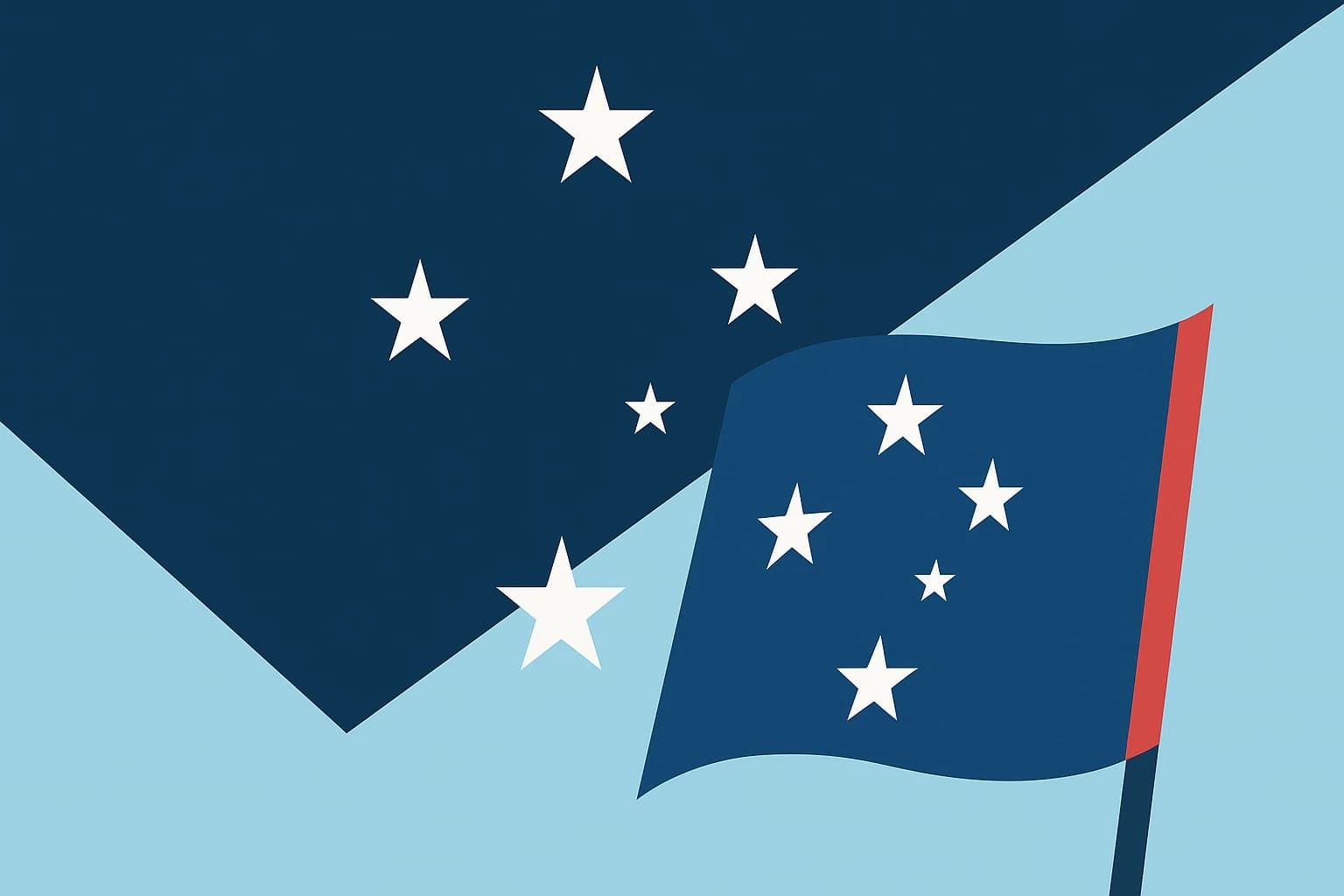
The influence is documented. The Federated States of Micronesia adopted its flag in 1979 using a field nearly identical to UN blue, explicitly to signal international legitimacy and alignment with the postwar multilateral order at the exact moment the country was moving from US Trust Territory to self-governance. Four white stars on a UN-blue field. Clean, minimal, and legible from across a General Assembly hall.
The pattern is broader than that. Somalia's flag, designed in 1954 while the country was still under colonial administration but anticipating independence, lands in the same Pantone neighborhood. So does Kosovo's flag from 2008.
These designers were not copying each other. They were all drinking from the same well. UN blue had become visual shorthand for "we are a legitimate sovereign state that belongs in the international community."
For a nation of 100,000 people in the middle of the Pacific, a flag that visually rhymes with the UN flag is not imitation but a deliberate claim to equal standing. Blue became the color of wanting to be taken seriously on a stage designed by and for larger powers. In trying to assert a distinct national identity, many island states converged on the same color precisely because it signaled belonging.
Tuvalu's nine stars and four decades of second-guessing
Tuvalu is the richest case, because the country has argued about its blue in public, changed its mind, and changed it back.
The 1978 independence flag was a Blue Ensign variant with nine stars for the nine atolls, designed by a Tuvaluan committee working alongside the departing British administration. The blue came straight from the colonial era; the stars were the local content inside an inherited frame.
Between 1995 and 1997 a new government replaced the Union Jack with a local motif and altered the design significantly. It proved deeply unpopular, not because the new flag was ugly but because removing the old visual markers was seen as erasing continuity and, more to the point, visual legitimacy. A national vote restored the original. For Tuvaluans the specific inherited blue carried meaning beyond aesthetics: it was a claim to recognized statehood, a receipt proving they had been processed through the proper channels of international acceptance.
Now bring that to 2026. Tuvalu sits at the center of one of the sharpest sovereignty questions of the era, because rising sea levels threaten to physically submerge the islands. Tuvalu has signed agreements, including the 2023 Falepili Union with Australia, to preserve its legal nationhood even if its land disappears beneath the waves. The blue field has become a symbol of national persistence in a new and literal sense. A color that once signaled colonial inheritance now signals existential defiance.
Tuvalu's blue has meant at least three different things across four decades: inherited legitimacy, contested identity, and survival. Which is why reducing island blue to "it represents the ocean" is so inadequate. The ocean is not a symbol for Tuvalu. It is a threat.
How islands personalize the same blue
Given that so many island nations landed on the same background color, the more interesting design question is how each one used the rest of the flag to assert something of its own.
Aruba's answer is a single red stripe edged in gold cutting across the blue field, a deliberate disruption of the standard colonial visual language. The four-pointed star carries specific local meaning: the four languages spoken on the island and the four corners of its ethnic communities. The flag accepts the blue premise and argues back with everything else on the canvas.
The Marshall Islands took a different path. The diagonal stripe running from lower-left to upper-right is read locally as a rising sun, and the white-and-orange combination against the blue field creates a visual energy unlike any other Pacific flag. The 24-pointed star encodes the number of electoral districts: hyper-local data in a globally legible format.
Micronesia and Tuvalu make a good contrast pair. Both use blue fields with white stars. Micronesia's four stars in a simple diamond on UN blue read as deliberately minimal and internationally oriented. Tuvalu's nine stars are arranged to mirror the geographic positions of its atolls, which makes the flag a map of a real, specific place.
The differentiation strategies show what each nation was most anxious to prove. Nations emphasizing international standing kept their blue clean and symbol-light. Nations emphasizing territorial specificity packed their flags with local data. Blue was the shared premise; the rest of the flag was the argument.
Rereading island flags as political documents
Blue on island and coastal flags operates on at least three frequencies at once. It is colonial residue. It is an aspirational signal. Only thirdly is it a geographic reference, and the relative weight of each differs by nation and by decade.
Flags are arguments made at a specific historical moment rather than illustrations of geography or identity. The moment that produced most of these island flags, the decolonization era from the 1960s through the 1980s, ran on a visual politics in which blue meant modern, peaceful, internationally legitimate, and post-colonial without being anti-Western.
The counterexamples help. Papua New Guinea in 1971 and Vanuatu in 1980 both rejected blue-dominant designs in favor of red, black, green, and gold, colors associated with African liberation movements and pan-indigenous identity. Rejecting blue was a political statement about which international community they wanted to join and which visual tradition they were claiming.
The convergence of island blues is a historical fingerprint, not a geographic one. It marks the moment when the postwar international order offered small nations a visual contract: adopt this palette and we will recognize you as one of us. Most took the deal. A few did not. Both choices say something about the pressures of becoming a nation in the second half of the 20th century.