The Flag of Fiji
Republic of Fiji
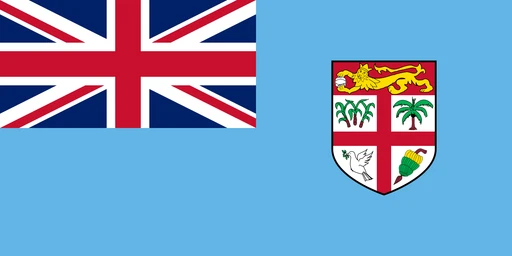
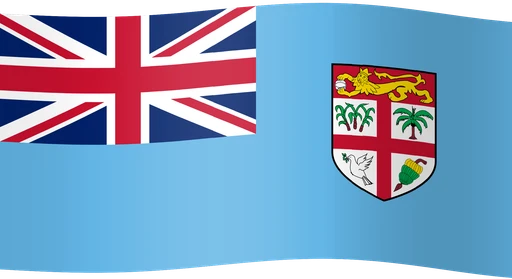
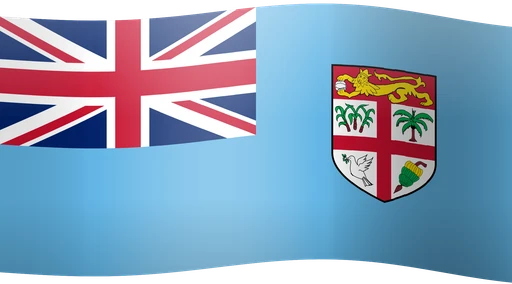
The flag of Fiji has a light blue field with the Union Jack in the canton, a reference to British colonial rule, and a shield taken from Fiji's national arms on the fly side. The shield holds a yellow lion with a cacao pod, three panels showing sugar cane, a coconut palm, and a bunch of bananas, and a fourth panel with a dove of peace.
Fiji's is one of the few national flags with a light blue field, a deliberate departure from the navy blue used by most Commonwealth nations, and one of even fewer to carry a full national coat of arms rather than a simplified emblem. At first glance it reads as a relic of the colonial era: Union Jack in the upper left, shield from the coat of arms on the right. It was adopted at independence in 1970 and has barely changed since.
A flag born at independence, and almost replaced
Fiji gained independence from Britain on October 10, 1970, and adopted the flag on that exact date, so the flag and the nation are the same age. The design did not emerge from a vacuum. It was a compromise: indigenous Fijian leaders, Indo-Fijian communities, and British advisors all had stakes in the symbolism, and the result reflects the tension between those interests rather than resolving it.
Serious proposals to redesign the flag and strip out the Union Jack have surfaced since. The most notable came in 2013, when Prime Minister Frank Bainimarama announced plans for a new flag better suited to Fiji's status as a republic, which it had held since 1987. Similar conversations have run across the Commonwealth, particularly in Australia and New Zealand. Unlike New Zealand, which held a binding and ultimately unsuccessful referendum in 2015 and 2016, Fiji has never put its flag to a public vote. The current design has survived four coups between 1987 and 2006, multiple constitutional overhauls, and periodic surges of republican sentiment.
Compare Fiji to Tuvalu, another small Pacific nation, which removed its Union Jack in 1995 and restored it by popular demand in 1997 after the redesign proved deeply unpopular. Fiji's flag has simply endured.
Why light blue
Pick up any book on Commonwealth flags and Fiji's light blue field sticks out. Australia, New Zealand, the Cook Islands, and most other former British territories use a dark navy or royal blue. Fiji went lighter, and the choice was intentional.
Fijian law describes the field simply as "light blue," and the official rationale ties it to the Pacific Ocean and sky, which suits an archipelago of more than 330 islands scattered across 1.3 million square kilometers of ocean. It also served a subtler purpose. Stepping away from the deep blue of the colonial Blue Ensign let Fiji assert a distinct national identity while keeping the Union Jack and the coat of arms.
Light blue fields are rare. Argentina, Uruguay, Somalia, and Finland all use variations, in very different configurations. There is also the practical matter of reproducing the exact shade. Since 1970 the hue has drifted depending on manufacturer and medium, and no single Pantone or hex code has been universally standardized, which is a recurring headache for flag makers and graphic designers.
The shield
The coat of arms on the fly half is a condensed national biography in heraldry: economics, religion, colonialism, and indigenous culture packed into one shield.
A red Cross of St. George on a white field divides the shield into four quarters. Sugarcane appears in one, the crop that dominated Fiji's colonial and post-colonial economy for over a century. A coconut palm occupies another, a nod to indigenous Pacific resources. A third holds a dove of peace clutching an olive branch, which is aspirational rather than historical. The fourth shows a bunch of bananas.
Above the shield sits a British lion holding a cocoa pod, a detail that carries more weight than it might seem. Cocoa production in Fiji was historically tied to the indentured labor system that brought tens of thousands of Indian workers to the islands between 1879 and 1916, a legacy that still shapes Fijian politics and demographics. The lion is unmistakably imperial.
Crowning the composition is a traditional Fijian drua, a double-hulled sailing canoe. Before European contact, these vessels were among the most sophisticated watercraft in the Pacific, capable of carrying hundreds of people across open ocean. Putting the drua at the top of the arms is a deliberate assertion of indigenous iTaukei civilization, reinforced by the two Fijian warriors in traditional regalia flanking the shield as supporters.
Then there is the motto: Rerevaka na Kalou ka Doka na Tui, "Fear God and Honor the Queen." Fiji has been a republic since 1987, so the phrasing sits in an awkward political space. It has not been formally changed, and its monarchist wording periodically fuels calls for revision.
The Union Jack question
No element of the flag generates more debate than the Union Jack in the canton. It is the focal point of nearly every redesign conversation.
Fiji became a British Crown Colony in 1874, after the Deed of Cession signed by paramount chief Ratu Seru Epenisa Cakobau transferred sovereignty to Queen Victoria. The colonial period lasted 96 years and reshaped the islands fundamentally, bringing plantation agriculture, indentured labor, Christianity, and English common law.
When independence came in 1970, keeping the Union Jack was not simply inertia. Fijian leaders actively chose it, seeing value in visible Commonwealth ties for trade, security, and diplomatic recognition. Even the 1987 coups led by Sitiveni Rabuka, driven largely by indigenous Fijian political concerns and the formal break with the monarchy, did not produce a new flag.
Other Pacific nations went the other way. Solomon Islands, Papua New Guinea, and Vanuatu all created entirely new flags at independence, with no British elements. Fiji, like Australia and Tuvalu, kept the Union Jack, though for different reasons in each case. For Fiji the canton signals ongoing Commonwealth membership and a particular diplomatic positioning in the Pacific. Domestically its meaning fractures along ethnic lines: some iTaukei Fijians see a connection to the Crown that originally recognized chiefly authority, while some Indo-Fijian communities see a reminder of the colonial system that brought their ancestors to Fiji as laborers.
From state ceremonies to rugby fields
The flag flies on government buildings across Suva, at Fijian embassies and high commissions abroad, and on naval and coast guard vessels. Fiji also maintains distinct naval and civil ensign variants: the naval ensign uses a white field with a red St. George's Cross and the national flag in the canton, while the civil ensign places the national emblem on a red field.
Its most electric appearances happen far from government buildings. Fiji's rugby sevens team has turned the light blue rectangle into one of the most recognizable symbols in international sport. When the team won the country's first Olympic gold medal at the 2016 Rio Games, the flag was draped over players' shoulders, painted on faces, and waved by fans from Suva to Sydney. That single tournament probably did more for the flag's global recognition than decades of diplomatic protocol.
At the United Nations and in Pacific regional organizations like the Pacific Islands Forum and the Melanesian Spearhead Group, the flag marks Fiji's seat at the table. At home it is central to Fiji Day on October 10, the Hibiscus Festival, and school ceremonies across the islands.
Large Fijian diaspora communities in Australia, New Zealand, the United States, and Canada display the flag at community gatherings, where it often appears alongside traditional masi (tapa cloth) patterns.
References
[1] Fiji Government Online (www.fiji.gov.fj). Official flag specifications and national symbols documentation.
[2] Flags of the World (FOTW) Database (www.crwflags.com). Vexillological analysis, color specifications, and historical variants of the Fijian flag.
[3] Smith, Whitney. Flag Lore of All Nations. Millbrook Press, 2001. Comprehensive reference including Pacific island flags with historical context.
[4] Scarr, Deryck. Fiji: A Short History. Allen & Unwin, 1984. Essential background on the colonial period and independence.
[5] Lal, Brij V. Broken Waves: A History of the Fiji Islands in the Twentieth Century. University of Hawaii Press, 1992. Covers the political context surrounding independence and the coups.
[6] College of Arms (London) records. Documentation of Fiji's coat of arms grant and heraldic specifications.
[7] Commonwealth Secretariat archives. Records of Fiji's independence ceremony and flag adoption, October 10, 1970.
[8] International Olympic Committee (IOC) official records. Documentation of Fiji's 2016 Olympic gold in rugby sevens and flag representation.
Common questions
- Why is the Union Jack on Fiji's flag?
- The Union Jack marks Fiji's ties to the UK: its colonial past and its Commonwealth membership.
- What does the light blue on the Fiji flag mean?
- The light blue is the Pacific Ocean, which surrounds the islands and which Fiji depends on.
- What do the symbols on Fiji's flag shield mean?
- The shield shows sugar cane, a coconut palm, bananas, and a dove: the country's agricultural base and peace.
- Why is Fiji's flag light blue instead of dark navy blue like other Commonwealth flags?
- Fiji deliberately chose light blue to stand out from the navy blues that most Commonwealth nations use. It represents the Pacific Ocean and sky while giving Fiji its own identity. Light blue flags are rare, so it makes Fiji's instantly recognizable.
- Why does Fiji keep the Union Jack on its flag if it's now independent?
- When Fiji became independent in 1970, the government chose to keep the Union Jack to show its continuing ties to the Commonwealth, which helped with trade, diplomacy, and security. It has survived four coups and Fiji becoming a republic in 1987, even though people have suggested removing it several times. It has never been put to a public vote.
Featured in these articles
- New Zealand Spent $26 Million Voting on a New Flag. Then Chose the Old One.
- The Star That Doesn't Belong: How Nauru's Flag Pinpoints a Tiny Nation in a Vast Ocean
- Dressed for the Coronation: Why So Many Caribbean Flags Are Still Wearing Britain's Blue
- Borrowed Blue: Why Island and Coastal Nations Didn't Choose the Ocean. They Chose the 20th Century
Download this flag
Free in 12 styles, from 32px icons up to 2000px, as SVG, PNG, WebP and JPG.