The Flag of Kosovo
Republic of Kosovo
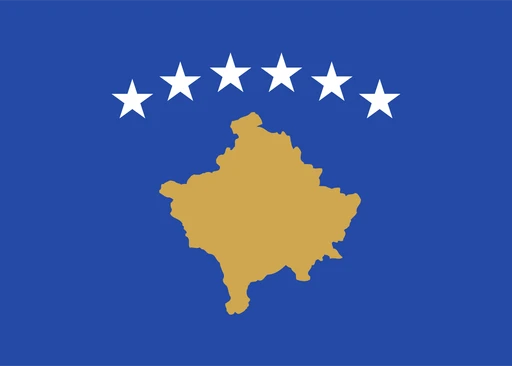
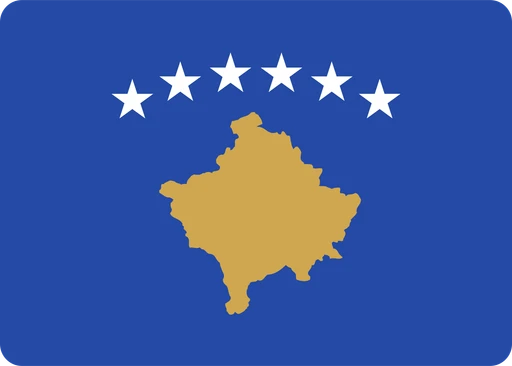
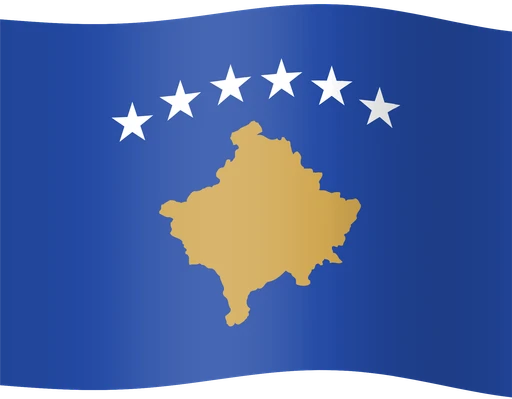
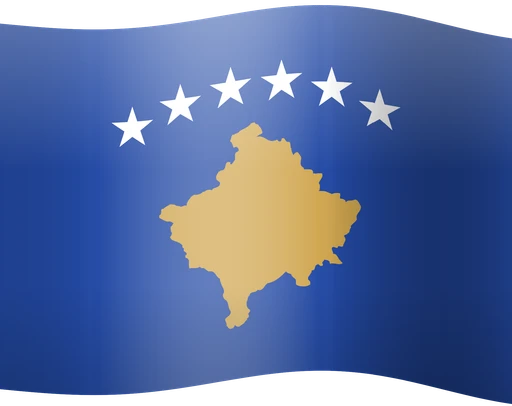
The flag of Kosovo has a blue field with a gold map of Kosovo set slightly toward the hoist. Six white stars sit in an arc above the map, one for each of the country's major ethnic groups. The blue and gold echo the European Union flag, a signal of Kosovo's ambition to join it.
Kosovo's flag was adopted on February 17, 2008, at the moment the country declared independence from Serbia, which makes it one of the youngest national flags on the planet. It came out of an internationally supervised design competition, overseen by the United Nations, rather than from centuries of heraldic tradition. A gold map, six white stars, a field of blue borrowed from the European Union.
A flag adopted the same day as independence
Kosovo's parliament declared independence and adopted a national flag on the same day. Most countries accumulate their symbols over decades or centuries. Kosovo had to invent itself all at once.
For nearly a decade before that moment, Kosovo had existed in political limbo. Following the Kosovo War of 1998 and 1999 and NATO's intervention against Serbian forces, the territory was placed under the administration of the United Nations Interim Administration Mission in Kosovo (UNMIK). During those years the UN flag flew over government buildings. Kosovo had institutions, a population, and a territorial boundary, but no flag of its own.
The design competition was organized under UN auspices during the final phase of status negotiations. Hundreds of submissions came in from Kosovo citizens and designers around the world. The winning concept came from Muhamer Ibrahimi, a local graphic designer, though a parliamentary commission refined it before final approval. The goal was clear: create something no single ethnic group could claim exclusively.
The flag was written into Article 6 of Kosovo's new Constitution, giving it constitutional status from the first day of statehood. Kosovo's independence remains contested, though. As of 2024, over 100 UN member states recognize it, but Serbia, Russia, China, and others do not, which means the flag carries a political charge in certain contexts: at some sporting events, in diplomatic settings, and at the UN General Assembly, where Kosovo holds no seat.
A map on a flag
The blue background isn't just any blue. It's Pantone 285 C, chosen to mirror the blue of the European Union flag. That's a political statement, not an aesthetic preference: Kosovo sees its future inside Europe.
Centered on the blue field is a gold silhouette of Kosovo's territory. This is genuinely rare in vexillology. Only a handful of national flags depict the country's own map, and the most famous parallel is Cyprus, which shows its island shape in copper-orange on white. Both Kosovo and Cyprus are small, ethnically divided, and partially recognized, and both chose to draw their borders on their flags.
Above the silhouette, six white stars form a gentle arc, one for each of Kosovo's six major ethnic communities: Albanians, Serbs, Bosniaks, Roma, Turks, and Gorani. The arrangement echoes the circle of stars on the EU flag, doubling down on the European aspiration, while the number six carries a specific local meaning.
What's absent matters too. There are no religious symbols anywhere on the flag, no crosses, no crescents. In a region where Orthodox Christian and Muslim identities have fueled conflict and shaped politics for centuries, that omission is striking. The flag was engineered to represent a civic nation rather than an ethnic or religious one.
What the flag leaves out
During the design competition, many submissions featured the Albanian double-headed eagle, the black bird on a red field that defines Albania's national identity. The eagle was rejected. Including it would have signaled ethnic Albanian dominance, or worse, aspirations toward a "Greater Albania" that would have alarmed Serbia, the international community, and Kosovo's own minority populations.
Red and black, the colors of the Albanian flag, were excluded for the same reason. Kosovo's designers and political leaders wanted a flag that couldn't be mistaken for a provincial variant of Albania's.
Not everyone accepted that. Many Kosovo Albanian activists and diaspora communities still fly the Albanian eagle flag alongside, or instead of, the official Kosovo flag at rallies, cultural events, and on private buildings. That tension between civic identity and ethnic loyalty remains alive.
Serbian Orthodox symbols were equally absent from all serious proposals, though Serbia's government doesn't recognize Kosovo's independence or its flag in any context. The design process was shaped as much by refusal as by choice.
Official use and the problem of recognition
Within Kosovo, the flag flies on all government buildings, police stations, military installations, and at official state ceremonies. The complications begin at the border.
The flag appears in international organizations where Kosovo holds membership: the International Monetary Fund, the World Bank, and the International Olympic Committee, which admitted Kosovo in 2014. That IOC recognition led to one of the flag's most visible moments. At the 2016 Rio Olympics, judoka Majlinda Kelmendi won Kosovo's first Olympic gold medal. The flag rose, the anthem played, and millions of viewers saw it for the first time.
In venues tied to states that don't recognize Kosovo, the flag simply doesn't exist. Kosovo is not a UN member, so its flag has no standing at the General Assembly. Bids for membership in UNESCO and Interpol were blocked by votes from non-recognizing states.
Kosovo also maintains a Presidential Standard and military ensigns, both of which follow the design language of the national flag. Protocol within Kosovo treats the flag with formal constitutional respect, consistent with its Article 6 status.
Kosovo among Balkan flags
The Western Balkans is a region where flags carry weight. Serbia's tricolor descends from Pan-Slavic tradition. Albania's double-headed eagle reaches back to the medieval hero Skanderbeg. North Macedonia fought a bitter dispute with Greece partly over a flag symbol. Bosnia and Herzegovina's flag, like Kosovo's, was designed under international supervision and uses EU-echoing blue with white stars.
Kosovo's flag stands apart from all of them. It carries no dynastic coat of arms, no religious emblem, no ethnic marker. Vexillological organizations like the Flag Institute in the UK and Flags of the World cite it as a textbook example of a civic flag, one designed to represent all citizens rather than a dominant group.
The Kosovo-Cyprus comparison keeps surfacing in academic and vexillological discussions: two small territories, both ethnically divided, both with contested borders, both choosing to put their map on their flag.
Kosovo's approach has also fed broader conversations about flag design in post-conflict states. For new nations or transitional territories, the Kosovo model offers a template: start fresh, avoid ethnic symbols, and signal your international aspirations.
References
[1] Constitution of the Republic of Kosovo (2008), Article 6. Official text available via the Kosovo Assembly. (https://www.assembly-kosova.org)
[2] United Nations Interim Administration Mission in Kosovo (UNMIK). Historical records on transitional governance and flag usage. (https://unmik.unmissions.org)
[3] Flags of the World (FOTW). Kosovo entry, including design specifications and historical background. (https://www.crwflags.com/fotw/flags/xk.html)
[4] The Flag Institute (UK). Analysis of the Kosovo flag design and vexillological context. (https://www.flaginstitute.org)
[5] International Olympic Committee. Kosovo National Olympic Committee recognition records. (https://www.olympics.com)
[6] BBC News. Coverage of Kosovo's 2008 independence declaration and flag adoption. (https://www.bbc.co.uk)
[7] CIA World Factbook. Kosovo country profile. (https://www.cia.gov/the-world-factbook/countries/kosovo)
[8] Smith, Whitney. "Flag." Encyclopædia Britannica. General vexillological methodology and context.
Common questions
- Why are there six stars on the Kosovo flag?
- The six stars stand for the main ethnic groups in Kosovo: Albanians, Serbs, Turks, Gorani, Romani, and Bosniaks.
- What does the map on the Kosovo flag represent?
- The gold map marks out Kosovo's territory and asserts its sovereignty.
- Why does the Kosovo flag show a map of the country?
- It's a way of saying "we exist." The gold map on Kosovo's flag marks the country's borders and makes a statement about sovereignty. Not many national flags show their own territory, but Kosovo does, alongside Cyprus. Both countries are small, ethnically mixed, and only partially recognized worldwide, so the map helps assert their legitimacy.
- What do the six stars on the Kosovo flag stand for?
- Each star represents one of Kosovo's major ethnic groups: Albanians, Serbs, Bosniaks, Roma, Turks, and Gorani. They're arranged in an arc that mirrors the EU flag's circle of stars, which points to Kosovo's goal of eventually joining Europe. The design says all these communities matter equally.
- Why isn't the Albanian eagle on the Kosovo flag?
- It was left out on purpose. Including Albania's double-headed eagle would have looked like Kosovo wanted to merge with Albania, or like ethnic Albanians dominated the country. That would have alarmed Serbia, the international community, and Kosovo's own minorities. So the flag was designed to represent everyone, not one ethnic group.
Featured in these articles
- The Star That Doesn't Belong: How Nauru's Flag Pinpoints a Tiny Nation in a Vast Ocean
- The Map That Became a Flag: Why Kosovo and Cyprus Broke Vexillology's Most Sacred Rule
- The Map That Became a Flag: Why Cyprus and Kosovo Put Their Own Borders on Their Banners, and What That Desperate Move Reveals
- Borrowed Blue: Why Island and Coastal Nations Didn't Choose the Ocean. They Chose the 20th Century
Download this flag
Free in 12 styles, from 32px icons up to 2000px, as SVG, PNG, WebP and JPG.