The Flag of Tuvalu
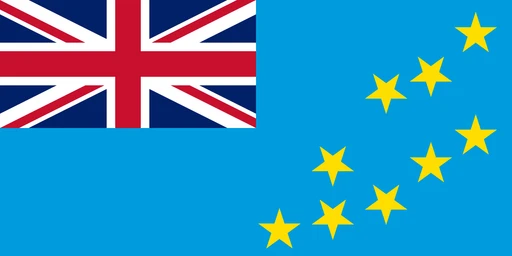
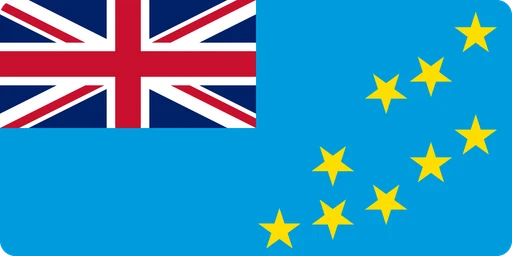
The flag of Tuvalu is a light blue field with the Union Jack in the canton and nine stars in the fly half. The stars stand for the nine islands that make up the country, and they are laid out to match the geography of the chain. The light blue is the Pacific.
Tuvalu adopted its flag on October 1, 1978, at independence from the United Kingdom, gave it up in 1995, and took it back two years later.
Independence, and a flag that came back
Before independence Tuvalu was part of the Gilbert and Ellice Islands, a British protectorate, and its flags carried British colonial symbols. The 1978 flag kept the Union Jack while adding the nine stars.
In 1995 a new design dropped the Union Jack entirely for something more nationalist in intent. It did not last. Public disapproval was strong enough that the original flag was reinstated in 1997. The episode is a compact illustration of how two impulses can sit side by side in one country: the wish for a symbol owing nothing to Britain, and an attachment to the historical connection.
Nine stars, one for each island
The field is light blue for the Pacific, with the Union Jack in the canton and nine yellow stars to the right. Each star is one of Tuvalu's islands: Nanumanga, Niutao, Nanumea, Nui, Vaitupu, Nukufetau, Nukulaelae, Funafuti, and Niulakita. They are not arranged decoratively. Their positions follow where the islands actually sit in the archipelago, so the fly half of the flag doubles as a map.
Use
The flag flies on government buildings, at state events, and wherever Tuvalu is represented internationally, under government guidelines for its handling. Maritime versions exist for Tuvaluan vessels, with the additions that maritime law calls for. At home it appears at independence day events and cultural festivals, and outside public buildings and private houses.
Union Jacks across the Pacific
Tuvalu is one of several Commonwealth countries whose flag still carries the Union Jack in the canton, and other Pacific flags mix local and colonial elements in much the same way.
References
Flags of the World - Tuvalu. Link
Flag Institute: Tuvalu. Link
Pacific Islands Report. Link
Common questions
- What do the nine stars on Tuvalu's flag represent?
- The nine stars are Tuvalu's nine islands: Nanumanga, Niutao, Nanumea, Nui, Vaitupu, Nukufetau, Nukulaelae, Funafuti, and Niulakita. Their positions on the flag follow the layout of the chain.
- Why is the Union Jack on Tuvalu's flag?
- It marks Tuvalu's history as a British territory before independence in 1978.
- Why did Tuvalu change its flag in the 1990s?
- In 1995 Tuvalu dropped the Union Jack for a design with no British elements. It proved unpopular, and the original flag came back in 1997.
Featured in these articles
- The Star That Doesn't Belong: How Nauru's Flag Pinpoints a Tiny Nation in a Vast Ocean
- Counted, Not Forgotten: How Four Island Nations Turned Their Flags Into Maps
- Borrowed Blue: Why Island and Coastal Nations Didn't Choose the Ocean. They Chose the 20th Century
- Stars at the Bottom of the World: Why Pacific Island Nations Put Constellations on Their Flags
Download this flag
Free in 12 styles, from 32px icons up to 2000px, as SVG, PNG, WebP and JPG.