The Scandinavian Cross: How One Medieval Symbol Locked Five Nations Into the Same Flag Template for Centuries
Julio Song · · 8 min read
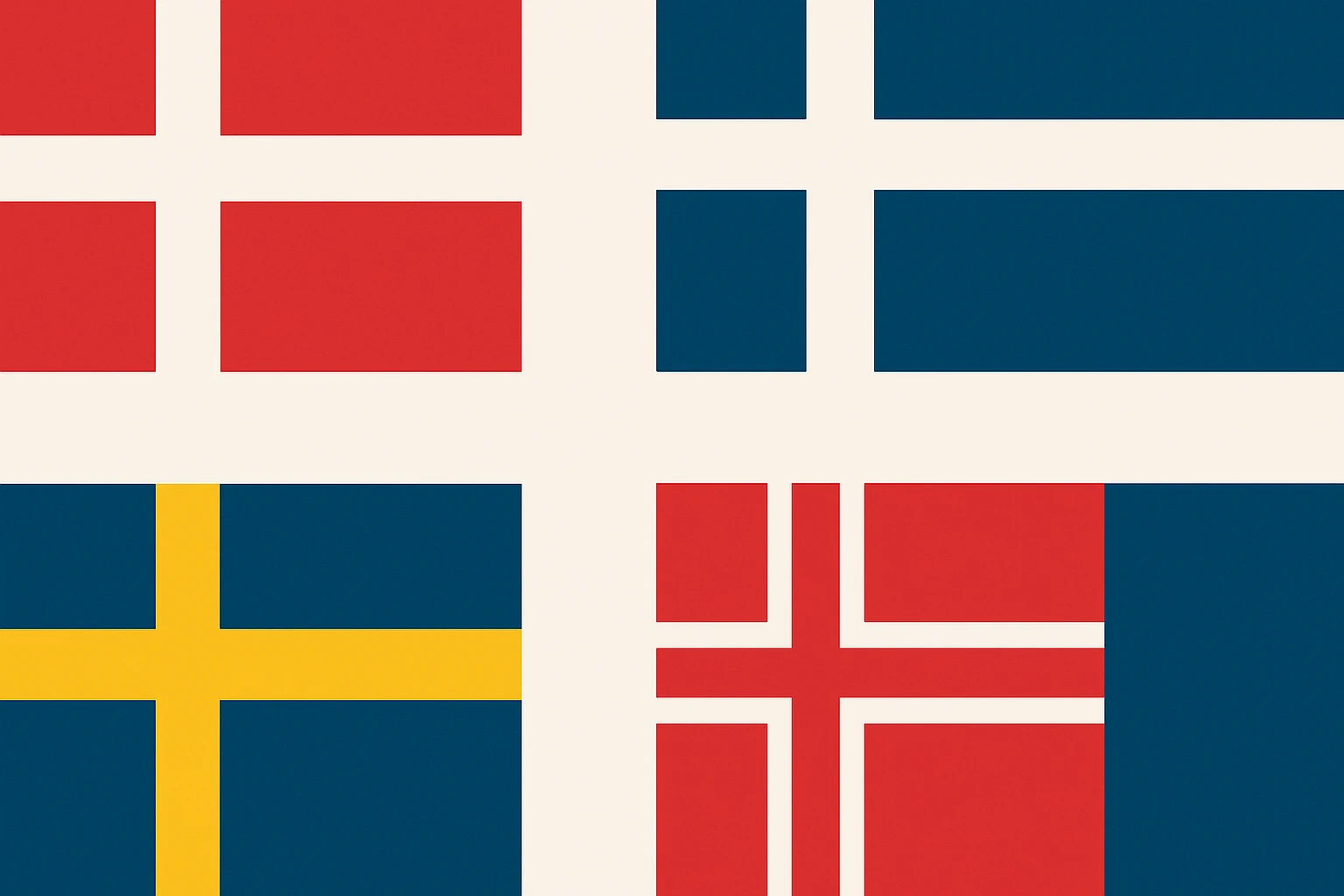
Lay the flags of Denmark, Sweden, Norway, Finland and Iceland side by side and squint, and you see the same flag five times. An off-center cross stretching to the edges, shifted toward the hoist. Same geometry, different colors.
Then consider what these five nations have done to each other over the past millennium. They have invaded each other, broken apart, declared independence, and built fiercely distinct identities. Norway fought to escape Denmark's shadow. Finland bled to separate from Russia. Iceland's independence from Denmark in 1944 was a matter of deep national pride. And when each of them sat down to design the single most potent symbol of its sovereignty, every one chose the same geometric template invented by a neighbor.
No treaty required it and no empire enforced it.
The Dannebrog, which fell from the sky (or so the legend goes)
The story starts with Denmark's Dannebrog, a white cross on a red field, which is by legend the oldest continuously used national flag in the world.
The traditional origin story is dramatic. On 15 June 1219, during the Battle of Lyndanisse near modern-day Tallinn, King Valdemar II was losing badly to Estonian pagans when a red banner with a white cross fell from the sky. The Danes rallied and won, and the flag stuck.
The historical record is less cinematic. The earliest verifiable mention of the Dannebrog is a 1370s entry in the Gelre Armorial, more than 150 years after the supposed heavenly delivery, which makes the 1219 legend almost certainly a later invention. Myths do not need to be true to work, though, and this one is still central to Danish national identity. Denmark celebrated the flag's supposed 800th anniversary in 2019 with national festivities.
What matters for the rest of the story is what the cross meant. It was a Christian cross rooted in Crusade-era symbolism, and Denmark's flag emerged while Scandinavian kingdoms were aggressively Christianizing the Baltic region. It was a statement of faith and conquest, and it became the source flag for the whole Nordic tradition.
Why the cross sits off-center
What makes a Nordic cross a Nordic cross, rather than a Swiss cross or an English St. George's cross, is the shift toward the hoist.
Switzerland's cross sits dead center, perfectly symmetric. On Denmark's flag the vertical bar sits roughly one-third of the way from the hoist side, and the horizontal bar divides the flag into two unequal halves. It looks wrong if you are used to centered designs, but it was engineered for a purpose.
Scandinavian nations were seafaring powers, and their flags flew from ship masts in North Atlantic winds. When a flag with an off-center cross streams in the wind, the cross appears more centered to someone watching from shore or from another vessel, because the elongated fly compensates for the fabric bunching near the hoist. Sailors needed to identify flags at a distance, in fog and rain and battle, and the asymmetric cross solved that.
The shift is now so tied to Nordic identity that any flag using it reads as Scandinavian worldwide. One glance places a country in that family.
Sweden joined the pattern despite everything
Sweden's flag, a golden-yellow cross on a blue field, uses the same geometry as Denmark's. The colors trace to the Swedish coat of arms, three crowns and a golden cross on blue, and the flag in its current form was codified by royal decree in 1906, though versions had been in use since at least the 16th century.
Denmark and Sweden fought more wars against each other than almost any other two European nations, at least 11 major conflicts between 1521 and 1814. The Dano-Swedish War of 1658 alone cost Denmark a third of its territory: Scania, Halland and Blekinge. These were existential struggles, not border squabbles.
Sweden adopted the Danish cross layout anyway. The cross was understood as Christian and Scandinavian rather than Danish, a shared heritage that outranked the rivalry, and Sweden signaled its distinctiveness through color instead of geometry.
Norway declared independence and kept the rules
Norway's flag is the most politically interesting Nordic cross, because it was designed as an act of national liberation and still stayed inside the template of the powers it was leaving.
Norway had been ruled by Denmark for over 400 years, from 1397 to 1814, within the Kalmar Union and then the Denmark-Norway union, and was then forced into a union with Sweden from 1814 to 1905. When the parliamentarian Fredrik Meltzer proposed the current design in 1821, it was a deliberate hybrid. The red field with white echoed Denmark and acknowledged shared history. The dark blue cross nodded to Sweden and the current union. The combination of red, white and blue invoked the French tricolore and its revolutionary ideals.
The flag was not fully official until 1898, when Norway removed the union mark, a combined Swedish-Norwegian emblem in the canton. That removal was a provocation, and the Swedish-Norwegian union dissolved seven years later.
Norway could have chosen anything: a coat of arms, a novel layout, an animal. Instead it differentiated within the Nordic cross system rather than outside it, which suggests the template was already read as a marker of regional belonging rather than Danish or Swedish dominance.
Former British colonies did something similar with the Union Jack. Australia and New Zealand still carry it in their cantons.
Shared templates survive bitter independence movements because they signal geographic and cultural kinship.
Finland and Iceland arrived late and proved the point
Finland's flag, a white field with a blue cross, was adopted in 1918 at independence from Russia, not from a Scandinavian power. Finland had been a Grand Duchy of Russia since 1809 and part of Sweden for over 600 years before that. Choosing the Nordic cross was a geopolitical statement about cultural alignment: Nordic, not Eastern. The blue and white stand for the country's lakes and snow.
Iceland's flag, a blue field with a red-and-white cross, was designed by Matthías Þórðarson and adopted in 1915 under Danish rule. It became the flag of the fully sovereign Republic of Iceland in 1944. Like Finland, Iceland used the cross to assert kinship with the Scandinavian cultural sphere while declaring political independence from Denmark.
By the early 20th century the Nordic cross had left its Danish origins behind. Adopting it was not submission but a claim of membership. The chronology tells the story on its own: Denmark in the 13th to 14th century, Sweden in the 16th, Norway in 1821, Iceland in 1915, Finland in 1918. Over 700 years the template kept recruiting.
The template keeps spreading
The five nations are only the start.
The Faroe Islands adopted their Nordic cross flag, the Merkið, in 1919. Faroese students in Copenhagen designed it, drawing on both Iceland's and Norway's flags, and it became official in 1948 when the Faroes gained self-governance within the Kingdom of Denmark.
Åland, the autonomous Swedish-speaking archipelago of Finland, adopted a Nordic cross flag in 1954: a blue cross on a yellow field with a red inner cross, blending Swedish and Finnish color elements.
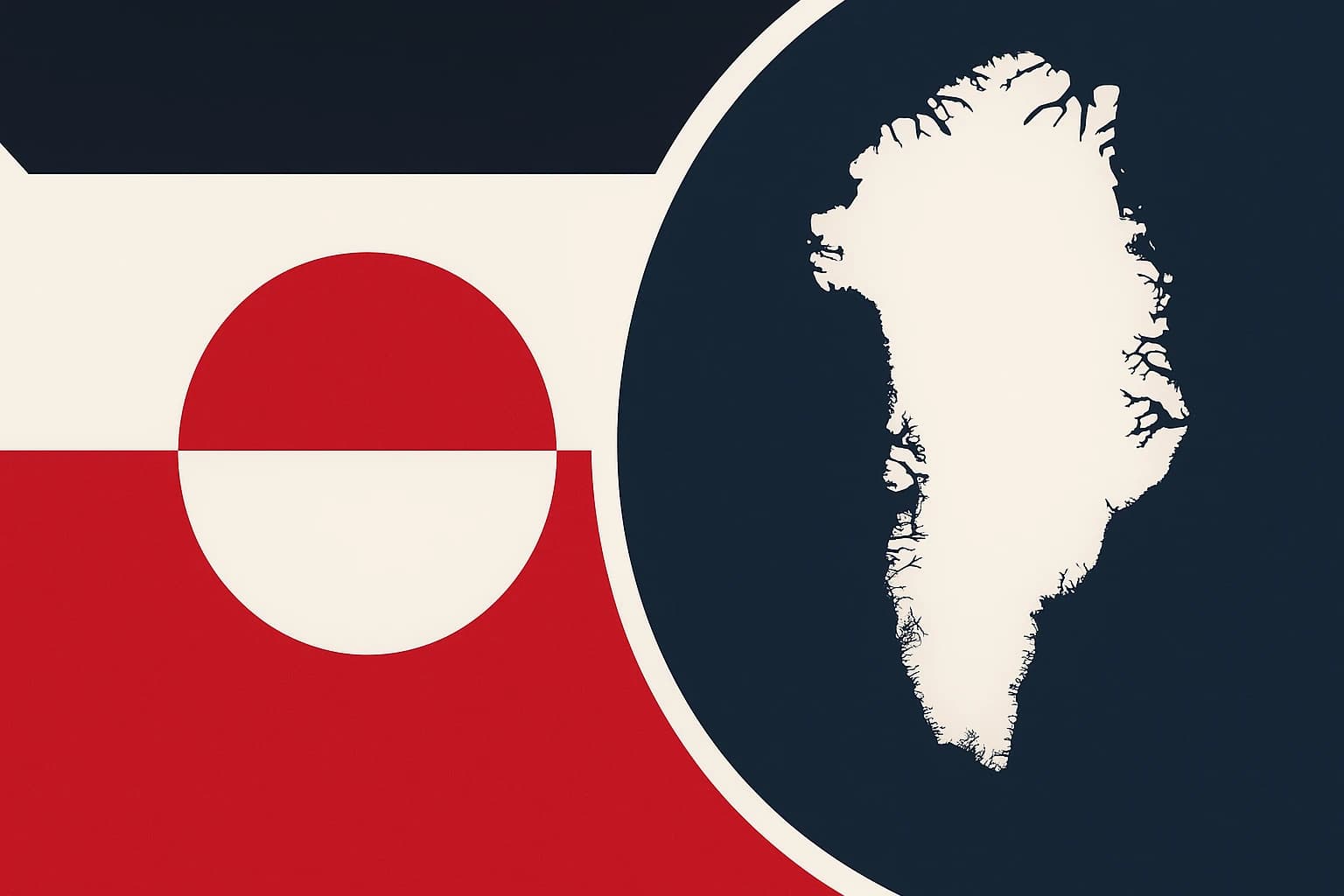
Greenland is the exception. Its 1985 flag, designed by Thue Christiansen, uses a semicircular design that deliberately breaks with the Nordic cross to assert Inuit rather than Scandinavian identity. That rejection is itself a statement, and nobody bothers walking away from a design system that means nothing.
Beyond official territories, the Nordic cross has been adopted by Shetland, Orkney and other regions with historical Norse connections, and it turns up in dozens of proposed flags worldwide, from Minnesota to Estonia. As of 2026 it remains the most imitated national flag layout on Earth.
Unity or erasure?
The unity argument is straightforward. The Nordic cross reinforces the idea of "Norden," the Nordic community. The Nordic Council (established 1952) and the Helsinki Treaty (1962) formalized cooperation, but the flags had been doing that symbolic work for centuries. With Nordic nations consistently near the top of global rankings for quality of life, governance and trust, the shared template feeds a regional reputation that every member benefits from.
The counterargument is just as real. When five nations share a geometric framework, individual identity gets flattened. Surveys consistently show that non-Scandinavians struggle to tell Nordic flags apart, and Norway, Iceland and the Faroe Islands get mixed up routinely.
The useful distinction is family resemblance versus corporate uniformity. The Nordic flags are siblings who dress similarly by choice, not franchisees working from a brand manual, and the difference is that nobody was compelled. Finland's adoption while breaking from Russia is the clearest proof that the template was chosen rather than imposed.
The refusals confirm it too. Greenland walked away from the cross, and the Sami people's flag, adopted in 1986, uses a circle design with no cross at all. The template's power lies in being optional: you use it because you want to belong, and you reject it when you don't.
Denmark was not trying to create a regional design system when its crusaders supposedly saw a cross fall from the sky in 1219. Eight centuries later that accident of legend is still recruiting new members, and the interesting question about any Nordic cross flag is less which country it belongs to than why that country chose to belong to the family.
Julio Song
Writer
Julio is a staff writer at FlagDB. He studied Mathematics at the University of Madrid and has a passion for vexillology.
More from Julio Song →Related articles
The Cross That Started It All: How Denmark's Dannebrog Became the Template for Every Nordic Flag
The Cross That Conquered the North: How Denmark's Dannebrog Became the Template for an Entire Continent