The Flag of the Faroe Islands
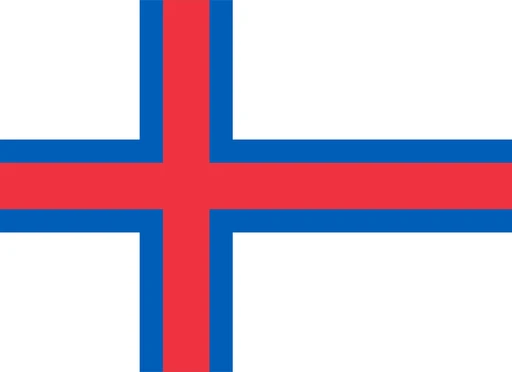
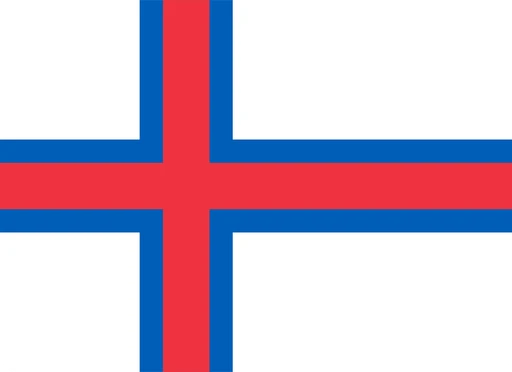
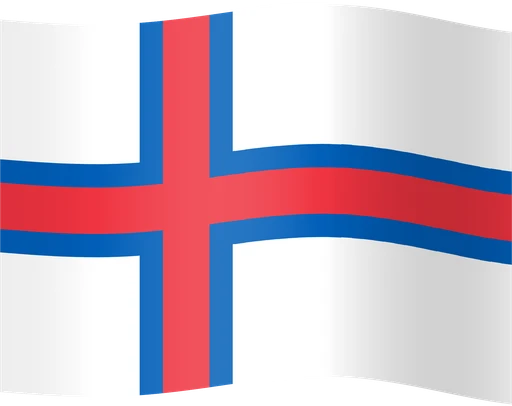
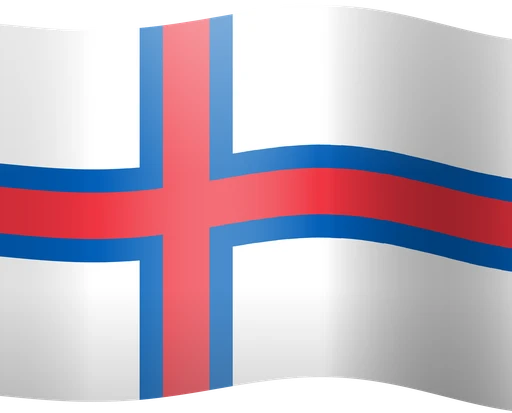
The flag of the Faroe Islands, known as Merkið, has a red Nordic cross outlined in blue on a white field. The cross places the islands within the Nordic family of flags. The proportions are 8:11.
The flag of the Faroe Islands, known in Faroese as Merkið, meaning "the banner" or "the mark," was made by students in Copenhagen in 1919, hand-stitched from repurposed fabric, and carried home to be raised over a village on Suðuroy that same summer. It predates Faroese autonomy by decades, so for most of its life it was a claim about what the islands might become rather than a description of what they were.
Stitched in secret: the origin of the Merkið
Three Faroese law students in Copenhagen designed the flag in 1919: Jens Oliver Lisberg, Janus Øssursson, and Paul Dahl. They were part of a rising Faroese cultural nationalism that treated the Faroese language, literature, and folk traditions as things worth defending against Danish assimilation. Lisberg is generally credited as the primary designer. He died in 1920 at the age of 23, never seeing the flag officially recognized, which is part of why the Merkið carries an elegiac quality in Faroese memory.
After the Faroese Students' Union in Copenhagen approved the design, Lisberg took the flag home with him and raised it in his village of Fámjin, on Suðuroy, on June 22, 1919. That first Merkið is still kept in the church at Fámjin. For the next two decades it remained an activist's flag with no legal standing, appearing at rallies, on fishing boats, and at home rule gatherings.
Then came the war. Germany invaded Denmark on April 9, 1940, and Britain, needing to secure the strategically important Faroe Islands, occupied them shortly after. The British occupying forces had a practical problem to solve: Danish-flagged ships could be targeted, so Faroese vessels needed a distinct identifier. On April 25, 1940, after weeks of Faroese pressure and protest marches, the British authorities recognized the Merkið as the marine flag of the Faroe Islands and announced it on the BBC in every major world language. That was the flag's first official standing of any kind.
April 25 is now commemorated as Faroese Flag Day, or Flaggdagur. Denmark itself did not formally recognize the Merkið until the Home Rule Act of 1948, eight years after the British already had.
A cross offset with purpose
At first glance the Merkið looks like the Norwegian flag with its colors rearranged, and that impression is not accidental. It has a red Nordic cross outlined in blue on a white field, with the cross offset toward the hoist side, following the convention shared by Denmark, Norway, Sweden, Finland, and Iceland.
Red and blue come directly from the Dannebrog, Denmark's flag, acknowledging centuries of political and cultural ties to the Danish crown. The white background points elsewhere: to the islands' snowy winters and to their sheep. The name "Faroe" derives from Føroyar, rooted in the Old Norse word fær, meaning sheep. The blue outline evokes the surrounding North Atlantic.
Visually the Merkið is the inverse of the Norwegian flag: same cross structure, same three colors, reversed arrangement. That is not coincidence either. The Faroe Islands share deep historical and linguistic ties with Norway, and the mirrored design signals the kinship.
Official specifications are precise. The red is a vivid scarlet, the blue a bright cobalt, and the Faroese government maintains exact Pantone and RGB values. The proportions are 8:11, width to length, slightly unusual compared with neighboring Nordic flags and giving the Merkið a more compact feel.
The Nordic cross family
Every Scandinavian nation and several associated territories use an offset cross on a colored field, which makes this arguably the most cohesive visual family of flags in the world. Denmark's white cross on red. Norway's blue-outlined red cross on red and white. Iceland's red-outlined white cross on blue. The Faroe Islands' design uniquely reverses Norway's palette, carving out a niche within the family.
Choosing to join the tradition was itself a political statement. It signaled European Christian heritage and Nordic solidarity, not a break from Scandinavia but a claim to a distinct seat at the Nordic table. That choice has resonated beyond the Faroes: the Shetland Islands flag, adopted in 2005, uses a white Nordic cross on a blue field, consciously acknowledging the Norse heritage Shetland shares with its North Atlantic neighbors.
Unlike the fully sovereign Nordic states, the Merkið does not fly at the United Nations. The Faroe Islands remain an autonomous territory of Denmark, and that constitutional reality limits where the flag can appear.
Flag Day and the living symbol
April 25, Flaggdagur, is one of the most important civic holidays in the Faroe Islands. Schools close. Flags fly from every home and public building. The day carries the solemnity of an independence day, even though the Faroes are not independent. For a population of roughly 50,000, on the islands and in diaspora communities in Denmark and the UK, the Merkið anchors a collective identity.
It turns up in unexpected places. Faroese passports, issued separately from Danish passports since 2006 though Faroese citizens remain Danish nationals, carry the Merkið. So do the jerseys of Faroese sports teams and the livery of Atlantic Airways. The Faroe Islands compete independently in FIFA, UEFA, and other international bodies, so the Merkið flies at matches where Denmark's Dannebrog is nowhere in sight. Those football qualifiers, where the Faroes occasionally pull off giant-killing upsets, have spread global awareness of the flag further than any diplomatic effort.
Not everyone agrees on what it means. Some independence advocates think the Merkið does not go far enough, pointing out that its red and blue are borrowed from the Danish flag. Others see a good expression of Faroese identity within the Kingdom of Denmark, a flag that honors the relationship rather than rejecting it.
The story of Jens Oliver Lisberg, who designed the flag at 22 and died at 23, has kept its hold. In Faroese collective memory he is the young man who imagined a nation's symbol and never saw it fulfilled, and the story circulates online alongside the islands' music scene and other cultural exports.
Protocol, variants, and official use
Faroese law governs the flag's use, with the Løgting (Faroese Parliament) overseeing regulations and protocol. Official flag days extend beyond Flaggdagur to include Ólavsøka (St. Olav's Day, July 29), the traditional national festival, and various Danish royal occasions, a calendar that reflects the territory's dual identity.
The Faroe Islands maintain both a civil ensign for merchant vessels and a government ensign variant. Fishing vessels hold a special place in the flag's history, since the 1940 recognition was granted to them specifically. Unlike Denmark proper, the Faroes do not use the Dannebrog as their primary flag; in all domestic contexts the Merkið is the de facto national symbol.
International use is more nuanced. At events where the Faroe Islands participate as part of Denmark, such as the EU or UN, the Danish flag takes precedence. In autonomous contexts like sports, fisheries negotiations, and cultural exchanges, the Merkið represents the islands on its own terms. It may be flown at half-mast for national mourning, following protocols that mirror Danish traditions but have been adapted to local custom.
References
[1] Faroese Government official portal (government.fo), flag history and official specifications.
[2] Løgting (Faroese Parliament) records on flag legislation and Flaggdagur designation.
[3] Smith, Whitney. Flags Through the Ages and Across the World. McGraw-Hill, 1975.
[4] Flags of the World (FOTW), fotw.info entry on the Faroe Islands flag, including historical variants and color specifications.
[5] Wylie, Jonathan. The Faroe Islands: Interpretations of History. University Press of Kentucky, 1987.
[6] West, John F. Faroe: The Emergence of a Nation. C. Hurst & Co., 1972.
[7] Znamierowski, Alfred. The World Encyclopedia of Flags. Lorenz Books, 2014.
[8] FIFA and UEFA member association records, Faroe Islands' independent sporting membership and flag use.
[9] Danish National Archives (Rigsarkivet), records relating to the 1948 Home Rule Act and formal flag recognition.
Common questions
- Why does the Faroe Islands flag feature a Nordic cross?
- The Nordic cross marks the islands' cultural and historical ties to the other Nordic countries, and the shared Christian heritage behind them.
- What do the colors on the Faroe Islands flag stand for?
- White is the ocean's foam and clear skies, red is Christianity and bravery, and blue is the deep sea and sky around the islands.
Featured in these articles
- The Cross That Conquered the North: How Denmark's Dannebrog Became the Template for an Entire Continent
- The Island That Designed Itself Into a Corner: How Greenland's Flag Quietly Broke Every Arctic Convention
- The Cross That Started It All: How Denmark's Dannebrog Became the Template for Every Nordic Flag
- Greenland's Red-and-White Rebel: How a Non-Sovereign Territory Designed a Flag to Look Nothing Like Denmark's
Download this flag
Free in 12 styles, from 32px icons up to 2000px, as SVG, PNG, WebP and JPG.