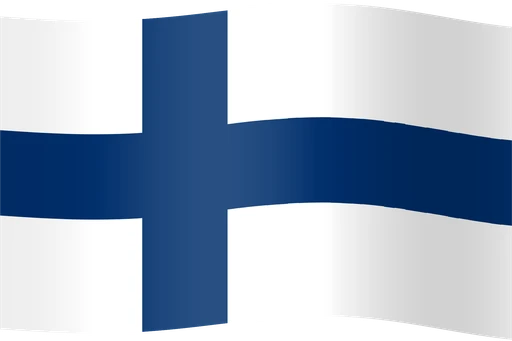
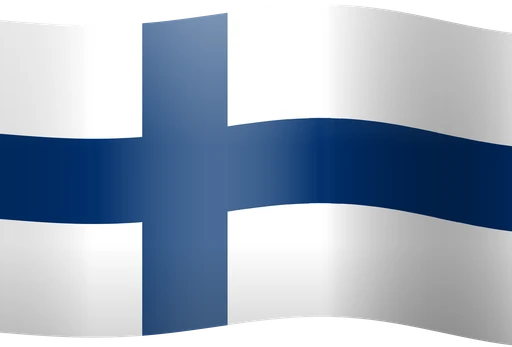
The Flag of Finland
Republic of Finland
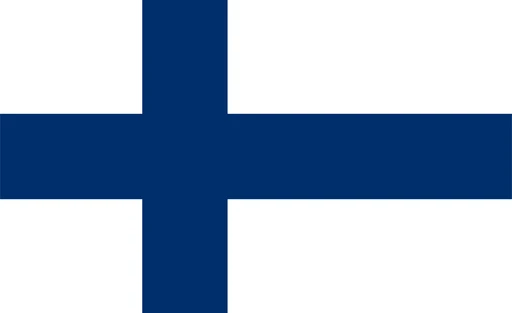
The flag of Finland, known as the Siniristilippu (Blue Cross Flag), has a blue Nordic cross on a white background. Blue stands for the country's lakes and sky, white for snow and summer nights. The cross ties Finland to the other Nordic countries.
The Finnish flag, a blue cross on a white field, looks simple, and the colors behind it were in use long before there was a Finnish state to fly them. Blue and white came out of a 19th-century nationalist awakening, survived decades of foreign rule, and were formalized in 1918 over a country that had been independent for barely five months.
A flag that started with a poem
For centuries Finland had no flag. Swedish rule lasted from roughly 1249 to 1809, and when Russia absorbed the territory as a Grand Duchy, Finns lived under the tsar's banners for another century. There was no Finnish state, so there was no Finnish flag. By the mid-1800s that was starting to change.
The Fennomania movement, a nationalist awakening centered on the Finnish language and culture, pushed a generation to ask what being Finnish meant and what symbols could carry it. Blue and white emerged early, popularized not by politicians but by poets and painters. Johan Ludvig Runeberg, Finland's national poet, wove snow-covered landscapes and cold blue skies into his patriotic verse, most famously in The Tales of Ensign Stål. The Romantic nationalist painters used the same palette. The colors were never decreed from above.
During the Grand Duchy period, civic organizations like the Lotta Svärd and various student groups flew blue-and-white flags informally, keeping the colors in circulation. When Finland declared independence on December 6, 1917, the question of a national flag became urgent. Some favoured a design featuring the Finnish lion, which had appeared on coats of arms for centuries. Others pushed for a Nordic cross in blue and white. The cross won, and on May 29, 1918, barely five months after independence, the current design became official. The lion did not disappear: it found its home on the state flag, in the center of the blue cross.
Ice, sky, and the Scandinavian cross
Finland's flag follows the Nordic cross pattern, an off-center cross whose vertical bar shifts toward the hoist side. All five Nordic nations use this layout, which links Finland to Denmark, Sweden, Norway, and Iceland. The tradition likely traces back to the Danish Dannebrog, one of the oldest national flags in the world, dating to the 13th century.
The blue of Finland's cross officially represents the country's thousands of lakes and its wide, pale sky. White stands for the snow that covers the land through long winters. The specific shade of blue has been refined over the years, and current official specifications call for Pantone 294 C, standardized to prevent drift across government uses, printed materials, and digital displays.
Proportions are fixed by law at 11:18, with the width of each cross arm precisely defined. That exactness matters more than it might seem. The design needed to be visible at sea and from a distance, easily distinguishable from its Nordic cousins, and simple enough that any citizen could reproduce it without specialized tools.
Civil flag and state flag
Finland officially maintains two versions of its national flag. The civil flag is the familiar blue cross on white, flown by private citizens, businesses, and organizations. The state flag adds the Finnish coat of arms, a golden lion wielding a sword on a red shield, centered within the cross, and only the government, military, and official state bodies use it.
There is a swallow-tailed variant as well. The Finnish Defence Forces and the President of Finland fly a forked, pointed version of the state flag. The presidential standard goes further, placing the coat of arms on a blue field bordered in yellow, displayed only when the President is present.
Finnish Flag Law, enacted and updated through the 20th century and most notably codified in 1978, governs who may fly which version and when. It is an unusually precise legal framework, specifying dimensions, colors, and permitted contexts in detail. All the Nordic countries maintain similar civil, state, military, and presidential distinctions, but Finland's version is among the most meticulously documented.
Finland's flag days
Finland keeps one of the most detailed official calendars of flag days in the world, set by government decree. On these days the flag must or should be flown from public buildings, and citizens are strongly encouraged to join in.
The main date is Finnish Independence Day, December 6, a solemn and deeply felt occasion. The calendar stretches well beyond it. February 5 marks the birthday of J.L. Runeberg, the national poet whose verse helped give the flag its colors. Mother's Day, May Day, and Nordic Day (March 23) are all on the list, as is the Day of Finnish Music, honoring Jean Sibelius.
Midsummer, or Juhannus, is the most emotionally charged of them. Finns traditionally raise the flag at 6 p.m. on Midsummer Eve and keep it flying through the barely-dark night until 9 p.m. the following evening, one of the few occasions when the flag stays up overnight. Midsummer also doubles as the official Flag Day of the Finnish Defence Forces.
On ordinary flag days the etiquette is specific: flags go up at 8 a.m. (or at sunrise, whichever comes later) and come down at sunset, no later than 9 p.m. Half-mast protocols are formally defined for national mourning and the deaths of senior officials. What stands out is how genuinely popular flag flying is among ordinary Finns, who participate with a kind of quiet, collective civic pride rather than anything louder.
Finland among its Nordic siblings
The Nordic cross binds Finland visually and symbolically to Denmark, Sweden, Norway, and Iceland: five sovereign nations sharing a single structural motif, each distinguished by color and proportion.
Denmark's Dannebrog is the likely origin point, its white cross on red supposedly dating to a 13th-century battle. As the Scandinavian nations carved out their own identities they adapted the cross to their own palettes: Sweden's gold on blue, Norway's blue-bordered white on red, Iceland's red-bordered white on blue. Finland went with cool blue on white. A trained eye can tell them apart at a glance, but to outsiders they form a deliberate family resemblance, which is the point.
The cross motif extends beyond sovereign states. The Faroe Islands, Åland, and the Sami people all use cross-based flags. Åland's is particularly clever: a red-and-yellow cross overlaid on the Finnish blue-and-white field, signaling both its Swedish-speaking identity and its autonomy within Finland.
Finland's adoption of the cross in 1918 was a conscious alignment with the Nordic world, a statement about where the newly independent nation saw its cultural and political home. After a century under Russian rule, that carried weight.
References
[1] Finnish Government official flag guidance. Prime Minister's Office. https://valtioneuvosto.fi/en/flag-and-coat-of-arms
[2] Act on the Flag of Finland (Laki Suomen lipusta, 380/1978, as amended). Finnish legislative database, Finlex. https://www.finlex.fi
[3] FOTW (Flags of the World), Finland entry. https://www.crwflags.com/fotw/flags/fi.html
[4] Smith, Whitney. Flag Lore of All Nations. Millbrook Press, 2001.
[5] Klinge, Matti. A Brief History of Finland. Otava Publishing, 1981 (multiple editions).
[6] Runeberg, Johan Ludvig. The Tales of Ensign Stål (Vänrikki Stoolin tarinat). Primary literary source for blue-and-white national symbolism.
[7] Nordic Council official site on the shared Nordic cross tradition. https://www.norden.org
[8] Statistics Finland (Tilastokeskus), historical archives on Independence and early statehood. https://www.stat.fi
Common questions
- What does the blue cross on Finland's flag stand for?
- The blue cross stands for Christianity and for the bond with the other Nordic countries. The blue itself is Finland's lakes and skies.
- Why are the Finnish flag's colors blue and white?
- Blue and white are the landscape: blue for the lakes and sky, white for the snow and the long winters.
- When was Finland's current flag adopted?
- Finland's current flag was adopted on May 29, 1918, after declaring independence from Russia in December 1917.
- What do the blue and white colors on the Finnish flag mean?
- Blue is Finland's thousands of lakes and the bright, pale sky. White is the snow that covers the land through the long winters. These colors weren't officially mandated at first. They came up through Finnish culture, poetry, and Romantic nationalist art in the 1800s, and were formalized when Finland became independent.
- Why does Finland use a cross design on its flag?
- Finland uses the Nordic cross, which all five Nordic countries share (Denmark, Sweden, Norway, Iceland, and Finland). When Finland adopted it in 1918, it was a deliberate choice to align with the Nordic world after a century of Russian rule. The design likely traces back to Denmark's Dannebrog, one of the world's oldest national flags.
Featured in these articles
- The Flag You've Never Seen: Why Some Countries Fly One Banner on Land and Another at Sea
- The Cross That Conquered the North: How Denmark's Dannebrog Became the Template for an Entire Continent
- The Island That Designed Itself Into a Corner: How Greenland's Flag Quietly Broke Every Arctic Convention
- The Cross That Started It All: How Denmark's Dannebrog Became the Template for Every Nordic Flag
Download this flag
Free in 12 styles, from 32px icons up to 2000px, as SVG, PNG, WebP and JPG.