The Flag of Greenland
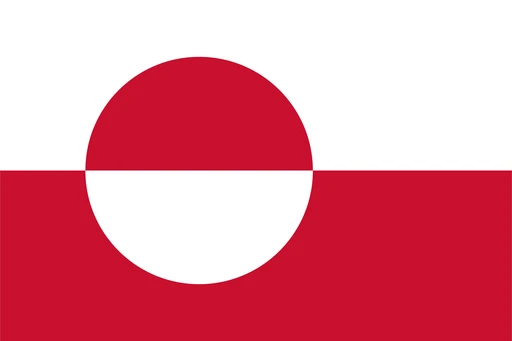
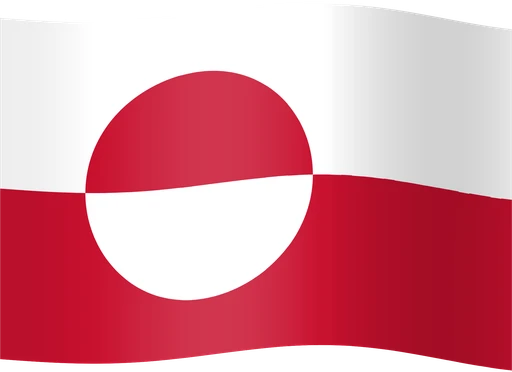
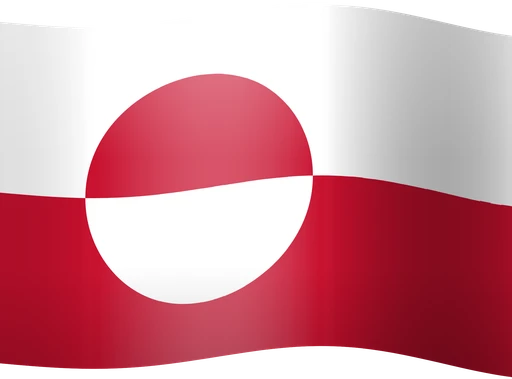
The flag of Greenland, known locally as Erfalasorput, meaning 'our flag', has two equal horizontal bands, white over red, with a large circle offset toward the hoist. The circle inverts the field: its upper half is red, its lower half white. The design is usually read as the sun sitting on the horizon over ice and ocean. Adopted on June 21, 1985, it breaks with the Nordic cross used across the rest of the region.
Greenland's flag looks like nothing else in the Nordic world. Every other country and territory in the region uses some variation of the Scandinavian cross. Greenland chose a circle split between red and white, sitting on the horizon line between ice and ocean, designed by a schoolteacher who had just finished a term as culture minister and adopted on the longest day of the year.
Where Erfalasorput came from
Greenlanders call their flag Erfalasorput, which translates as "our flag." The name was the point: this one belongs to us.
The story starts with Home Rule. In 1979 Denmark granted Greenland a degree of self-governance, and the question of a flag surfaced almost immediately. A public design competition followed, drawing 555 proposals, 293 of them from Greenlanders. The winning entry came from Thue Christiansen, born in Maamorilik in 1940, a trained teacher and visual artist who had been elected to the Inatsisartut in 1979 and served as Greenland's Minister of Culture and Education until 1983.
Christiansen's design beat a competing proposal built around a Nordic cross in green and white, which would have slotted Greenland into the Scandinavian flag family alongside Denmark, Norway, Sweden, Finland, Iceland, and the Faroe Islands. The vote was close, fourteen to eleven. The cross had backing from Greenlandic politicians who preferred continuity with Nordic tradition, and rejecting it was the substance of the decision.
Erfalasorput was adopted on June 21, 1985. The date is Greenland's National Day, timed to the summer solstice, when the sun barely dips below the horizon. Adoption came six years after Home Rule and well before the Self-Government Act of 2009, which expanded Greenland's autonomy further.
The circle on the horizon
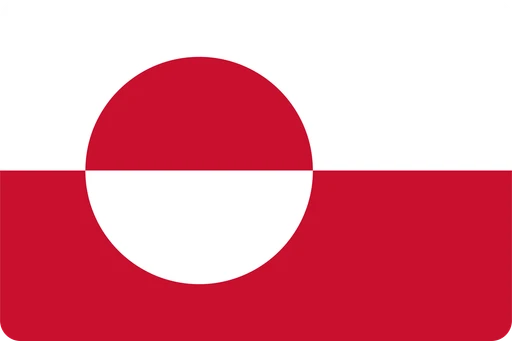
Two equal horizontal bands, white on top, red on the bottom. A large circle sits on the dividing line between them, its upper half red, its lower half white. No stars, no coat of arms, no text, no crosses.
The circle's colors invert the background: red against white above, white against red below. It belongs to neither half of the flag, which is what gives it the floating quality.
Most Greenlanders read the circle as the sun on the horizon, a reference to the midnight sun of summer and the polar darkness of winter. The white band evokes the Greenland ice sheet, the second largest in the world, which covers roughly 80% of the island. The red band suggests the ocean, or the glow of a low Arctic sun across snow.
The red and white mirror Denmark's Dannebrog, one of the oldest national flags still in use. Greenland shares colors with its former colonial ruler and arranges them entirely differently.
Vexillologists rate this flag highly. It does well on the standard design principles: simplicity, meaningful symbolism, few colors, recognizable at distance. The North American Vexillological Association has cited it as an example of effective modern flag design. It has none of the shields, crowns, and unreadable mottos that clutter so many territorial flags.
What the flag means to Greenlanders
Greenland is home to roughly 56,000 people, most of them Kalaallit Inuit. For a population that small, spread across the world's largest island, shared symbols count for a lot. Erfalasorput arrived before full self-governance, and many Greenlanders read it as a sign of what was coming: proof that they were a people rather than a province.
Ask Greenlanders what the colors mean and the answers come back rooted in landscape and daily life. White is the icebergs calving into Disko Bay and the snow over Nuuk in December. Red is the traditional anorak and the summer sun hanging low over the fjords.
Every June 21 the flag flies everywhere for National Day. Families gather for Greenlandic games, music, and feasting, and many people wear the kalaalliit atugarissaat, the national costume, with its beadwork and sealskin boots. Before 1985 it was the Danish Dannebrog that flew on those occasions. Greenlandic communities in Denmark, especially in Copenhagen, fly Erfalasorput at festivals, hang it in windows, and sew it onto jackets.
Greenlandic schools teach the story of the flag's adoption as part of civic education.
Protocol and everyday use
Erfalasorput flies over government buildings in Nuuk, over schools, post offices, and public institutions across the territory. In many official contexts, it's flown alongside the Danish Dannebrog, a visual reminder that Greenland remains an autonomous territory within the Kingdom of Denmark rather than a fully independent state.
There are no separate civil or naval ensign variants. Greenland uses a single flag design across all contexts, keeping things characteristically simple. The flag appears on Greenlandic passports, official documents, and the logos of numerous Greenlandic organizations and businesses. Its proportions follow a standard 2:3 ratio, consistent with most European and Nordic flags.
One notable absence: Greenland doesn't currently participate independently in the Olympics or most international sporting bodies. Greenlandic athletes compete under the Danish flag, which means Erfalasorput's international visibility is largely diplomatic and cultural rather than athletic. Rules governing half-mast display and days of mourning follow guidelines issued by the Greenlandic government, Naalakkersuisut.
Outside the Nordic family
Every other Nordic country and territory uses a Nordic cross: Denmark, Norway, Sweden, Finland, Iceland, the Faroe Islands, Åland. Greenland is the only exception, and the rejection of the cross is the most consequential design decision in modern Arctic vexillology.
The Faroe Islands make the sharpest contrast. Also an autonomous Danish territory, the Faroes chose a Nordic cross for their flag, the Merkið, adopted in 1948. Two Danish territories, two opposite answers.
The circular motif puts Erfalasorput in a small family that includes Japan's Hinomaru, Bangladesh's green-and-red disc, and Palau's golden circle on blue. None of those uses a two-toned circle split along the horizon.
Scholars have drawn parallels between Erfalasorput and the flags of other indigenous-majority self-governing territories that broke with colonial visual traditions, choosing symbols rooted in land and lived experience rather than the heraldic language of European empires. The choice was about who gets to decide what a flag should look like as much as about the design itself.
References
[1] Naalakkersuisut (Government of Greenland). Flag history and national symbols. naalakkersuisut.gl
[2] Christiansen, Thue. Original design submission records held by the Greenland National Museum and Archives (Nunatta Katersugaasivia Allagaateqarfialu), Nuuk.
[3] Pedersen, Poul. "Grønlands flag" in Den Store Danske (The Great Danish Encyclopedia), Gyldendal.
[4] North American Vexillological Association (NAVA). Flag design principles and ratings. nava.org
[5] Flag Institute (UK). Entry on the flag of Greenland. flaginstitute.org
[6] Smith, Whitney. Flags Through the Ages and Across the World, McGraw-Hill, 1975.
[7] Gad, Finn. The History of Greenland (3 vols.), C. Hurst & Co., 1970-1982.
[8] Statsministeriet (Danish Prime Minister's Office). Documentation on Home Rule Act 1979 and Self-Government Act 2009.
[9] Greenland Representation in Denmark (Grønlands Repræsentation). Official communications on national symbols.
Common questions
- Why is the design of Greenland's flag off-center?
- The off-center disk is the sun sitting on the horizon. Shifting it toward the hoist keeps it on the dividing line between the white band, which stands for the ice sheet, and the red band, which stands for the ocean.
- What does the disk on Greenland's flag mean?
- The disk is the sun setting over ice and snow. The red and white are the colors of Greenland's landscape and of the Danish flag it replaced.
- Who created Greenland's flag?
- Thue Christiansen, a Greenlandic artist, designed the flag. It was chosen from 555 entries in a national competition.
- How is Greenland's flag connected to Denmark's?
- Greenland's flag uses the same red and white as Denmark's Dannebrog, but arranges them in a design of its own rather than a Nordic cross.
- What does the circle on the Greenland flag represent?
- It's the sun on the horizon. The red half sits against white and the white half against red, flipping their colors. This represents the midnight sun in summer and the darkness of winter. The red evokes the ocean and the Arctic sun's warmth, while the white echoes Greenland's massive ice sheet.
- What's the official name of the Greenland flag?
- Erfalasorput, which is Greenlandic for "our flag." The name itself was important to the Greenlandic people because it meant the flag belonged to them, not imposed from outside.
Featured in these articles
- The Circle That Carries a Nation: How Japan, Bangladesh, and Laos Each Loaded a Simple Disc With Completely Different Meaning
- The Island That Designed Itself Into a Corner: How Greenland's Flag Quietly Broke Every Arctic Convention
- The Cross That Started It All: How Denmark's Dannebrog Became the Template for Every Nordic Flag
- Greenland's Red-and-White Rebel: How a Non-Sovereign Territory Designed a Flag to Look Nothing Like Denmark's
Download this flag
Free in 12 styles, from 32px icons up to 2000px, as SVG, PNG, WebP and JPG.