New Zealand Spent $26 Million Voting on a New Flag. Then Chose the Old One.
Julio Song · · 8 min read
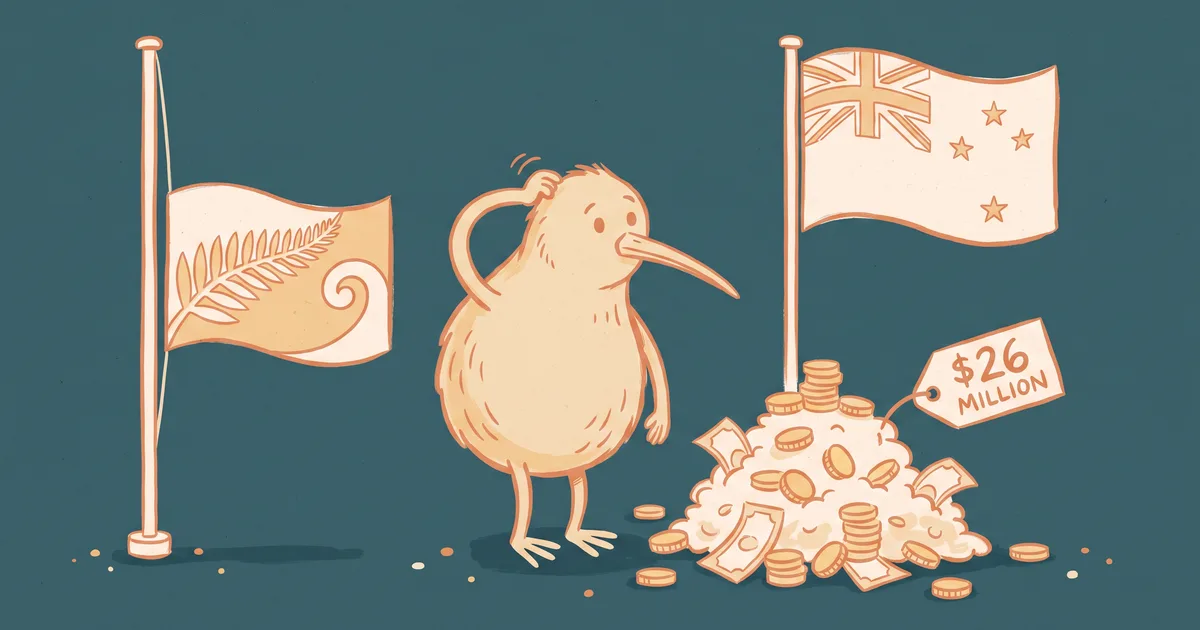
New Zealand spent NZ$26 million asking its own citizens a single question, twice: do you want a new flag? Twice, the answer came back no. Turnout for the second vote hit 67.78 percent, higher than the 48.78 percent who turned out to pick a favorite alternative in the first round. More people showed up to keep the old flag than had shown up to choose a new one.
The flag they kept is a Blue Ensign with the Union Jack in the canton and four red stars edged in white marking the Southern Cross on the fly. New Zealand formally adopted it as the national flag in 1902, under King Edward VII's signature. Up close it's distinctive. From a distance, at a conference table lined with a hundred other flags, it reads as a near copy of Australia's.
That resemblance sits behind the whole story here. It explains why a government spent two years and $26 million trying to replace the flag, why the process nearly failed twice, and why a much smaller Pacific neighbor was working through the identical problem, Union Jack and all, at almost the same time.
A flag built to be mixed up
New Zealand's flag began as a Royal Navy design. First Lieutenant Albert Hastings Markham drew it in 1869 for the colony's government ships, and the design was approved that October for that narrow purpose alone. It stayed an unofficial working flag for more than three decades before Parliament gave it statutory standing through the New Zealand Ensign Act 1901, which took effect on 24 March 1902.
Australia had built its own flag on the same template around the same period: a Blue Ensign, the Union Jack in the corner, stars on the fly for the Southern Cross. The two flags differ once you look closely. Australia's carries six stars, including a seven pointed Commonwealth Star beneath the Union Jack. New Zealand's carries four, each with a red center and a white border. From across a room, the difference disappears, and the two flags are still routinely mistaken for each other, a mix-up cited by flag change campaigners as reason enough to redesign.
A prime minister's pet project
Prime Minister John Key announced in March 2014 that if his National Party won re-election that September, New Zealand would hold a referendum on the flag within three years. National won, and Key followed through. He wanted a flag that stood on its own, the way a maple leaf identifies Canada without needing a second look, pointing to the silver fern already worn by the All Blacks as the obvious local equivalent.
Key later admitted the flag mattered to him personally more than most of his policy work. In a 2018 interview he called the failed change his biggest regret in office, saying "the reason I wanted to change the flag was to have something that was uniquely New Zealand." He blamed the opposition Labour and Green parties for turning a design question into a partisan one, and second guessed his own restraint: "I think I should have just pushed it even harder." He called it a small thing next to the rest of his record as prime minister, then undercut that in the same breath: "that is the one I feel I definitely failed on."
Ask 10,292 people what they want
The government built a public process around the promise. A Flag Consideration Panel of twelve people, none of them designers or flag specialists, was tasked with soliciting ideas and producing a shortlist. Between May and July 2015, the public submitted 10,292 design suggestions, every one of them published online. The panel narrowed that pile to a longlist of 40 in August, then to an official shortlist of four, all of them variations on a silver fern.
The shortlist landed badly. Members of the public compared one finalist to Weet-Bix cereal packaging, novelty plastic plate patterns and the National Basketball Association logo, while economist Gareth Morgan dismissed the whole set as "tea towels of Kiwiana" and the National Business Review called them "amateur" and "dated." The backlash moved fast enough that it created a fifth option nobody on the panel had chosen.
The design nobody picked, chosen by the public anyway
Designer Aaron Dustin had submitted a flag called Red Peak under the pseudonym Andor Unista, an anagram of his own name. It ranked 35th in early public surveys and didn't come close to the official shortlist. The design uses a white chevron over red, black and blue triangles, the chevron standing for the tectonic uplift that formed the Southern Alps and the colors drawn from Māori creation stories about the sky father Rangi and earth mother Papa: red earth, black night, blue dawn.
Once the official four flags disappointed the public on 2 September 2015, a grassroots push for Red Peak took off within days. A blog post, a newspaper opinion column and an online petition gathered 50,000 signatures in about two weeks. Key gave in on 23 September and agreed to add Red Peak as a fifth option. Parliament moved into urgency to pass the change in a single sitting day, with royal assent following on 24 September, at an added cost of roughly $380,000 to redo the referendum material that had already gone to print.
Two votes, one expensive answer
The first referendum ran from 20 November to 11 December 2015, using preferential voting across all five designs. It drew 1,546,734 votes, a turnout of 48.78 percent. Red Peak finished third on first preferences, well behind two versions of Kyle Lockwood's silver fern design, one in black, white and blue and one in red, white and blue. After preferences were redistributed, the black, white and blue version won, a rare case of the same designer's two entries finishing first and second.
The second referendum, held from 3 to 24 March 2016, was the binding one: keep the current flag, or switch to Lockwood's winning design. Turnout jumped to 67.78 percent, and the current flag won with 1,208,702 votes to 921,876, a margin of roughly 56.7 to 43.3 percent. Only six of the country's 71 electorates preferred the alternative: Bay of Plenty, Clutha-Southland, East Coast Bays, Ilam, Selwyn and Tāmaki.
The whole exercise, panel, design competition, publicity campaign and two referendums together, cost the country NZ$26 million. Key defended the price tag afterward rather than apologize for it, arguing the debate itself had value: "you can't shy away from a debate or a discussion about nationhood."
Fiji had the same problem, and a shorter memory
New Zealand wasn't the only former British colony wrestling with a Union Jack it wanted gone. Fiji's Prime Minister Frank Bainimarama first raised the idea in his 2013 New Year address, describing a new flag as a way "to reflect a sense of national renewal, to reinforce a new Fijian identity" as the country moved to a republic under a fresh constitution. He confirmed the plan on 3 February 2015 and launched a national design competition, aiming to raise a new flag on 11 October, the 45th anniversary of independence.
Fijians submitted more than 2,000 designs. A National Flag Committee narrowed them to 23 finalists by 9 June 2015, favoring imagery of canoes, stars, shells and the ocean over the current Union Jack and shield layout. Then the target date slipped, and slipped again, and the whole project quietly stalled.
On 17 August 2016, Bainimarama announced the government was abandoning the change altogether. The stated reason had nothing to do with design committees or public consultation. Fiji had recently won its first Olympic gold medal, in rugby sevens at the Rio Games, and the celebrations that followed were fought under the old flag. A banner nobody had bothered to defend in a design competition suddenly had a gold medal attached to it, and the government let the redesign drop rather than compete with that.
The one country that pulled it off
Set next to New Zealand and Fiji, Canada's own flag change looks almost effortless. Canada replaced its Red Ensign, another Union Jack derived colonial banner, with the maple leaf flag it flies today, and it did the whole thing without a public vote. A 15-member, all-party parliamentary committee formed on 10 September 1964 reviewed 3,541 submitted designs and settled on George Stanley's maple leaf. The House of Commons approved it 163 to 78 in a session that ran past two in the morning, and the flag was raised on Parliament Hill on 15 February 1965.
New Zealand tried the opposite approach: a public design pipeline, a shortlist picked by a celebrity panel, a rescued underdog design, and finally a binding national vote pitting a specific alternative against the flag people already knew. Given a straight choice between the familiar and the unfamiliar, most voters picked familiar, twice over. Fiji never got that far, stopped not by a losing vote but by a winning rugby team. Both countries still fly a flag with someone else's colonial cross tucked in the corner. Both governments found out that admitting the flag is a problem is a lot easier than agreeing on what should replace it.
Julio Song
Writer
Julio is a staff writer at FlagDB. He studied Mathematics at the University of Madrid and has a passion for vexillology.
More from Julio Song →