The King Who Wouldn't Pick a Side: How the Union Jack Ended Up on an American State Flag
Julio Song · · 8 min read
Fifty state flags fly over the United States, and only one of them carries another nation's flag inside it. This isn't a faded echo or a borrowed color. The actual Union Jack sits full size in the corner of Hawaii's flag, like it never left. The country that flag belongs to fought two wars against the United States, and Hawaii kept its flag anyway, through a coup, an annexation, and more than sixty years of statehood.
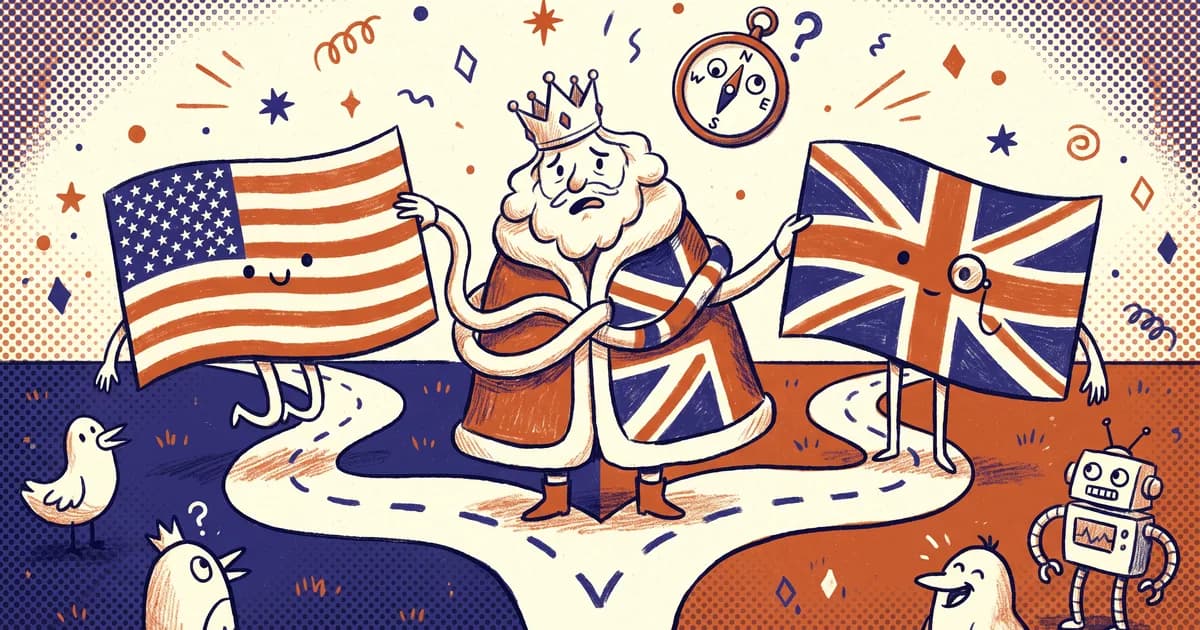
That's not an oversight. It's what's left of a king trying to avoid getting crushed between two empires that both wanted his islands.
A gift from a British captain
The story starts in 1794, at Kealakekua Bay, with a British naval officer named George Vancouver. Vancouver had spent years charting the Pacific, and he'd built a working relationship with Kamehameha I, the chief who was in the middle of unifying the Hawaiian Islands under a single crown. During that visit, Vancouver presented Kamehameha with a British flag. Some accounts call it the Union Jack, others the Red Ensign, and the record from 1794 isn't clean enough to settle the argument. What both versions agree on is what happened next: the flag went ashore, and it flew.
For close to two decades, that borrowed British flag was Hawaii's flag. It wasn't a symbol of conquest. Kamehameha never lost his throne to Britain, and the flag worked more like a marker of alliance, the kind of thing a rising kingdom hangs onto when it wants a distant naval power on its side rather than against it.
A king who wouldn't choose sides
By the 1810s, flying a British flag had turned into a liability. The United States and Britain were fighting the War of 1812, and American and British trading ships both stopped regularly in Hawaiian ports. A kingdom that depended on both couldn't afford to look like it had picked the British navy over American merchants, or the other way around.
So Kamehameha's advisers put together something new: keep the Union Jack in the corner as a nod to the old relationship, but add horizontal stripes in red, white and blue underneath it, colors that echoed both flags at once without copying either. It read as British at a glance and American at a second glance, and it belonged to neither.
The timeline backs this up. In April 1816, Kamehameha bought a brig from a Scottish sea captain named Alexander Adams and put him in command, renamed Kaʻahumanu after one of the king's wives. Adams wrote that he was honored to sail "under the Flag of His Majesty," without describing it in detail, which tells you the flag already existed by then even if nobody had pinned down its exact look. By March 1817, the Kaʻahumanu became the first Hawaiian ship to sail into a foreign port, Canton in China, flying a distinctly Hawaiian flag rather than a borrowed one.
The design still wasn't fixed. In 1818, Russian navigator Vasily Golovnin visited Oahu and recorded a flag with seven stripes, red, white, blue, red, white, blue, red, plus the Union Jack in the canton. Close to today's flag, but not identical. Hawaii would spend almost three more decades tinkering with the exact count before a crisis forced the issue.
The five months Britain owned Hawaii outright
That crisis had a name: the Paulet affair.
In February 1843, a British consul named Richard Charlton had a running dispute with the Hawaiian courts over land claims and the treatment of British subjects. He sailed off to lodge a complaint with the Royal Navy's Pacific command, and what came back was Lord George Paulet, captain of HMS Carysfort, backed by more firepower than the kingdom had. Paulet arrived in Honolulu on February 10 and gave Kamehameha III an ultimatum.
On February 25, 1843, the king signed the islands over under protest, appealing directly to the Queen of Britain to reverse what Paulet had done. For five months, Britain ran Hawaii. Then, on July 31, Rear Admiral Richard Thomas arrived, outranked Paulet, and declared the whole seizure illegitimate. Sovereignty went back to Kamehameha III that same day, and the British government later disowned Paulet's decision entirely.
At the thanksgiving service that followed, Kamehameha III stood in front of a crowd and said a line that Hawaii still repeats: "Ua mau ke ea o ka ʻāina i ka pono," the life of the land is perpetuated in righteousness. Hawaii adopted it as the state motto, and July 31 is still marked as Lā Hoʻihoʻi Ea, Restoration Day.
Eight stripes, one sovereign
The Paulet affair is also why Hawaii's flag looks exactly the way it does today. Coming out of five months under a foreign flag, the kingdom had every reason to lock its own design down for good. In 1845, a design credited to Captain Hunt of HMS Basilisk fixed the stripe count at eight, one for each of the major islands, arranged white, red, blue, white, red, blue, white, red, with the Union Jack still sitting in the canton. Kamehameha III unfurled it at the opening of the legislative council on May 25, 1845, and nobody has changed a stripe since.
Here's the part that surprises people: there's no official government record explaining what the specific colors mean. Guides online will tell you white stands for purity, red for the strength of the Hawaiian people, blue for the surrounding ocean. It's a nice story, but it's unofficial. The 1845 decree fixed the count and the pattern. It never assigned meaning to red, white or blue individually, which makes Hawaii one of the rare state or national flags where the shape is locked in by law but the symbolism is unofficial folklore.
Hawaii isn't the only one flying the Jack
Hawaii isn't the only flag with a Union Jack tucked in the corner. Australia flies one. So does New Zealand. Bermuda too.
What separates Hawaii from all three is what the Union Jack still means where it flies. Australia and New Zealand are Commonwealth realms, with the British monarch as their head of state to this day. Bermuda is a British Overseas Territory, full stop, still governed under the Crown. Their Union Jacks describe a live constitutional relationship.
Hawaii's doesn't describe anything current. The kingdom that struck the compromise in 1816 was never a British possession, and the American state flying that flag today has no constitutional tie to London at all. The Union Jack on Hawaii's flag is a fossil of a 19th century alliance, kept out of habit and history rather than any relationship that still exists.
A flag that survived its own kingdom
The flag's real feat isn't the design. It's how many governments it outlasted.
On January 17, 1893, a group of American and European businessmen in Honolulu, backed by armed United States Marines, overthrew Queen Liliʻuokalani. A provisional government took over under Sanford B. Dole, and for a stretch, the American flag flew over Iolani Palace in place of the Hawaiian one.
It didn't stay that way for long. In 1894, the new Republic of Hawaii formally readopted the old kingdom's flag design, stripes, Union Jack and all, as its own. When the United States annexed Hawaii on August 12, 1898, the territorial government kept the same flag. When Hawaii became the fiftieth state in 1959, the flag came along unchanged into statehood.
Run the sequence and it's genuinely strange: an independent kingdom, a coup, a short-lived republic, a U.S. territory, and finally a U.S. state, five different governments across more than a century, and the flag never had to be redesigned once. Most flags that survive a coup get changed to prove the new regime broke from the old one. Hawaii's never did.
Flying it upside down
That continuity is exactly why the flag carries weight in the Hawaiian sovereignty movement today. Activists who argue the 1893 overthrow was illegal, and that the kingdom's sovereignty was never legitimately surrendered, fly Hawaii's own flag upside down as a distress signal, a visual argument that the state it now represents was born from an act it shouldn't recognize.
Not everyone in the movement reaches for the same flag, though. Some fly the Kanaka Maoli flag instead, a design introduced in 2001 that drops the Union Jack and the American-echoing stripes entirely in favor of colors tied to Native Hawaiian tradition, precisely because the official flag still carries the compromise Kamehameha struck with two competing empires two centuries ago.
So the same eight stripes and the same foreign canton that once meant "we won't pick a side" now sit at the center of an argument about whether Hawaii ever should have had to make that compromise at all.
The flag flying over the Iolani Palace grounds today is the one Kamehameha III unfurled in 1845, pieced together from a British gift, an American rivalry and a king who refused to let either empire claim him outright. It survived a coup, an annexation and a statehood vote without a single redesign. That's either proof the 1816 compromise worked, or the reason people are still arguing over it.
Julio Song
Writer
Julio is a staff writer at FlagDB. He studied Mathematics at the University of Madrid and has a passion for vexillology.
More from Julio Song →