Four Colors, One Island: How Mauritius Built the World's Most Mathematically Honest Flag
Julio Song · · 9 min read
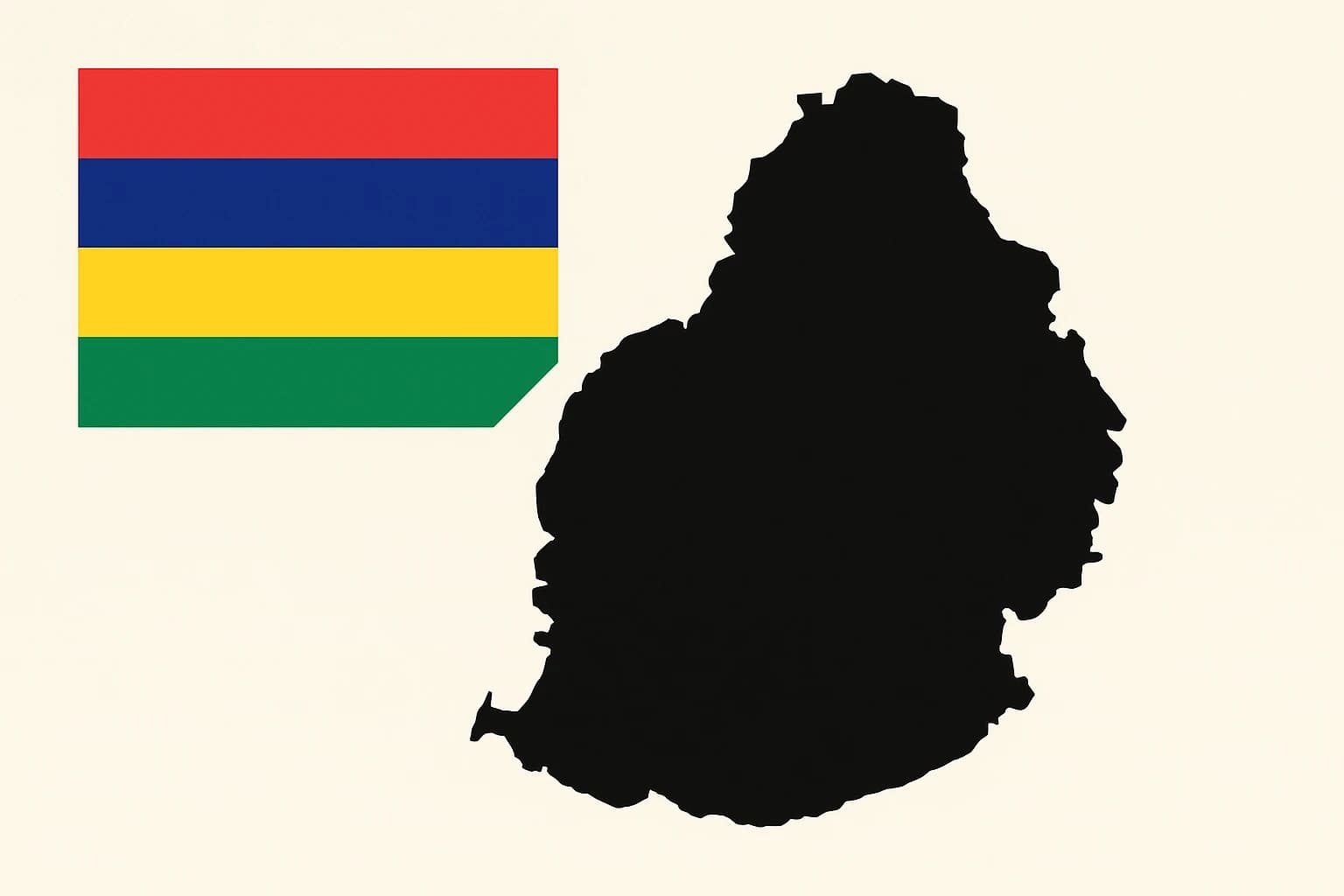
Among the world's 195 national flags, the tricolor dominates. Three stripes, three colors, three ideas collapsed into one tidy rectangle. France, Germany, Italy, Ireland, Romania, Chad, Senegal, and on and on. Then there's Mauritius: four horizontal stripes in red, blue, yellow and green, no coat of arms, no star, no crescent. Four bands of equal width, with no single stripe dominant.
The Mauritian flag is one of the rarest designs in global vexillology, a national symbol built not to paper over difference but to name it. The four stripes were almost rejected by the 1968 independence committee as "too divisive," and the fact that they survived is the interesting part.
Why most flags lie by omission
The French tricolor of 1794 set a template that the entire world copied. Blue, white, red. Liberty, equality, fraternity. Three values, three stripes, done. The design was elegant, memorable, and deeply political. It also became the default blueprint for flag-making across two centuries of colonialism and independence alike.
Look at the wave of African independence flags from the late 1950s and early 1960s. Ghana in 1957. Guinea in 1958. Mali in 1961. All three adopted variations on the Pan-African red, gold, and green tricolor, signaling continental solidarity and liberation from European rule. These were visually striking flags with real emotional weight. They were also, in a structural sense, acts of simplification.
There's a psychological logic to three stripes. Triangulation creates a sense of resolution. Three points make a stable shape. Three acts make a complete story. Four, on the other hand, implies something unresolved. A remainder. A piece that won't fold neatly away.
What happens in most flag design committees is erasure. Not the malicious kind, usually, but the structural kind. Representing a nation in a single image means simplifying, and simplifying means choosing which story to tell and which to leave out. France's blue-white-red claimed to unify an entire revolution. The Pan-African tricolors claimed to unify continents of ethnic, linguistic, and religious difference under three bands of color. Nobody asked often enough what a flag would look like if it were designed to tell the truth about the society it represents.
The four-stripe anomaly
The Mauritian flag consists of four equal horizontal stripes: red on top, then blue, yellow, and green. It was adopted at independence on March 12, 1968. Its official name is "Les Quatre Bandes," and its near-total absence of symbols makes it unusual even among minimalist flag designs. No star. No crescent. No coat of arms on the field. Four colors, and nothing else.
Scan the world's national flags and you will struggle to find another four-horizontal-stripe design in active use. Flags with four or more colors exist, but they tend to arrange those colors in triangles, diagonals, or complex heraldic patterns. Mauritius is alone in its commitment to four equal, parallel bands.
Each stripe carries an official meaning codified at independence:
- Red represents the blood and struggle for independence.
- Blue represents the Indian Ocean surrounding the island.
- Yellow represents the new light of independence and the island's economic promise, particularly its sugarcane wealth.
- Green represents the lush vegetation and the island's diverse peoples.
Unlike the Union Jack, which layers symbols of conquest and subordination, the Mauritian flag gives no color dominance over another. All four stripes share identical width, and no color sits above another in prominence, because the design treats hierarchy itself as the problem.
What the flag leaves out matters as much. No religious symbol, no ethnic motif, no portrait of a founding figure, no hammer or sickle or eagle. The absences are the argument: no single identity gets to claim this rectangle.
The 1968 negotiations
Mauritius in the mid-1960s was a genuinely fractured society compressed onto 2,040 square kilometers of volcanic island in the Indian Ocean. Roughly 68% of the population was Indo-Mauritian, descended from laborers brought to work the sugar plantations. About 27% were Creole and mixed-heritage. A small but economically influential Franco-Mauritian elite controlled much of the land. And a Sino-Mauritian community added yet another layer to the demographic puzzle.
Prime Minister Sir Seewoosagur Ramgoolam's Labour Party had to build a coalition broad enough to win the 1967 general election and stable enough to satisfy British requirements for a functional, representative government before the handover of sovereignty. The flag was part of that negotiation, and not a minor part, since a flag is the first thing a new nation shows the world.
The four-stripe proposal was one of several designs under consideration. Critics within the independence committee argued that it would "institutionalize division" by visually separating communities rather than synthesizing them into a unified symbol. A tricolor, they said, would be safer. Cleaner. More dignified.
Ramgoolam's allies argued the opposite: that pretending plurality didn't exist was the more dangerous lie, and that a flag naming difference was a more durable foundation for coexistence than one hiding it. The four stripes weren't a compromise but a statement of principle.
On March 12, 1968, the flag was raised for the first time at the Port Louis independence ceremony, with Prince Philip watching on behalf of the British Crown.
Neighboring islands, different answers
Mauritius was not the only island nation working out how to represent a small, diverse, historically colonized population in a single image. Its neighbors answered differently.
Cape Verde adopted its current flag in 1992, replacing a Pan-African tricolor with a blue-dominant design and a circle of ten stars for the archipelago's islands. After the end of single-party rule, Cape Verde wanted a flag pointing toward geography and democracy rather than ideological color-coding: we are islands, not a movement.
São Tomé and Príncipe went the opposite direction when it gained independence in 1975. Its flag chose the Pan-African green-yellow-red tricolor with a black triangle and two stars, consciously aligning the new nation with a continental liberation narrative rather than its own specific island plurality. The flag looked outward, toward Africa. Mauritius looked inward, toward itself.
The Maldives offers the sharpest contrast. Its flag, in use since 1965, places a green rectangle and white crescent on a red field. It is one of the most religiously explicit national flags in the world, a direct assertion that Islam is the organizing principle of national identity. There is no visual space on that flag for the archipelago's minority communities. The Maldivian flag answers the question of national identity by choosing a single answer and making it fill the frame.
Each of these island nations faced a version of the same design problem and answered it differently. Mauritius is the outlier, the only one that refuses to resolve the tension and instead encodes it into the geometry of the flag.
What the green stripe is doing
Of the four stripes, the green one carries the heaviest load. Its official meaning, "the island's diverse peoples," is doing a lot of work in a single band of color, and it's fair to ask whether naming diversity in a stripe is genuine recognition or a different kind of erasure. Collapsing Indo-Mauritians, Creoles, Franco-Mauritians, and Sino-Mauritians into one band of green is its own simplification.
Mauritian citizens have read the stripes in various ways over the decades. A popular folk reading maps the four colors onto the island's four main ethnic communities, which the government has never officially endorsed and never suppressed either. That gap between official meaning and popular meaning is part of what keeps the flag alive as a symbol rather than a relic.
The flag's promise was tested in 1999, when communal riots erupted in Port Louis following the death of reggae singer Kaya in police custody. The violence was real. The inter-ethnic tensions were raw. For a moment, the four equal stripes looked less like a design philosophy and more like wishful thinking. But the flag survived that crisis as a still-legitimate symbol. Nobody called for its replacement. Nobody burned it.
South Africa's flag, designed in 1994, offers a useful parallel. It uses six colors arranged in a Y-shaped pattern, a deliberate multi-color design meant to represent post-apartheid plurality.
Both flags attempt to do political work through geometry. Both are subject to ongoing debates about whether a flag is capable of carrying that weight, or whether it merely aestheticizes it.
The green stripe's ambiguity is the flag's most honest feature. It admits that diversity is not a solved problem but an ongoing one, and it leaves room for incompleteness, which is closer to the truth of any multi-ethnic society than the tidy resolution a tricolor offers.
The Mauritius countermodel in 2026
As of 2026, flag redesign debates are active across several nations. New Zealand continues to wrestle with questions about republic status and Treaty of Waitangi representation. Canada faces periodic pressure around Quebec's distinct society symbolism. Several post-colonial African states are reconsidering the colonial-era color inheritances baked into their flags.
The dominant modern theory of flag design, drawing on the work of vexillologists like Ted Kaye and the North American Vexillological Association's "Good Flag, Bad Flag" principles, emphasizes simplicity, meaningful symbolism, limited colors (two or three), and a distinctive central element. By those standards, Mauritius violates several rules. Four colors, no central symbol, no immediately recognizable icon. And yet it arguably succeeds at the deeper goal those rules are trying to serve: making a flag that means something true about the nation it represents.
Flags designed for unity-by-erasure tend to fracture when the erased groups reassert themselves. Yugoslavia's tricolor collapsed with the state it represented. The Soviet hammer and sickle became an artifact the moment the union dissolved. Flags that name difference are harder to look at and harder to repudiate.
The Mauritian model asks for political nerve that most flag committees don't have. Admitting your nation is four things rather than one means admitting nation-building is unfinished, and flying that from every government building and embassy.
Four things, not one
The Mauritian flag was nearly replaced by something tidier, three stripes and a star, something that would have told the world a simpler and more consoling story. The four-stripe design survived as a philosophy rather than a compromise.
What makes it unusual is not the colors. Red, blue, yellow, and green are common enough. It's the decision to refuse synthesis and let four meanings stand side by side without resolving into one.
Flag debates around the world are arguments about who gets included in a national story. Mauritius has been living with its answer for 58 years, which is longer than most committees would have bet on.
Julio Song
Writer
Julio is a staff writer at FlagDB. He studied Mathematics at the University of Madrid and has a passion for vexillology.
More from Julio Song →