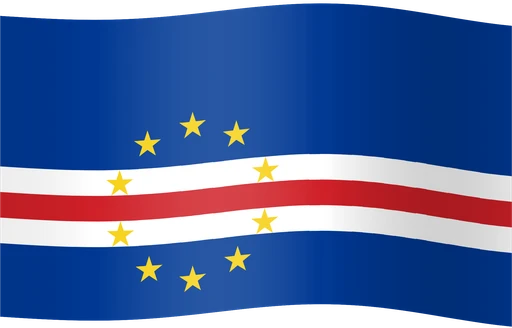
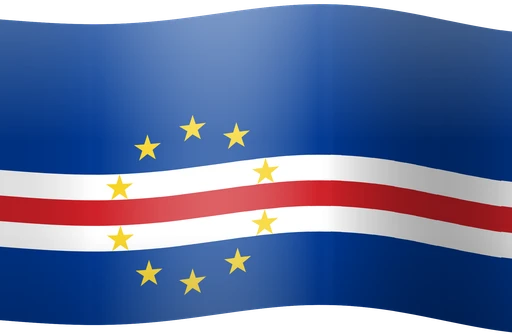
The Flag of Cape Verde
Republic of Cabo Verde
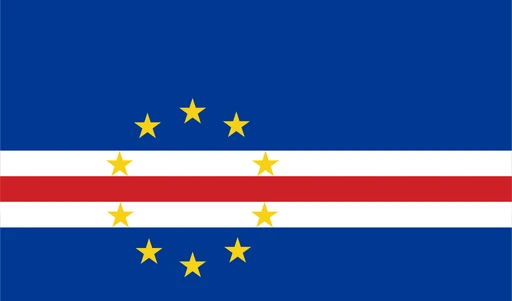
The flag of Cape Verde is a horizontal tricolour of blue, white, and red. Blue stands for the ocean and sky, white for peace, and red for the struggle for independence. Ten yellow stars sit in a circle toward the hoist, one for each of the country's ten main islands.
Cape Verde's flag is one of the youngest in Africa and one of the most deliberate acts of national reinvention on the continent. Adopted on September 22, 1992, a year after the islands moved to multiparty democracy, it broke with the pan-African palette the country had used since independence in 1975. Out went the red, yellow, and green shared with Guinea-Bissau and tied to a failed political union. In came deep blue, white, and red, plus a circle of ten stars for the ten volcanic islands. The design describes what Cape Verdeans actually see from the islands rather than a continental ideology.
The 1992 flag change
Cape Verde gained independence from Portugal on July 5, 1975, alongside Guinea-Bissau. Both countries emerged under PAIGC (the African Party for the Independence of Guinea and Cape Verde), a shared liberation movement that expected eventual political unification. The 1975 flag made that ambition visible, using the pan-African colors of red, yellow, and green in a design nearly identical to Guinea-Bissau's. The plan collapsed in 1980, when a coup in Guinea-Bissau ended the unification project. Cape Verde's branch of the party reorganized as PAICV and the two countries drifted apart politically, though the old flag stayed up.
The real break came a decade later. In 1991, the shift to multiparty democracy swept the MpD (Movement for Democracy) into power, and with it came an appetite for new national symbols. A commission was established to redesign the flag, coat of arms, and anthem as part of a broader constitutional revision. On September 22, 1992, the new flag became law.
It wasn't universally celebrated. Critics accused the government of erasing liberation history, of turning its back on Africa. Proponents countered that Cape Verde had never been a typical African state. It's an archipelago 570 kilometers off the West African coast, Creole in culture, Lusophone in language, shaped more by the Atlantic trade winds than by any continental movement. The new flag, they argued, told the truth about where Cape Verde actually sits in the world. That argument won, though the debate still surfaces in political discussions today, especially around election seasons.
Ten stars on blue
The proportions are 2:3 and most of what you see is a deep navy blue for the Atlantic and the sky over it. The nearest mainland is hundreds of kilometers away, and the sea runs through daily life on the islands, from fishing to migration to the weather.
Across the lower part of the flag, at five-twelfths of the height from the bottom, run three horizontal stripes: white, red, white. The red is narrower than you might expect, held between its white neighbors. It stands for the effort and determination of the Cape Verdean people, with a geological echo of the islands' volcanic origins. Fogo, the most dramatic of the ten, last erupted in 2014. The white stripes are peace and the path toward national development.
The stars are ten five-pointed yellow ones in a circle, tilted slightly toward the hoist: Santo Antão, São Vicente, Santa Luzia, São Nicolau, Sal, Boa Vista, Santiago, Maio, Fogo, and Brava. The circle puts none of them on top of the others, which matters for an archipelago whose islands are genuinely unalike, from the flat salt pans of Sal to the steep green valleys of Santo Antão.
The circle of stars follows the European Union flag, which fits a country that wanted to look outward. What is missing is green. For a country whose name means "Green Cape," that is worth explaining.
A name that does not match the place
The country's name doesn't actually describe the country. "Cape Verde" derives from Cap-Vert, the westernmost point of the African mainland in present-day Senegal. Portuguese sailors named the islands after that distant green promontory, not after anything they found on the archipelago itself. The islands are largely arid and volcanic, more brown and black basalt than lush greenery.
So leaving green off the flag reads like an honest correction. In 2013 the government went further and asked international organizations to use the Portuguese name "Cabo Verde" rather than translations like "Cape Verde" or "Cap-Vert." That was part of the same identity project as the flag: an Atlantic crossroads rather than an appendage of the African mainland.
The flag in the diaspora
More Cape Verdeans live abroad than on the islands. The diaspora numbers between 500,000 and 700,000 people against a resident population of around 590,000, so the flag flies in more places outside the country than inside it.
In New England, especially Massachusetts and Rhode Island, the Cape Verdean community is old and well established. Providence and Boston host large Cape Verdean festivals where the blue flag hangs alongside American and Portuguese flags, and sometimes the older pan-African design. The same happens in Lisbon, Rotterdam, and Luxembourg City. For a people shaped by migration and seafaring, the ocean blue lands differently than a continental palette would.
Some diaspora communities still fly the pre-1992 flag for its liberation history. The two designs sit side by side at festivals and community centers, continental solidarity next to island independence.
Protocol and usage
Official flag protocol is governed by Cape Verdean law, with specific rules about display on government buildings, naval vessels, and at international events. A civil ensign and a naval ensign exist with slight variations for maritime use, though the national flag is by far the most commonly seen.
Each of the ten islands and most municipalities maintain their own flags, many incorporating local symbols: volcanic peaks, maritime motifs, agricultural imagery. The flag is flown at half-mast on national mourning days, following protocols similar to those of Portugal and other Lusophone nations. During national holidays, especially Independence Day on July 5 and Flag Day, the flag becomes the centerpiece of public celebrations across the archipelago and in diaspora communities worldwide.
Cape Verde among island flags
The circle of stars puts Cape Verde in a small visual family. Tuvalu uses nine stars on a sky-blue field for its islands, and the Federated States of Micronesia scatters four white stars across a similar blue. All three describe geography rather than ideology: stars as islands, blue as ocean.
That fits a post-Cold War shift in flag design away from revolutionary symbolism toward something more grounded in place. Within Africa the flag remains an outlier, with no pan-African colors at all, which matches how Cape Verde positions itself: Creole, Lusophone, Atlantic, tied at once to Europe, Africa, and the Americas.
References
[1] Constitution of the Republic of Cape Verde (1992), Article 8, National Symbols.
[2] Boletim Oficial da República de Cabo Verde, September 1992 (official gazette publishing the flag law).
[3] Znamierowski, Alfred. The World Encyclopedia of Flags. Lorenz Books, 2013.
[4] Lobban, Richard A. Cape Verde: Crioulo Colony to Independent Nation. Westview Press, 1995.
[5] FOTW (Flags of the World), Cape Verde page. http://fotw.info/flags/cv.html
[6] Meintel, Deirdre. Race, Culture, and Portuguese Colonialism in Cabo Verde. Syracuse University Press, 1984.
[7] Government of Cabo Verde official website, National Symbols section. https://www.governo.cv
[8] CIA World Factbook, Cabo Verde country profile. https://www.cia.gov/the-world-factbook/countries/cabo-verde/
[9] Smith, Whitney. Flags Through the Ages and Across the World. McGraw-Hill, 1975.
Common questions
- Why did Cape Verde change its flag in 1992?
- In 1992, Cape Verde introduced a new flag to emphasize its independent identity, moving away from designs tied to unity with Guinea-Bissau.
- What do the ten stars on the Cape Verde flag mean?
- The ten yellow stars stand for the ten main islands of Cape Verde, set in a circle so that no island sits above the others.
- Why is there a red stripe on the Cape Verde flag?
- The red stripe stands for the effort of building the nation, and for the determination that took.
- Why did Cape Verde change its flag in 1992?
- Cape Verde switched to multiparty democracy in 1991, and the old flag didn't fit anymore. It used Pan-African colors shared with Guinea-Bissau, tied to a political union between the two countries that never worked out. The new design moved away from continental symbolism and leaned into Cape Verde's identity as an Atlantic archipelago, highlighting the ocean, the islands, and a fresh democratic start.
- What do the ten stars on the Cape Verde flag represent?
- Each star represents one of Cape Verde's ten major islands: Santo Antão, São Vicente, Santa Luzia, São Nicolau, Sal, Boa Vista, Santiago, Maio, Fogo, and Brava. They're arranged in a circle, which is a nice touch. It signals equality among the islands, with no single one placed above the others.
- Why is there no green on the Cape Verde flag even though the name means 'Green Cape'?
- The name actually comes from Cap-Vert, a green headland on the African mainland in Senegal, not the islands themselves. The islands are mostly arid and volcanic, so skipping green on the flag is really just an honest nod to what the place actually looks like rather than what its name suggests.
- What do the colors on the Cape Verde flag mean?
- The deep blue is for the Atlantic Ocean and sky that surround the islands. The red stripe represents the people's effort and determination, with a nod to the volcanic origins of the archipelago. White stripes stand for peace and the path toward national development. And the yellow stars? Those are the ten islands.
Featured in these articles
Download this flag
Free in 12 styles, from 32px icons up to 2000px, as SVG, PNG, WebP and JPG.