In 2014, Indonesia threatened to formally protest to the International Olympic Committee after yet another broadcaster mixed up its flag with Monaco's during a televised event. The two nations sit 7,000 miles apart. They share no language, no religion, no colonial history. And yet their flags are virtually identical: two horizontal stripes, red on top, white on the bottom. Flip Poland's flag upside down and you have a third match.
This is not a coincidence born of laziness or copying. Each flag traces back centuries through completely independent histories, from a medieval Javanese empire to a European gambling dynasty to a legendary white eagle. Their convergence on the same two-stripe design is one of the strangest accidents in geopolitics, and it raises a question that gets more urgent as the number of sovereign nations grows: in a world of 200-plus flags, is truly unique national symbolism even possible anymore?
Two stripes, three nations, zero connection
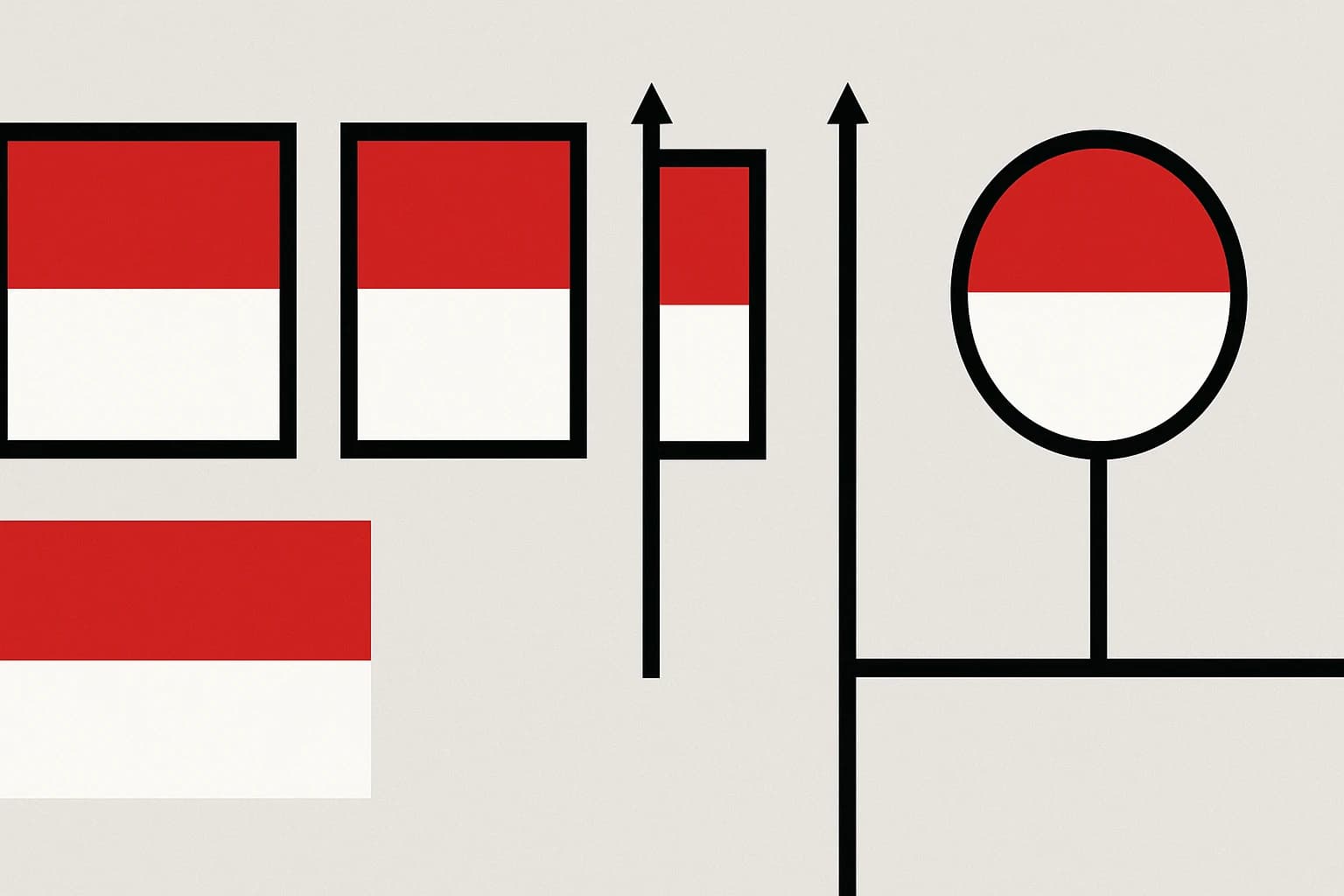
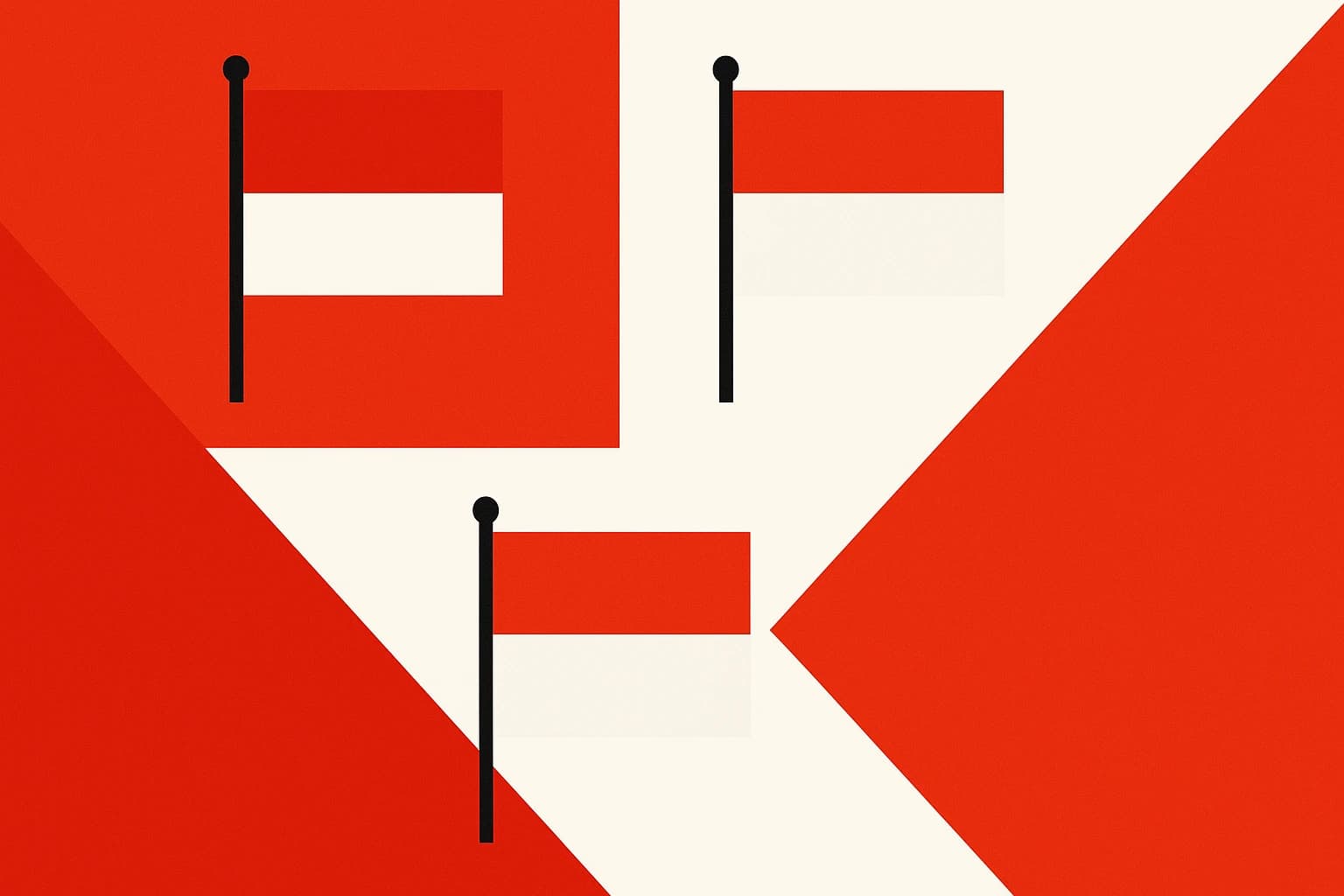
Indonesia's flag and Monaco's flag are both bicolor horizontal bands, red over white.
The only technical difference is aspect ratio. Indonesia's is 2:3, Monaco's is 4:5. At standard broadcast resolution or on a small phone screen, they are indistinguishable.
Flip either one upside down and you get Poland's flag: white over red.
That third point of confusion shows up constantly at international events, especially when flags are displayed upside down, which is a surprisingly common protocol error.
At the 2017 SEA Games in Kuala Lumpur, Indonesia's flag was printed upside down in a souvenir booklet, turning it into Poland's. That produced Indonesian protests, a formal Malaysian apology, and a wave of social media outrage. Google once displayed Monaco's flag for Indonesia in search results. Sports broadcasters at the Olympics and FIFA events have been blurring the line between the two red-and-white nations for decades.
So how did three nations with no shared history, geography, or culture land on the same design? Through three completely independent origin stories.
The Sang Saka Merah-Putih: Indonesia's flag and the ghost of Majapahit
Indonesia's red-and-white color scheme predates European colonialism in Southeast Asia. It traces back to the Majapahit Empire (1293 to 1527), one of the largest and most powerful states in the region's history, whose rulers used red and white banners as royal and military symbols.
The meaning runs deep in Javanese and broader Austronesian culture. Red represents courage and the physical world, the body and the earth. White represents purity and the spiritual world. The pairing echoes Hindu-Buddhist cosmological dualities that pervaded Majapahit court culture for centuries.
When Indonesian nationalists in the early 20th century needed a symbol of pre-colonial identity, they reached back to Majapahit. On August 17, 1945, when Sukarno declared independence, the Sang Saka Merah-Putih, the Sacred Red-and-White, was raised for the first time as a national flag. According to legend, Sukarno's wife Fatmawati sewed it partly from ordinary cloth.
Indonesia formally adopted the flag in Article 35 of its 1945 constitution. That makes it one of the few flags whose design is constitutionally enshrined with roots stretching back to the pre-colonial era rather than invented after independence.
The Grimaldi banner: Monaco's flag and 700 years of dynastic heraldry
Monaco's story starts with a coup. In 1297, François Grimaldi disguised himself as a Franciscan monk to seize the fortress of Monaco. The Grimaldi family's heraldic colors, red and white, were established in their coat of arms, which features red and white lozenges that still appear on Monaco's state emblem today.
Monaco's national flag was officially adopted on April 4, 1881, under Prince Charles III. The bicolor design was chosen as a simplified version of the dynastic arms. Seven centuries of family heraldry, boiled down to two stripes.
Then it got awkward. In the 1940s and 1950s, after Indonesia declared independence, Monaco reportedly raised concerns about the similarity. Indonesia firmly rejected any suggestion of changing its flag, citing the Majapahit heritage that predated Monaco's formal adoption by centuries. No resolution was ever reached, and both nations simply coexist with near-identical flags.
The scale mismatch is hard to miss. Monaco is 2.02 square kilometers with roughly 40,000 residents. Indonesia spans 1.9 million square kilometers with 275 million people. The world's second-smallest country and its fourth-most-populous nation, sharing the same banner.
The white eagle on a red field: Poland's inverted twin
Poland's white-and-red scheme traces to one of the great founding legends of the Slavic world. Three brothers, Lech, Czech, and Rus, set out to found new nations. Lech saw a white eagle nesting against a sunset-reddened sky and chose it as his emblem. The white eagle on a red shield became Poland's coat of arms, documented since at least the 13th century under the Piast dynasty.
The flag derived from the coat of arms straightforwardly: the white stripe for the eagle, the red stripe for the shield background. Poland's flag was formally codified during the November Uprising of 1831 and officially adopted in its modern form on August 1, 1919, after the country regained independence.
The upside-down Poland problem is real. When Indonesia's flag gets accidentally inverted, you get Poland's. When Poland's gets inverted, you get Indonesia's, or Monaco's. This has caused genuine diplomatic incidents. The 2017 SEA Games booklet mishap wasn't a one-off. It is a recurring headache for protocol officers at every major international gathering.
Poland, Indonesia, and Monaco all use the same two colors with no additional symbols, charges, or emblems on their civil flags, which makes them the purest examples of bicolor convergence in world vexillology.
Flag doppelgängers: a global epidemic
The red-and-white trio isn't alone. Flag look-alikes are everywhere.
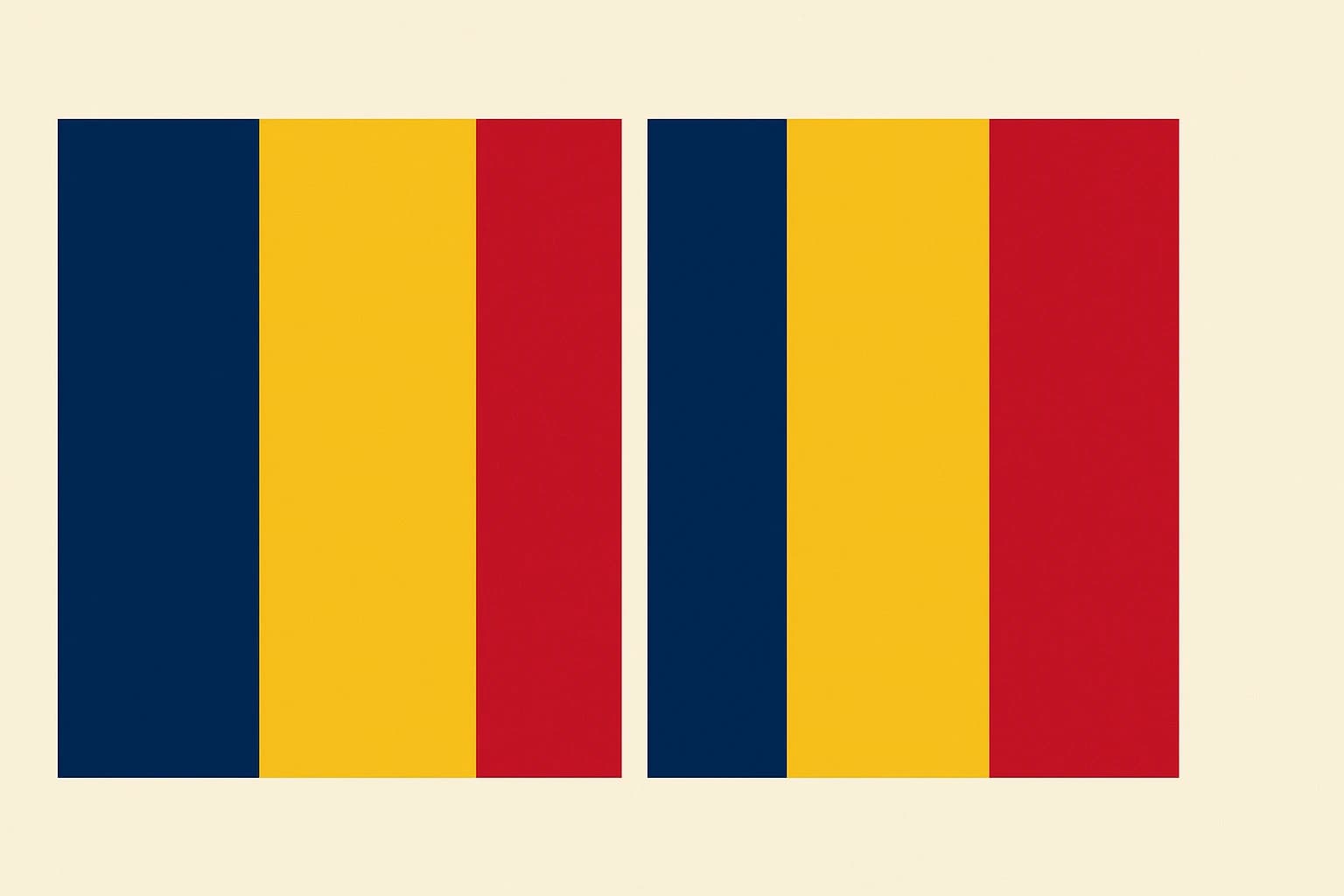
Chad and Romania have flags that are virtually identical: blue, yellow, and red vertical tricolors.
They differ only in a slightly darker shade of blue on Chad's flag. Chad formally protested to the United Nations in 2004 but received no resolution. Romania, which adopted its tricolor in 1848, argued historical precedence.
The Pan-African color cluster creates another tangle. Mali, Guinea, and Senegal all use green, yellow, and red vertical stripes in varying orders, drawn from the shared symbolism of the Pan-African movement.
Guinea and Mali's flags differ only in stripe order. Senegal adds a green star. And Côte d'Ivoire's flag is Ireland's in reverse.
Other notorious pairs: the Netherlands and Luxembourg, both red-white-blue horizontal tricolors with different blue shades; Australia and New Zealand, both blue ensigns with the Southern Cross; and the Slavic tricolor family, where Russia, Slovakia, and Slovenia all use white-blue-red with minor modifications.
Why does this keep happening? The constraints are structural. Flags need to be simple enough to recognize at a distance, on a ship, or across a battlefield. Most use two to four colors from a palette of roughly seven standard heraldic ones: red, blue, green, yellow or gold, white, black, and orange. With limited colors and simple geometric layouts, duplication is mathematically inevitable.
Think of it this way. You have seven crayons and three stripes. The number of unique combinations runs out fast.
The unwritten rules: what happens when flags collide
There is no international law or treaty governing flag uniqueness. The United Nations has no flag registry or approval process. Sovereignty means any nation adopts whatever flag it wants.
Informal diplomatic norms fill the gap. When two flags look similar, international protocol officers rely on contextual cues: alphabetical placement, accompanying nameplates, different aspect ratios. At the Olympics, flags are always displayed alongside three-letter country codes, INA for Indonesia, MON for Monaco, POL for Poland, precisely because of these issues.
Some countries have tried to differentiate. Indonesia considered but rejected adding its national garuda emblem to the flag. New Zealand held a $26 million referendum in 2015-2016 to adopt a new, distinctive flag featuring a silver fern design. Voters chose to keep the old one.
The design challenge only gets harder. With 193 UN member states, dozens of dependent territories, and countless subnational flags, the seven-color, simple-geometry design space is effectively saturated. South Sudan, the world's newest country, adopted its flag in 2011 using Pan-African colors plus a blue triangle.
Future new nations face an increasingly crowded visual landscape.
Why it matters: identity, dignity, and the power of colored cloth
Flag confusion is a matter of national dignity, not trivia.
When Indonesia's flag was printed upside down at the 2017 SEA Games, nobody treated it as a typo. It provoked genuine anger, diplomatic fallout, and a trending social media campaign. Flags are shorthand for identity, and getting them wrong signals disrespect whether or not that was the intent.
The commercial dimension matters too. Flag mix-ups in merchandise, apps, and emoji sets affect millions of users and generate PR crises for tech companies. Apple, Google, and Microsoft have all faced scrutiny over flag emoji accuracy. A wrong flag in a search result or a product listing says something about whose identity you bothered to get right.
The Indonesia-Monaco case also says something about how history works. Two completely independent civilizations, separated by thousands of miles and centuries of distinct development, arrived at the same visual symbol through entirely different paths. Red for blood, courage, and power. White for purity, peace, and the divine. Human cultures share a surprisingly small symbolic vocabulary, and convergence is the rule rather than the exception.
A red-and-white world
The next time you see a simple red-and-white bicolor flying at an international summit, pause before assuming you know which country it represents. It might be the legacy of a 13th-century Javanese empire, a 13th-century Monegasque coup, or a legendary white eagle spotted against a blood-red sky.
Three unrelated nations arriving at the same design is not a failure of creativity. It is what happens when a narrow symbolic vocabulary has to carry the weight of belonging and sovereignty for the whole world. That the same two stripes can do that for 275 million people in one place and 40,000 in another is the part worth sitting with.